

“Failure is simply an opportunity to begin again; this time more innovatively and intelligently.”
– Henry Ford, Former President of the USA

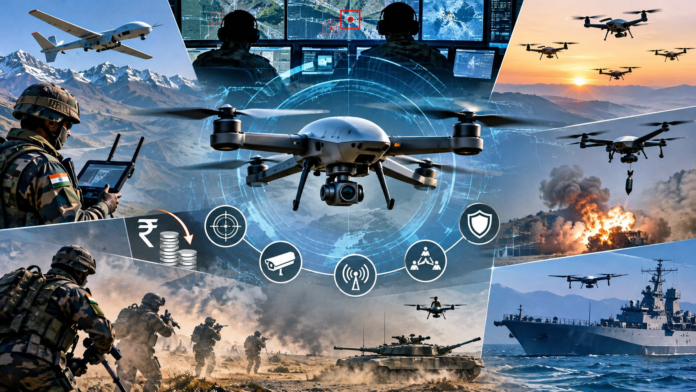
The character of warfare is undergoing a fundamental transformation. Military superiority, traditionally measured by manpower, firepower, armoured formations, air power and naval strength, is increasingly influenced by the ability to acquire, process and exploit information through unmanned systems. Drones have become central to this transformation, providing persistent surveillance, rapid target acquisition, responding with unprecedented speed, precision engagement and operational flexibility at comparatively low cost.
The significance of drones lies in their ability to successfully connect sensors, decision-makers and weapons. A surveillance drone can identify an adversary’s position, transmit information to a command centre and facilitate engagement by artillery, aircraft or another unmanned platform. This integration compresses the traditional sensor-to-shooter cycle and enhances operational responsiveness. The proliferation of inexpensive commercial technology has further democratised access to aerial capabilities. Smaller nations and non-state actors can now acquire capabilities that were previously available only to technologically advanced military powers. Consequently, numerical superiority in conventional weapons does not automatically translate into battlefield dominance.
The Indian Armed Forces require a comprehensive drone strategy that combines indigenous manufacturing, operational integration, artificial intelligence, electronic warfare and effective counter-drone capabilities. The objective makes it imperative to transform India from a growing consumer of unmanned technology into a major designer, manufacturer and exporter of advanced military drone systems.
DRONE WARFARE: MULTIDIMENSIONAL MILITARY CAPABILITY
Drone warfare must be understood as a family of lethal interconnected technologies rather than a single weapons category. Different platforms perform different operational functions, and their combined employment produces a phenomenal multidimensional battlefield advantage.

The significance of drones lies in their ability to connect sensors, decision-makers and weapons. A surveillance drone can identify an adversary’s position, transmit information to a command centre and facilitate engagement by artillery, aircraft or another unmanned platform
(a) Intelligence, Surveillance and Reconnaissance: ISR is among the most significant applications of unmanned systems. Drones provide persistent observation of adversary movements, military installations, logistics concentrations, artillery positions and border infrastructure. High-altitude, even long-endurance platforms can monitor extensive geographical areas, while tactical drones provide immediate intelligence to formations operating closer to the battlefield. Thermal imaging, electro-optical sensors, synthetic aperture radar and other surveillance technologies improve detection under difficult environmental conditions. The ability to transmit information rapidly enables commanders to anticipate adversary movements and reduce uncertainty. For India, these capabilities are particularly relevant along the Line of Actual Control and Line of Control, where difficult terrain, extreme weather and restricted accessibility complicate conventional surveillance methodologies.
(b) Precision Strike and Loitering Munitions: Armed drones and loitering munitions have introduced a new dimension to precision warfare. Unlike conventional platforms that must return after releasing their weapons, loitering munitions can remain airborne while searching for an assigned target before engaging. Their relatively low cost, operational flexibility and potential for deployment in numbers make them attractive for selected battlefield missions, but effectiveness depends on reliable target identification, communications, navigation, operational discipline and the ability to function in contested electromagnetic environments.

(c) First-Person-View and Tactical Drones: FPV drones have emerged as an important instrument of close battlefield engagement. Their low cost and adaptability allow military units to employ them for reconnaissance and specialised strike missions. They have significantly altered the vulnerability of exposed personnel, armoured vehicles, artillery positions and logistical movements. Their proliferation has created a battlefield environment in which concealment, camouflage, dispersion, mobility and deception have become essential elements of survival.
(d) Electronic Warfare and Information Dominance: Drone operations depend upon communication, navigation, data transmission and electromagnetic connectivity. These dependencies create vulnerabilities that adversaries can exploit through jamming, spoofing and other electronic countermeasures. Conversely, drones can carry electronic surveillance equipment and support military efforts to identify and assess hostile electromagnetic activity. The future battlefield will therefore witness a continuous contest between drone operators, electronic warfare specialists and counter-drone systems.
Maritime surveillance drones can monitor shipping routes, coastal approaches, exclusive economic zones and strategically important maritime areas. Unmanned surface and underwater vehicles offer additional possibilities for mine countermeasures, hydrographic surveys, maritime reconnaissance and selected anti-submarine warfare support functions
(e) Maritime and Naval Applications: Unmanned systems are increasingly relevant to naval operations. Maritime surveillance drones can monitor shipping routes, coastal approaches, exclusive economic zones and strategically important maritime areas. Unmanned surface and underwater vehicles offer additional possibilities for mine countermeasures, hydrographic surveys, maritime reconnaissance and selected anti-submarine warfare support functions. For the Indian Navy, such capabilities can strengthen maritime domain awareness across the IOR, particularly around important sea lanes and approaches to strategic maritime chokepoints.
(f) Administrative Support: The military utility of drones extends beyond combat. Unmanned platforms can support the movement of medical supplies, communication equipment and essential stores to isolated locations. In mountainous terrain along LAC or the LoC, they can assist reconnaissance of anticipated infiltration routes and support selected casualty evacuation and emergency response tasks. Their humanitarian applications are equally important in disaster management, flood relief, search-and-rescue operations and assessment of inaccessible areas.
(g) Artificial Intelligence (AI) and Autonomous Systems: AI is likely to become the defining technological force multiplier in future drone warfare, as AI-enabled systems can assist in image analysis, navigation, surveillance, anomaly detection and decision support. Greater autonomy may permit unmanned platforms to operate in environments where communication links are unreliable or disrupted. Decisions involving lethal force require appropriate human oversight, clear rules of engagement, accountability and compliance with international humanitarian law. The future military advantage will belong to the country capable of integrating drones intelligently into a reliable military architecture.
RUSSIA–UKRAINE WAR: HIGHLIGHTS MODERN DRONE WARFARE
The Russia–Ukraine war provides the most compelling contemporary demonstration of how drones can transform the conduct of conventional warfare. Since February 2022, both sides have progressively expanded their employment of unmanned systems, converting the conflict into an extraordinary contest of technological adaptation, mass production and operational innovation. What began with conventional military formations, artillery, armoured vehicles and later air power has now developed into a battlefield where drones influence almost every critical phase of military operations.
The Russia–Ukraine war provides the most compelling contemporary demonstration of how drones can transform the conduct of conventional warfare. What began with conventional military formations, artillery, armoured vehicles, and later air power has now developed into a battlefield where drones influence almost every critical phase of military operations
(a) Ukraine’s Adaptation to Asymmetric Warfare: Ukraine initially faced a substantial disadvantage in conventional military resources. It responded by rapidly developing and deploying relatively inexpensive commercial and military drones. Small quadcopters became important for battlefield observation, artillery correction and monitoring Russian military movements. FPV drones subsequently emerged as a significant means of attacking exposed military equipment and personnel. Ukraine’s experience demonstrated that affordable unmanned platforms, when employed with effective intelligence and communications, could impose considerable costs on much more expensive military assets. The conflict also encouraged a decentralised innovation culture in which military personnel, technology companies, volunteer organisations and private manufacturers contributed to the development and supply of unmanned systems.
(b) Russia’s Expertise in Drone Capabilities: Russia progressively expanded its own drone capabilities, employing reconnaissance UAVs, Lancet-type loitering munitions, FPV systems and long-range one-way attack drones. The combination of surveillance drones and artillery improved battlefield observation and engagement. Loitering munitions provided another means of attacking selected military targets, while longer-range systems extended the threat to infrastructure and logistical networks. The Russian experience demonstrated that drone warfare cannot be considered exclusively a Ukrainian innovation. Both sides have continually adapted their platforms, tactics and countermeasures.
(c) Drone-Oriented Battlefield: One of the most consequential lessons has been the emergence of persistent aerial observation across substantial portions of the frontline. Armoured vehicles, artillery positions, supply convoys and troop concentrations have become increasingly vulnerable to detection. Conventional formations must now contend with the possibility that their movements may be observed and acted upon rapidly. The traditional advantages of massed armoured manoeuvre have consequently been constrained in heavily congested areas. A 2026 assessment by the Australian Army Research Centre highlights how unmanned systems have influenced engagements from the individual soldier to operational and strategic levels. The Ukraine experience has demonstrated that adaptation and integration are as important as the platforms themselves.
(d) Electronic Warfare Contest: The war has also demonstrated that no drone technology remains permanently dominant. Electronic warfare has disrupted communication and navigation links, reducing the effectiveness of some remotely controlled systems. In response, both sides have explored alternative communications, fibre-optic control, improved navigation resilience and greater onboard autonomy. The development of fibre-optic FPV drones is particularly significant because their control and video transmission through a physical cable make them resistant to conventional radio-frequency jamming, although they introduce limitations involving weight, range and manoeuvrability. This technological competition illustrates that drone warfare is an evolving contest between offensive innovation and defensive adaptation.
The Indian Government’s National Defence Industries Conclave in March 2026 specifically emphasised indigenous drone manufacturing, including domestic production of components, software, engines and batteries, towards greater comprehensive technological self-reliance
(e) Strategic Lessons for India: The Russia–Ukraine conflict has five major lessons for Indian military planners:
- Mass matters: Affordable drones must be available in sufficient numbers to sustain prolonged operations and replace losses.
- Technology must evolve continuously: A drone that performs effectively today may become vulnerable tomorrow.
- Integration is decisive: Surveillance, communications, artillery, air power and command systems must operate as a coordinated network.
- Electronic warfare is indispensable: Every drone capability must be supported by resilient communications, navigation and countermeasure systems.
- Industrial capacity determines endurance: Battlefield innovation must be supported by domestic production, repair facilities, component availability and rapid upgrades.
INDIA’S SECURITY ENVIRONMENT AND DRONE SUPERIORITY
India’s strategic and geographical circumstances demand a distinct approach to unmanned warfare in the coming years.
(a) Northern and Western Frontiers: The Himalayan snow-bound frontier presents formidable surveillance and logistical challenges. High-altitude drones can assist in monitoring adversary movements, observing infrastructure development and supporting situational awareness. Along the western frontier, drones have considerable relevance for counter-terrorism, border surveillance, detection of infiltration attempts and monitoring of suspicious aerial activity. The increasing availability of small unmanned platforms to hostile non-state actors also necessitates an effective counter-drone architecture.
(b) Two-Front War: A simultaneous security challenge involving China and Pakistan would place considerable demands on India’s military resources. Indigenous drones could provide persistent surveillance, improve battlefield awareness and support selected missions without requiring the deployment of expensive manned platforms for every task. Joint planning, common standards and integrated command-and-control arrangements will be essential. However, India must avoid developing isolated Service-specific capabilities.
(c) Indian Ocean Region: The Indian Ocean is central to India’s economic and strategic interests. Maritime drones can strengthen surveillance of shipping lanes, monitor suspicious vessels and support naval operations across extensive maritime spaces. A combination of aerial, surface and underwater unmanned platforms could provide the Indian Navy with a more comprehensive maritime picture.
India must prioritise indigenous development of Electric and hybrid propulsion systems, Small aero-engines, Batteries and power-management systems, Flight-control computers, Secure communication modules, Navigation and positioning systems, electronic warfare-resistant components, AI-enabled mission software, Composite materials and lightweight structures
(d) Internal Security Dynamics: Drones can assist security forces in reconnaissance, surveillance of difficult terrain, monitoring of vulnerable installations and selected counter-terrorism missions. Their use must remain governed by appropriate legal safeguards, intelligence verification and operational accountability. India must therefore develop an integrated drone doctrine that addresses conventional warfare, border security, maritime operations, counter-terrorism and strategic deterrence.
INDIA’S DRONE POWER MANDATES AATMANIRBHARTA
‘Aatmanirbharta in drone warfare’ must become a strategic national mission and should be designated to the two ‘Defence Corridors of Tamil Nadu and Uttar Pradesh’ under suitably selected military commanders (in service), rather than a limited defence procurement programme. India possesses a substantial technological foundation through its defence public sector, private manufacturers, engineering institutions, research laboratories, start-ups and growing electronics industry. The challenge is to integrate these capabilities into a coordinated, optimised ecosystem for War. The Government’s National Defence Industries Conclave in March 2026 specifically emphasised indigenous drone manufacturing, including domestic production of components, software, engines and batteries, towards greater comprehensive technological self-reliance.
(a) Indigenous Design and Manufacturing: India must develop complete domestic design and manufacturing capabilities for different categories of military drones, which should include Miniature and micro-surveillance drones, Tactical reconnaissance UAVs, Medium- and high-altitude long-endurance platforms, Armed UAVs, Loitering munitions, Long-range maritime surveillance drones, Unmanned surface and Underwater vehicles, Logistics and emergency support drones and also Autonomous and collaborative unmanned platforms. The objective should be a diversified inventory suited to different operational requirements rather than dependence on a limited number of expensive platforms.
(b) Indigenous Components and Technological Sovereignty: Import dependence in critical components can undermine operational readiness during prolonged conflict. India must prioritise indigenous development of Electric and hybrid propulsion systems, Small aero-engines, Batteries and power-management systems, Flight-control computers, Secure communication modules, Electro-optical and infrared sensors, Navigation and positioning systems, electronic warfare-resistant components, AI-enabled mission software, Composite materials and lightweight structures. Particular attention must be given to semiconductor components, processors, advanced sensors and secure software. A drone assembled in India with critical imported components does not represent complete strategic autonomy.
India should aspire to become a competitive international supplier of reliable and cost-effective unmanned systems. Indigenous drones could strengthen defence partnerships with friendly countries, particularly in the Indian Ocean Region, Southeast Asia, Africa and other regions seeking affordable surveillance and security technologies
(c) Public-Private Partnership (PPP): Defence public sector undertakings should function as system integrators, technology partners and production anchors, while private companies and start-ups should be encouraged to innovate and manufacture specialised systems. Organisations such as Hindustan Aeronautics Limited, Bharat Electronics Limited, Bharat Dynamics Limited and other defence manufacturers can contribute effectively to this ecosystem. Private enterprises, including emerging drone manufacturers and electronics companies, should receive opportunities for development, testing and large-scale production. The government must create an environment in which innovative firms can participate in defence manufacturing without being constrained by unnecessarily prolonged procurement procedures.
(d) Imperative R&D First Priority: The DRDO, academic institutions, IITs, engineering universities and private research laboratories must work towards common technological objectives. Research priorities should include in their curriculum Artificial intelligence and machine learning, Autonomous flight and navigation, Advanced propulsion, Secure data links, Sensor fusion, Anti-jamming technologies, Swarm coordination, High-performance batteries, Advanced composite materials and Cybersecurity and software assurance. Research must be connected to actual military requirements, with regular field evaluation and rapid incorporation of operational feedback.
(e) ‘Indigenised Dedicated Clusters’ for Production at Scale: The Ukraine conflict has demonstrated that high rates of drone attrition make industrial replenishment indispensable. India should establish dedicated manufacturing clusters supported by common testing facilities, component suppliers, certification institutions and skilled manpower. Production must be scalable, allowing manufacturers to increase output during a national emergency. The Indian Armed Forces should also maintain sufficient stocks of critical components, replacement systems and repair equipment.
(f) Leverage Export Potential: India should aspire to become a competitive international supplier of reliable and cost-effective unmanned systems. Indigenous drones could strengthen defence partnerships with friendly countries, particularly in the Indian Ocean Region, Southeast Asia, Africa and other regions seeking affordable surveillance and security technologies. Exports would also increase production volumes, improve manufacturing efficiency and strengthen India’s strategic influence. However, exports must be governed by responsible controls, end-use verification and applicable international obligations.
(To be continued)

Lt Gen S K Gadeock is a distinguished military leader, global strategist, and scholar who served as the Commandant of the Defence Services Staff College. A decorated veteran and former Logistics Advisor to the Botswana Defence Force, he has held numerous high-ranking appointments including Director General of the Amity Institute of Defence & Strategic Studies. Serving on the Advisory Board of Raksha Anirveda, he is a prolific writer and motivational speaker.