


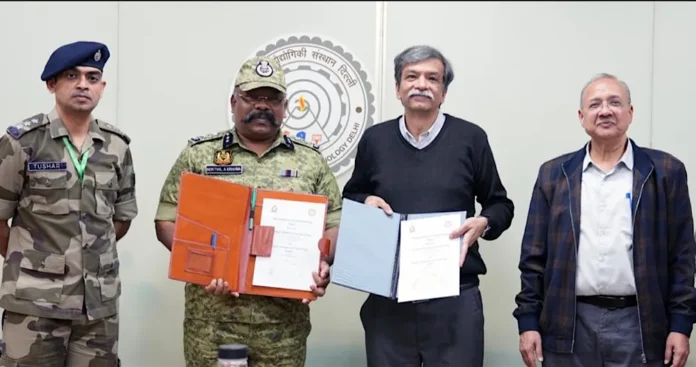
The Central Industrial Security Force (CISF) has signed a Memorandum of Understanding (MoU) with the Indian Institute of Technology, Delhi (IIT-D) to strengthen its work on drone and anti-drone technology, with a focus on protecting critical infrastructure. The agreement was signed at the IIT, Delhi campus on November 26.
The partnership sets out cooperation in research and development, specialised training, capacity building and technical consultancy. It is intended to connect operational challenges encountered by CISF personnel with IIT Delhi’s technical and academic expertise, and to support the development of practical solutions for security settings where unauthorised drones pose a concern.

CISF Inspector General Senthil Avoodai Krishna Raj S signed for the force, accompanied by Assistant Commandant Tushar Sharma. IIT, Delhi Director Professor Rangan Banerjee signed for the institute. Professor Ashwini K Agrawal, Dean of Research and Development, was also present.
The agreement comes as security agencies contend with the expanding use of unmanned aerial systems and the possibility that they may be used to observe or approach sensitive sites. The operational requirements vary by location, making detection and response a challenge that cannot necessarily be addressed with one uniform system.
Airports, for example, require security measures that can identify aerial risks while avoiding interference with flight operations. Ports face maritime and coastal conditions, while coal and power facilities may cover extensive industrial areas and require monitoring over broad perimeters. The collaboration is expected to explore solutions shaped around such differing environments, rather than assume identical requirements across all installations.
The MoU also provides for technical programmes for CISF personnel and knowledge-sharing between the two institutions. Research work could draw on the force’s experience at protected sites to identify operational problems for further study. The future programmes describe a framework for cooperation, however, and do not specify a timetable, budget, named technology or deployment plan for any system developed under the agreement.

The agreement adds IIT, Delhi to a growing network of academic collaborations reported by the CISF. Other partnerships involve IIT Ropar, IIT Kanpur, IIT Madras and IIT Hyderabad, with areas of work that include cybersecurity, technical training and drone-related capabilities. A separate report said the force had also partnered with the Drone Federation of India on work associated with a counter-drone hub in Behror, Rajasthan.
The broader approach reflects the role of research partnerships in translating security needs into technology and training priorities. Such cooperation can help an agency assess what capabilities are needed in different operational contexts, while giving researchers access to real-world problems. The agreement itself does not establish that a particular counter-drone system has been developed or acquired; its stated purpose is to create a framework for research, capacity building and technical support.

For the CISF, which protects installations including airports and industrial facilities, the immediate value of the partnership will depend on how the framework is turned into specific research projects and training. Any eventual systems would also need to be suited to the infrastructure they protect and to the constraints of operating in active public and industrial environments.
The MoU therefore marks a step towards closer institutional collaboration, rather than a finished operational capability. By bringing together security personnel and engineering researchers, the two organisations aim to strengthen preparedness against aerial threats and build solutions responsive to the needs of critical infrastructure.