

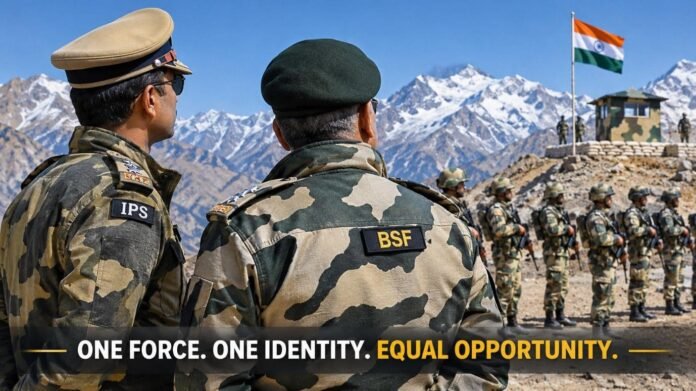
An organisation may have one uniform, one flag, one command structure, and one operational mission, yet remain divided by the very system that creates its leadership. This is the paradox confronting India’s Central Armed Police Forces (CAPFs). Behind their impressive operational achievements lies a persistent structural tension between officers in their permanent cadres and those inducted from the Indian Police Service (IPS) on deputation. Both streams bring experience, professional commitment and valuable capabilities. Yet, their parallel career structures, differing service conditions and unequal perceptions of opportunity have often created an environment of competition rather than institutional integration.
The issue is not the competence of individual officers, nor should it be reduced to a contest between the IPS and the CAPF cadres. It is a question of organisational design. When officers spend their careers within a force, acquire specialised knowledge, command troops and understand its operational character, they naturally aspire to its highest leadership positions. When another stream enters at senior levels, sometimes with different career incentives and promotion prospects, friction becomes difficult to avoid.

The consequences extend beyond individual careers. They influence command continuity, morale, institutional ownership, and the quality of decision-making. A force entrusted with national security cannot afford a divided professional identity.
An organisation cannot develop an undivided institutional identity under a divided career structure.
Understanding the Fault Lines
The roots of this friction lie in the way leadership appointments, promotions and deputation have evolved. Organic cadre officers of the BSF, ITBP, CRPF, CISF and SSB generally begin their careers at the junior officer level and progress through a demanding professional hierarchy. Their experience is accumulated over years of field deployment, unit command, operational responsibilities and administrative assignments. They develop an intimate understanding of their organisation, its people, geographical challenges and operational limitations.
IPS officers, on the other hand, enter the CAPFs through deputation, generally at higher levels, carrying with them experience acquired in state policing, investigation, intelligence and administration. These are valuable capabilities. However, differences in career progression, tenure, seniority and access to command appointments can generate perceptions of institutional inequality.

India needs to move away from the IPS-versus-CAPF debate and embrace a model of integrated professional leadership. The objective should be developing one leadership ecosystem in which both streams have equitable opportunities and operate under common professional standards
The organic cadre officer may see a career ceiling approaching despite decades of service, while the deputationist may regard the CAPF assignment as one among several career postings. Neither perception necessarily reflects individual intent, but both are products of the existing arrangement.
Frequent changes in senior leadership can also affect continuity. Officers who have spent years developing operational strategies may find themselves working under successive leadership teams with differing priorities. Over time, professional differences can harden into cadre loyalties, affecting cooperation and organisational confidence.

The problem, therefore, is not that two streams exist. It is that they do not always operate within one transparent and equitable career framework.
When a system creates two career ladders within one organisation, competition for the top inevitably becomes competition between cadres.
From Competing Cadres to Integrated Leadership
India needs to move away from the IPS-versus-CAPF debate and embrace a model of integrated professional leadership. The objective should neither be the elimination of IPS participation nor the creation of exclusive organic cadre ownership. It should be the development of one leadership ecosystem in which both streams have equitable opportunities and operate under common professional standards.
This requires integration at three distinct levels: junior or field leadership, middle management and senior command. At each level, officers from both streams should have meaningful representation in appropriate appointments, subject to clearly defined eligibility, professional qualifications and organisational requirements.
The principle must be equality of opportunity rather than an automatic entitlement based on parent cadre. An IPS officer should not enjoy an inherent advantage because of the service through which he entered, just as an organic cadre officer should not be promoted merely because he has spent longer within the organisation. Both must demonstrate their suitability for the responsibilities they seek.
Each CAPF should have a common leadership framework, supported by a transparent distribution of sanctioned appointments between the two streams. The precise allocation must emerge from an objective cadre review, considering the respective cadre strengths, organisational requirements and availability of qualified officers.
This would preserve the advantages of IPS experience while recognising the institutional knowledge accumulated by permanent cadre officers. Assam Rifles, given its distinctive organisational and administrative arrangements, would require separate consideration.
Two streams of recruitment must ultimately converge into one stream of professional leadership.
Integration at All Three Levels of Leadership
The transition from parallel career structures to integrated leadership must begin at the point where officers assume command responsibilities. It cannot be achieved by merely reserving a few senior appointments for one cadre or the other. Integration must be built into the entire leadership pyramid.
- Field Leadership Level. IPS officers selected for CAPF assignments should undergo structured force-specific familiarisation before assuming independent responsibilities. This should include attachment with battalions, exposure to forward deployments, operational duties and personnel management. They must understand the conditions under which their men operate. Organic cadre officers, meanwhile, must receive equitable access to field command appointments, professional courses and career-enhancing assignments. The objective is to develop mutual respect at the very stage when professional identities are formed.
- Middle Management Level. At DIG and IG grades, appointments should be drawn from both streams through a common eligibility and assessment framework. Officers must demonstrate operational experience, administrative competence, leadership ability and an understanding of the force’s specialised responsibilities. Neither parent cadre should become a passport to preferred appointments.
- Senior Leadership Level. At ADG, Special DG and DG, the principle of equitable opportunity must become non-negotiable. Eligible organic cadre officers must have a realistic pathway to the highest office, while IPS officers should retain opportunities to occupy senior leadership positions based on merit and experience. Fixed and reasonably long tenures should protect institutional continuity.
This is not about mechanically dividing every appointment into equal halves. It is about ensuring meaningful representation across all three levels through a transparent, periodically reviewed cadre-management policy.
Representation without responsibility is tokenism; responsibility without equal opportunity is institutional discrimination.
One Promotion System, One Professional Yardstick
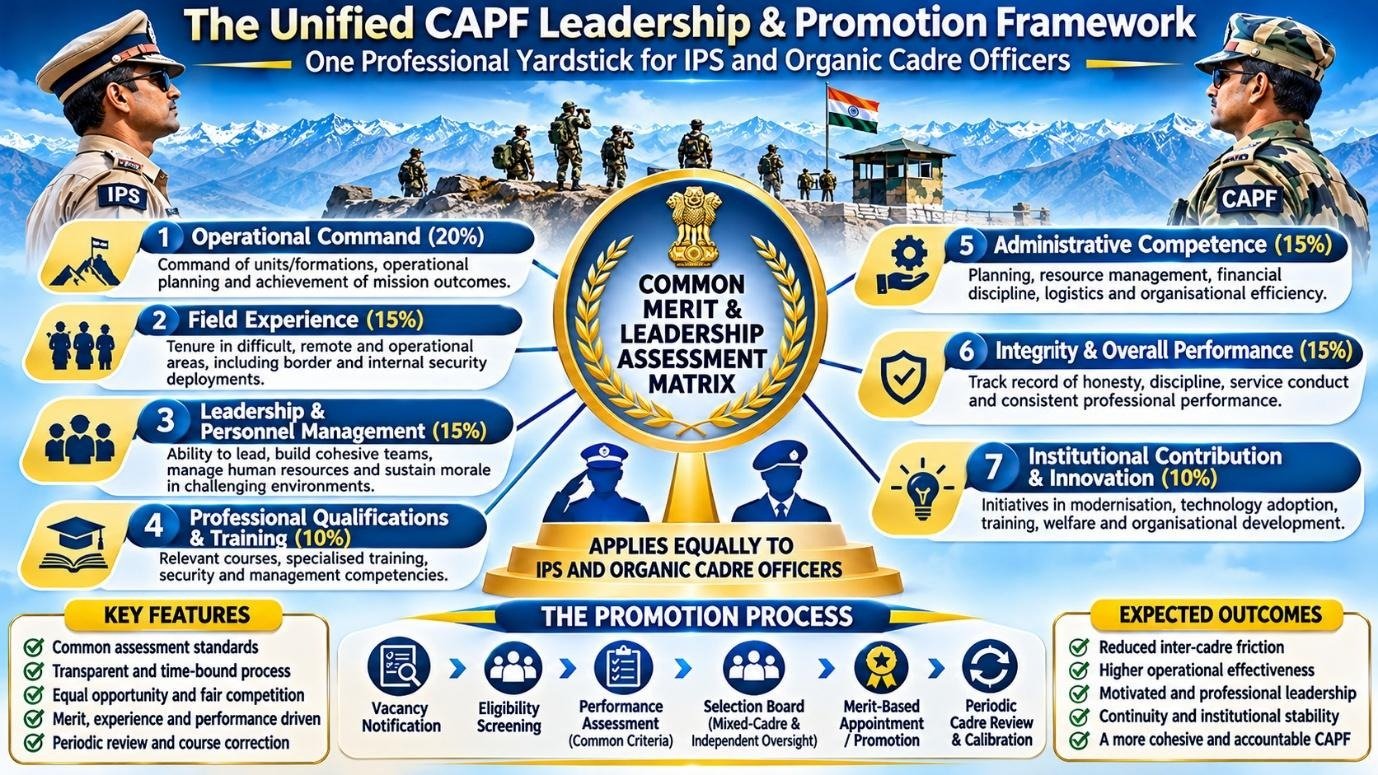
The most practical instrument to eliminate inter-cadre friction would be a Unified CAPF Leadership and Promotion Framework, notified by the Ministry of Home Affairs and implemented separately within each force under common principles.
IPS officers selected for CAPF assignments should undergo structured force-specific familiarisation before assuming independent responsibilities. This should include attachment with battalions, exposure to forward deployments, operational duties and personnel management
- Leadership and Cadre Management Board. Each force should have a Leadership and Cadre Management Board comprising senior representatives of both streams, with independent administrative oversight. It should periodically examine vacancies, promotion prospects, selection procedures, and the distribution of leadership appointments. No cadre should be permitted to dominate the selection process for the other.
- Common Professional Assessment Matrix. More importantly, promotions and appointments must be governed by a Common Professional Assessment Matrix. The parameters should include operational command experience, performance in difficult deployments, personnel management, professional qualifications, administrative and financial competence, integrity, innovation and contribution to institutional development. Weightages may differ according to the nature of the appointment, but the underlying standards must be uniform.
- Common Performance Appraisal Framework. A Common Performance Appraisal Framework should replace parallel assessment cultures wherever service rules permit. Officers should be evaluated against the responsibilities they have discharged, rather than the parent service from which they originate. Seniority should remain relevant for determining eligibility, but it must not become a substitute for demonstrated leadership.
- Periodic Independent Audit. The system should also publish vacancy positions, eligibility conditions and broad promotion timelines. Unexplained delays and discretionary allocation of important appointments must be minimised. A Periodic Independent Audit would help identify structural bias before it becomes a source of litigation and resentment.
There is already an important judicial foundation for this reform. In Sanjay Prakash and Others v. Union of India (May 23, 2025), the Supreme Court recognised the CAPFs as Organised Group-A Services for cadre-related benefits and directed cadre reviews, revision of service rules and progressive reduction of IPS deputation posts up to the Senior Administrative Grade within an outer limit of two years. The Court also emphasised the need to address stagnation and improve participation of CAPF cadre officers in organisational decision-making.
The proposed integrated framework should build upon this foundation, while retaining a legitimate and professionally defined role for IPS officers.
The uniform may be different in its history, but the yardstick of professional excellence must be the same.
Defusing Inter-Cadre Animosity
Administrative restructuring alone will not eliminate the mistrust that has accumulated over years. The deeper challenge is to change the everyday professional environment in which officers from the two streams interact. A common identity cannot be created through circulars; it must emerge from shared responsibilities, fair treatment and mutual professional respect.
Administrative restructuring alone will not eliminate the mistrust that has accumulated over years. The deeper challenge is to change the everyday professional environment in which officers from the two streams interact. A common identity cannot be created through circulars; it must emerge from shared responsibilities, fair treatment, and mutual professional respect
- Common CAPF Leadership Orientation Programme. All officers entering leadership positions, irrespective of their parent cadre, should undergo a common CAPF leadership orientation programme. This should familiarise them with the force’s operational doctrine, organisational history, service conditions and institutional challenges.
- Mixed-Cadre Appointments. Mixed-cadre appointments should become the norm at formation headquarters, operational commands and important policy establishments. Officers must work together, share responsibility and be jointly accountable for outcomes. Professional interaction should begin well before they reach senior command appointments.
- Reporting and Appraisal Arrangements. Reporting and appraisal arrangements must be designed to prevent one stream from becoming the exclusive gatekeeper of the other’s career. Where practicable, mixed-cadre review boards should assess performance and promotion suitability. This would reduce the scope for perceptions of favouritism or institutional bias.
- Transparent Tenure and Posting Policies. Transparent tenure and posting policies should replace excessive discretionary intervention. Important field and headquarters appointments must be distributed through objective criteria, with comparable opportunities for both streams.
- Cadre Integration and Grievance Committee. Each force should establish a permanent Cadre Integration and Grievance Committee, with representation from both streams and access to the MHA. It should examine promotion disputes, posting inequities, professional discrimination and systemic grievances. An annual anonymised report could identify recurring problems and recommend corrective measures.
The purpose is not to eliminate healthy competition. Competition based on professional achievement strengthens an organisation. Competition based on parent-cadre identity weakens it.
Cadre integration cannot be achieved by an administrative order alone; it must be experienced in everyday professional life.
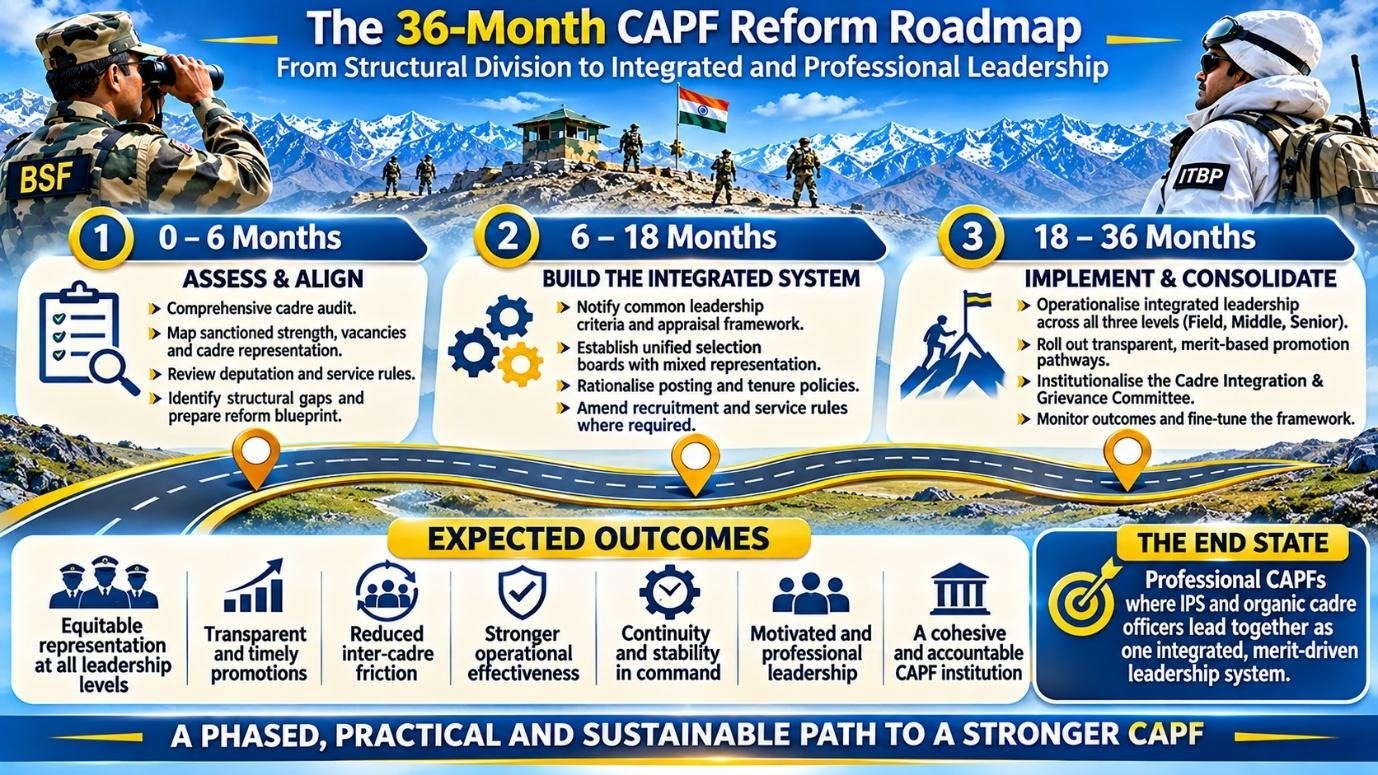
Practical Roadmap for Transition
Any reform of this magnitude must be carefully sequenced. Existing officers have entered service under prevailing recruitment rules and legitimate career expectations. Abrupt changes could create fresh inequities while attempting to correct old ones.
The MHA should therefore constitute a high-level committee comprising representatives of IPS, the organic cadres of all CAPFs, service administration experts, and independent public-administration specialists. Its mandate should be to develop an integrated leadership and career-management model, rather than simply recommend a numerical reduction in deputation.
The MHA should constitute a high-level committee comprising representatives of IPS, the organic cadres of all CAPFs, service administration experts, and independent public-administration specialists to develop an integrated leadership and career-management model, rather than simply recommend a numerical reduction in deputation
- First Six Months. The first six months should be devoted to a comprehensive cadre audit. This must establish sanctioned strength, existing vacancies, cadre-wise representation at different levels, promotion prospects, deputation patterns, and the availability of eligible officers. The exercise should also examine differences between the forces instead of assuming that one staffing formula will suit all.
- Next Twelve Months. During the next twelve months, common leadership criteria, integrated appraisal procedures, transparent posting policies and selection-board mechanisms should be notified. Service and recruitment rules must be amended wherever necessary, with appropriate consultation and legal scrutiny.
- Following Eighteen Months. The following eighteen months should see phased implementation of the revised leadership structure, accompanied by periodic monitoring of promotions, representation and organisational climate.
Existing officers must receive transitional protection. No one should suffer retrospective career prejudice because of a restructuring exercise. The system must also distinguish between deputation, permanent cadre strength and appointments reserved for functional requirements.
The Supreme Court’s May 2025 directions have already placed cadre review and service-rule reform on the Government’s agenda. Parliamentary scrutiny has also highlighted promotion stagnation and the need to examine deputation arrangements in the border guarding forces.
The task now is to translate these institutional concerns into a sustainable administrative framework.
Structural reform must be evolutionary in implementation, but decisive in institutional intent.
Professionalism Must Transcend the Parent Cadre
India’s CAPFs are no longer merely organisations performing traditional policing functions. They are specialised national security institutions entrusted with border management, internal security, protection of critical infrastructure and maintaining stability in some of the country’s most challenging operational environments. Their future effectiveness will depend as much on the quality of institutional leadership as on modern equipment, technology and infrastructure.
The Supreme Court’s May 2025 directions have already placed cadre review and service-rule reform on the Government’s agenda. Parliamentary scrutiny has also highlighted promotion stagnation and the need to examine deputation arrangements in the border guarding forces
The Government must therefore move beyond the binary argument of IPS versus organic cadre. IPS officers bring valuable experience in policing, intelligence, administration and coordination with state governments. Permanent cadre officers bring accumulated operational knowledge, institutional continuity and an intimate understanding of their forces. Both capabilities are necessary. Neither should be allowed to become a source of institutional privilege or professional insecurity.
The objective must be to create an organisation in which officers identify themselves first and foremost with their force, take collective ownership of its achievements and failures, and compete for leadership positions on a common professional platform.
A BSF officer, an ITBP officer or a CRPF officer should aspire to reach the highest office not with the apprehension that his parent cadre may become an impediment, but with the confidence that his professional record will determine his prospects.
Ultimately, the strength of a force lies not in the service background of its leadership but in the institutional confidence of the men and women who serve under it.
A force is not made professional by the rank of the officer commanding it. It is made professional by the system that selects its leaders, develops its people, and gives every deserving officer an equitable opportunity to rise.
Lt Gen Rajeev Chaudhry (Retd) writes on contemporary national and international issues, strategic implications of infrastructure development towards national power, geo-moral dimension of international relations, and leadership nuances in a changing social construct. The views expressed are of the author and do not necessarily reflect the views of Raksha Anirveda