

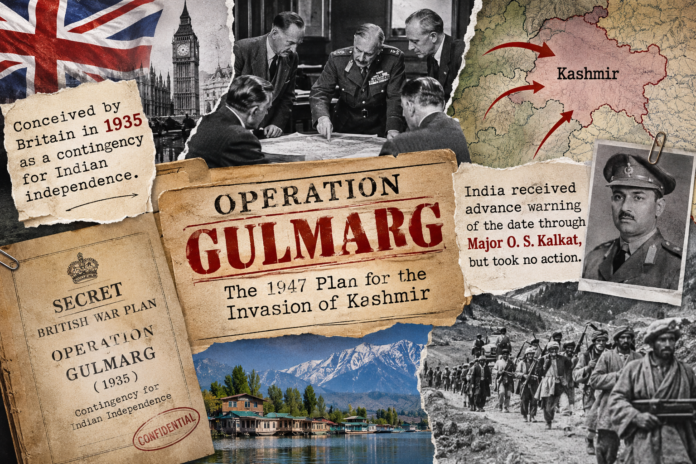
The Strategic Origins: Operation Gulmarg was conceived by Britain in 1935 as a contingency plan in case India became independent. Britain implemented it from August 1947. It was an adjunct to the “Great Game”, the long-running effort to stop Soviet expansion toward the British Indian Empire.
The plan rested on geography. The north-western region of India gives access to Central Asia and the Middle East, and Britain wanted to keep influence over it after independence. The means was a new state, Pakistan, which would include Jammu and Kashmir. The state mattered because it gave Pakistan strategic depth.

The same reasoning explains an earlier decision. In 1935, Britain took the Gilgit Agency on a 60-year lease, because the territory lies next to the Soviet Union. I read the lease and Operation Gulmarg as parts of one strategy.
Britain devised Operation Gulmarg in 1935 as part of the “Great Game” to check Soviet expansion. As planned a new Pakistan including Jammu and Kashmir would give depth to the region and control access to Central Asia and the Middle East
The Historical Background
I trace the political divisions that made this plan workable to the period after the 1857 uprising. Britain concluded that India could be governed most securely if it remained disunited, and it adopted a policy of “Divide and Rule”. To carry out the policy, it needed an educated class trained in Western ways. By the early twentieth century, Britain had built that class, which I refer to as the “Brown Sahibs”.
Hindu-Muslim tensions grew from 1906, when the Aligarh Muslim Movement began. It led to the formation of the Muslim League in 1920. James Ramsay MacDonald, who was British Prime Minister from 1929 to 1935, wrote in a book published in 1910 that the discord between the communities had been created through manoeuvres in Shimla and London. By 1930, the divide had become difficult to reverse, and by 1947 the mutual hostility had reached its peak.
This hostility produced the Two Nation Theory and the partition of the subcontinent. In my assessment, it also underlies Pakistan’s continuing hostility toward India, and any durable peace in the region had to address it.

Kalkat escaped house arrest in Pakistan and reached Delhi. He briefed senior military officials and the then Defence Minister, but the British-staffed intelligence directorate took no action
The Discovery of the Plan
The central evidence for Operation Gulmarg comes from Major Onkar Singh Kalkat, who later rose to Major General. In August 1947, he was Brigade Major of the Bannu Frontier Brigade Group. The brigade was based at Bannu in the North-West Frontier Province, now Khyber Pakhtunkhwa in Pakistan. Its commander was a British officer, Brigadier CP Murray, also spelled Murry.
As Brigade Major, Kalkat was authorised to open letters addressed to the brigadier in his absence. On August 20, 1947, he opened a secret letter to Murray from General Frank Messervy, the British chief of the Pakistan Army. Messervy had signed it on August 18. Attached to it were the plans for Operation Gulmarg.

The documents contained Pakistan’s invasion plan for Jammu and Kashmir. They gave the exact date of attack as October 22, 1947. They also listed the Pakistani soldiers who would take part. India therefore had the information about two months before the invasion began.
The Warning and Its Dismissal
Kalkat told Brigadier Murray about the letter. Murray told him to tell no one in Pakistan, because disclosure could cost him his life. Soon afterwards, the Pakistan Army placed Kalkat under house arrest, apparently suspecting that something was wrong.
Official records show Nehru and Gandhi were unaware of the plan. Field Marshal Manekshaw’s account suggests Mountbatten delayed Indian intervention, which began only after Sardar Patel pressed Nehru to approve it
Kalkat escaped from his captors and left Mir Ali. He reached Ambala in Indian Punjab and travelled on to Delhi in a goods train. Before leaving Pakistan, he had arranged for his family to be sent to India, with help from Muslim friends and the District Commissioner of Mianwali. His family later went missing in refugee camps, and he was searching for them in East Punjab when the invasion began.
In Delhi, Kalkat briefed senior officials. They included Brigadier Kalwant Singh, Colonel P N Thapar, who was then Director of Military Operations, and Defence Minister Sardar Baldev Singh. No action followed. The British-staffed intelligence directorate paid no heed to the information.
British officers of the Indian Army also described the expected attackers as “raiders” and “tribals” rather than Pakistan Army soldiers. In my assessment, this description concealed the fact that the plan was an operation of the Pakistan Army. I also hold that Lord Mountbatten and the British chiefs of the Indian and Pakistan armies knew of the plan. Kalkat described these events in his book Far Flung Frontiers.
Britain’s earlier attitude toward Maharaja Hari Singh fits the same pattern. Before partition, Britain showed a clear preference for him, in the expectation that Jammu and Kashmir would accede to Pakistan.
The Delay in India’s Response
Official records show that Jawaharlal Nehru and Mahatma Gandhi had no knowledge of Operation Gulmarg. However, Field Marshal Manekshaw gave an account in an interview with Prem Shankar Jha. It suggests that Mountbatten used Nehru’s idealism to delay Indian military intervention.
British officers in the J&K State Forces, including Major General HL Scott, sent troops away from Srinagar and left it exposed. The Poonch uprising served as a deception while Srinagar was the actual target. Lt Col Narain Singh and Brig Rajinder Singh delayed the invaders and made Indian intervention possible
The invasion began on October 22 1947, as the plan had specified. Nehru approved the deployment of the Indian Army only after Sardar Patel pressed him to do so. In my view, Nehru and Muhammad Ali Jinnah were among the leaders Britain had cultivated in the “Brown Sahibs” class, and their political descendants continue to hold influence in both countries. I will set out Manekshaw’s account in full in Part Two of this article.
The Weakening of Kashmir’s Defences
British officers in the service of the Jammu and Kashmir State Forces also shaped events. Major General HL Scott, a British officer, served as Chief of Staff of the State Forces under Maharaja Hari Singh from 1936 until late September 1947.
Scott sent the 9th Battalion from Srinagar to Poonch to deal with Muslim unrest there. This left Srinagar and the Maharaja without adequate defence. I read the Poonch uprising of July and August as a deception. It created the impression of a threat to Jammu while Srinagar was the real target.
Another earlier decision also reduced the state’s military strength. Three artillery batteries of the State Forces had been merged into the Indian Army and were never returned.
Despite this, the state forces made a difference on the night of the attack. Lt Col Narain Singh of the 4th J&K State Battalion and Brigadier Rajinder Singh, Chief of the J&K State Forces, fought delaying actions. These actions created conditions in which the Indian Army could intervene. On the night of October 21-22, Muslim soldiers killed Hindu soldiers of the 4th Battalion at Muzaffarabad.
Conclusion
The record, as I read it, shows that Operation Gulmarg was a long-planned British contingency with a clear strategic purpose. Its details reached India in August 1947 through Major Kalkat, together with the date of attack. The information was dismissed at the level where it could have been acted on, and Indian intervention was delayed until Sardar Patel’s pressure secured approval. The state’s own forces and a small number of officers held the situation long enough for the Army to arrive.

-An ex-NDA and Wellington Staff College graduate, Col Rajinder Singh is a renowned author and security analyst. He has authored four books, two individually and two in collaboration. His best-selling books are Kashmir – A Different Perspective and The ULFA Insurgency. The views expressed are of the author and do not necessarily reflect the views of Raksha Anirveda