

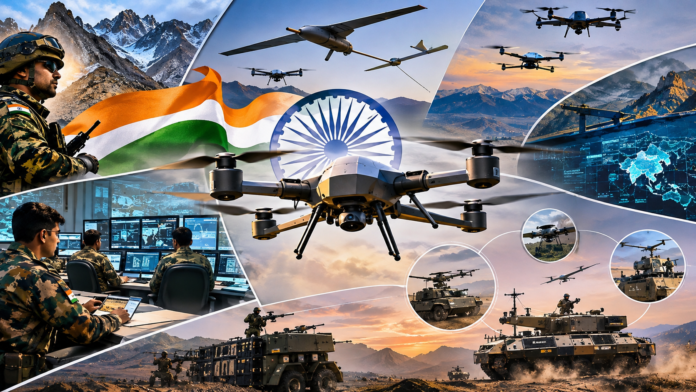
India must develop complete domestic design and manufacturing capabilities for different categories of military drones. But manufacturing indigenous drones will not deliver military superiority unless accompanied by a fundamental transformation in operational doctrine, creation of force structures and specialised training activities. The three Services must integrate unmanned systems into their respective operational concepts while developing joint capabilities for multidomain warfare. DSSC has taken the initiative of incorporating drone warfare in its curriculum.
(a) Indian Army – Tactical Drone Integration: The Indian Army must equip its operational formations with a comprehensive range of tactical drones. Surveillance and reconnaissance drones should become integral to infantry, mechanised, artillery and special forces formations. Each operational formation should have access to trained drone operators, maintenance personnel, data analysts and electronic warfare support. The Army has already demonstrated an encouraging beginning through in-house manufacturing. Its Annual Report 2025–26 records the production of 819 drones, comprising 193 surveillance drones, 337 kamikaze/armed/weaponised drones and 289 FPV drones. This provides a foundation for expanding indigenous manufacturing and institutionalising battlefield innovation.

(b) Indian Air Force – Unmanned Air Power: The Indian Air Force must develop a balanced manned-unmanned force structure. Future operations should progressively incorporate unmanned combat platforms, long-endurance surveillance drones and collaborative systems operating alongside manned aircraft. The development of loyal wingman concepts and manned-unmanned teaming will be particularly important. Such systems could extend surveillance, improve situational awareness and provide additional operational options while reducing exposure of pilots to selected high-risk missions. The IAF must also strengthen its ability to detect, identify and counter hostile drones through integrated radar, electronic warfare and air-defence networks.
The Indian Army must equip its operational formations with a comprehensive range of tactical drones. Surveillance and reconnaissance drones should become integral to infantry, artillery and special forces formations. Each operational formation should have access to trained drone operators, maintenance personnel, data analysts, and electronic warfare support
(c) Indian Navy – Maritime Unmanned Warfare: The Indian Navy should accelerate the development and induction of maritime unmanned systems. Shipborne surveillance drones, long-endurance maritime UAVs, unmanned surface vessels and underwater systems can support maritime domain awareness and protect critical maritime interests. The integration of drones with coastal surveillance networks, naval aviation, warships and maritime patrol aircraft would improve the Navy’s ability to monitor extensive oceanic areas.
(d) Preparation of Joint Drone Warfare Doctrine: India requires a tri-Service doctrine for unmanned warfare under an integrated national military framework. The doctrine should establish common operational standards for surveillance, communication, identification, data sharing, training and maintenance. It should also clarify the respective responsibilities of the Army, Navy and Air Force while encouraging joint operations and technological interoperability. A central joint unmanned systems coordination mechanism could facilitate capability development, procurement prioritisation, operational evaluation and technology upgrades.
(e) Training and Human Capital: Drone warfare requires specialised human resources. India should establish dedicated military training institutions in the Integrated Theatre Commands and DSSC for UAV operations, maintenance, electronic warfare, AI-enabled systems, autonomous technologies and counter-drone operations. The curriculum must combine technical proficiency with military judgement, operational security and legal understanding. Specialised Training in joint training establishments should also extend to commanders at all levels, who must understand how these unmanned systems influence battlefield planning, force protection and operational decision-making.

The Indian Navy should accelerate the development and induction of maritime unmanned systems. Shipborne surveillance drones, long-endurance maritime UAVs, unmanned surface vessels, and underwater systems can support maritime domain awareness and protect critical maritime interests
COUNTER-DRONE WARFARE: MILITARY ASCENDENCY
The proliferation of hostile drones creates a parallel requirement for effective counter-drone capabilities. The ability to manufacture and operate drones must be matched by the ability to detect, identify, track and neutralise hostile unmanned platforms. The threat is particularly serious because inexpensive drones can challenge expensive military infrastructure and create disproportionate defensive costs. India must develop a layered counter-drone architecture incorporating:
Early Warning and Detection: Modern radar, electro-optical sensors, acoustic detection and radio-frequency monitoring should provide comprehensive awareness of low-altitude aerial threats. Electronic countermeasures: Indigenous electronic warfare systems should be capable of disrupting hostile control and navigation links where operationally appropriate. Kinetic interception: Guns, specialised interceptor drones and other appropriate defensive systems should provide additional protection against threats that cannot be neutralised electronically. Integrated air defence: Counter-drone systems must be connected with existing radar networks, air-defence formations and command centres to ensure coordinated responses. Critical infrastructure protection: Military bases, ammunition depots, airfields, naval installations, energy infrastructure and sensitive government facilities require appropriate drone-protection arrangements. Artificial intelligence: AI-enabled surveillance and threat classification can help distinguish hostile drones from authorised or civilian aerial activity and reduce unnecessary responses. India must avoid an approach in which every drone threat is countered by an expensive missile or conventional air-defence weapon. Cost-effective layered defence, based on the nature and severity of the threat, is mandatory.

FUTURE STRATEGY: AUTONOMOUS MULTIDOMAIN OPS
The next generation of warfare will be shaped by the convergence of drones, artificial intelligence, robotics, cyber capabilities, satellite communications and advanced computing. Three developments deserve particular attention.
India requires a tri-Service doctrine for unmanned warfare under an integrated national military framework. The doctrine should establish common operational standards for surveillance, communication, identification, data sharing, training, and maintenance
(a) Collaborative Drone Swarms: Coordinated groups of unmanned platforms could perform surveillance, reconnaissance, communication relay and other authorised missions. Their principal advantage would be the ability to distribute tasks across multiple platforms rather than depend on a single expensive system. India should invest in swarm coordination, resilient communications and safe autonomous control, with appropriate human supervision over consequential decisions.
(b) Manned-Unmanned Teaming: The future battlefield will increasingly involve manned aircraft, ground formations and unmanned platforms operating together. Manned systems will provide command, judgement and mission oversight, while unmanned platforms can undertake selected high-risk or persistent tasks. This model can increase operational reach and improve the survivability of military personnel.
(c) Artificial Intelligence: AI will increasingly assist military commanders in processing enormous quantities of information received from multiple sensors. The integration of satellite imagery, drone surveillance, radar information and battlefield intelligence could improve the speed and quality of operational decisions. Nevertheless, AI must remain a decision-support capability subject to human accountability, cybersecurity safeguards and reliable verification.
(d) Space-Based Support: Satellite communications, navigation, weather information and earth observation will remain essential to advanced unmanned operations. India must strengthen the resilience of its space-based infrastructure and develop alternative navigation and communication arrangements for situations in which satellite services are disrupted. The future advantage will depend on the integration of space, air, land, maritime and cyber capabilities into a common operational framework.
STRATEGIC RECOMMENDATIONS FOR AATMANIRBHARTA
India must move from incremental drone procurement towards a coordinated national mission for indigenous unmanned warfare. The training institutions must incorporate Drone Warfare technology in their curriculum to assimilate and optimise its destructive potential. The following recommendations merit priority attention.
Drone warfare requires specialised human resources. India should establish dedicated military training institutions in the Integrated Theatre Commands and DSSC for UAV operations, maintenance, electronic warfare, AI-enabled systems, autonomous technologies, and counter-drone operations
(a) Establish a ‘National Military Drone Mission’: A dedicated national military drone mission should be co-opted into the organisation to coordinate the three Services in the Ministry of Defence, the Military Operation Directorates of the tri-services, DRDO, DPSUs, private industry, start-ups and academic institutions. It should establish measurable targets for indigenous design, manufacturing, component production, operational induction and technological upgrades.
(b) Creation of dedicated ‘Joint Drone Warfare Command’ Structure: A Tri-Service coordination mechanism should be established under the appropriate integrated defence headquarters to oversee doctrine, interoperability, training, research priorities and operational integration. The objective should be joint capability development without creating unnecessary bureaucratic layers and could be considered to be part of the ecosystem of the Integrated Theatre Command.
(c) Prioritise Complete Indigenous Manufacturing: India must progressively eliminate dependence on imported critical components. Propulsion, batteries, processors, sensors, communication modules, flight controllers and mission software should receive priority under a phased indigenisation programme, to be strictly coordinated by the DRDO.
(d) Develop a Three-Tier Indigenous Drone Inventory: The Armed Forces should develop three complementary categories, as this approach would balance affordability, operational effectiveness and technological sophistication.
- Low-cost Mass-produced systems: Tactical surveillance and expendable unmanned platforms for widespread operational availability.
- Medium-category Advanced systems: Longer-endurance surveillance, specialised strike and maritime reconnaissance platforms.
- High-technology Strategic systems: Advanced autonomous platforms, collaborative combat drones and long-endurance systems for demanding strategic missions.
A dedicated national military drone mission should be co-opted into the organisation to coordinate the three Services in the Ministry of Defence, the Military Operation Directorates of the tri-Services, DRDO, DPSUs, private industry, start-ups, and academic institutions
(e) Establish Military Drone Manufacturing Clusters: Dedicated manufacturing clusters should be established in partnership with state governments, DPSUs, private manufacturers and technology institutions. These clusters should have common testing facilities, certification infrastructure, component manufacturing and repair capabilities.
(f) Strengthen Defence Start-ups and MSMEs: The iDEX programme and ADITI challenges should be expanded with greater access to military testing facilities, predictable procurement pathways and long-term development contracts. Innovative companies must be encouraged to participate in the development of specialised components and complete platforms.
(g) Introduce Continuous Battlefield Innovation: The Services should establish dedicated innovation cells to collect operational feedback, evaluate emerging technologies and accelerate the development of improved systems. Drone designs should undergo frequent evaluation rather than remain tied to lengthy procurement cycles.
(h) Establish Dedicated Drone Warfare Training Institutions: Specialised institutions should train operators, technicians, engineers, data analysts and military commanders in unmanned warfare, AI, electronic warfare and counter-drone operations.
(i) Build Indigenous Counter-Drone Superiority: India must develop a layered, cost-effective counter-drone ecosystem that integrates detection, electronic warfare, interception and conventional air defence.
India should use its growing manufacturing capabilities to become a reliable exporter of military surveillance drones, maritime unmanned systems, and counter-drone technologies. Defence exports should support strategic partnerships while reinforcing domestic production capacity
(j) Encourage Manned-Unmanned Teaming: The Army, Navy and Air Force should progressively integrate unmanned platforms into their operational structures, including collaborative systems supporting manned aircraft and maritime platforms.
(k) Create Strategic Reserves and Production Surge Capacity: India must maintain adequate stocks of critical components and establish the capacity to rapidly expand manufacturing during emergencies. The Ukraine experience makes it clear that industrial replenishment and rapid replacement are essential to sustaining military operations.
(l) Develop India as a ‘Global Drone Export’ Hub: India should use its growing manufacturing capabilities to become a reliable exporter of military surveillance drones, maritime unmanned systems, counter-drone technologies and other specialised platforms. Defence exports should support strategic partnerships while reinforcing domestic production capacity.
(m) Institutionalise Cybersecurity and Responsible Autonomy: All indigenous military drone systems must undergo rigorous cybersecurity assessment, software verification and testing for operational reliability. The use of AI in target recognition and other consequential military decisions must remain subject to appropriate human control and accountability.
(n) Adopt a ‘Ten-Year Technological’ Roadmap: The Ministry of Defence should unequivocally establish a phased roadmap extending towards 2035, with clear milestones for indigenous components, production capacity, operational induction, AI integration and export competitiveness.
(o) Drone Power Pivotal to National Strategic Autonomy: Drone warfare is becoming a central determinant of battlefield effectiveness, technological competitiveness and national defence preparedness. The Russia–Ukraine conflict has demonstrated that the ability to innovate, manufacture and adapt unmanned systems can influence the conduct and sustainability of prolonged warfare. It has also exposed the limitations of relying exclusively on expensive conventional platforms without adequate protection against low-cost aerial threats. India must therefore pursue a balanced approach. Drones should complement, not replace, tanks, artillery, fighter aircraft, naval platforms and conventional military formations. Their purpose should be to enhance the effectiveness of these capabilities through better surveillance, faster decision-making, precision engagement and reduced exposure of personnel. The most important requirement is to develop a complete indigenous ecosystem in which military requirements drive technological research, private industry delivers scalable production, and operational experience continuously informs product improvement.
Aatmanirbharta must extend from the smallest electronic component to the most sophisticated autonomous platform. It must also encompass software, propulsion, batteries, sensors, communication systems, and maintenance infrastructure. India’s strategic autonomy will remain incomplete if its military drones depend upon foreign suppliers for critical technologies
Aatmanirbharta must extend from the smallest electronic component to the most sophisticated autonomous platform. It must also encompass software, propulsion, batteries, sensors, communication systems and maintenance infrastructure. India’s strategic autonomy will remain incomplete if its military drones depend upon foreign suppliers for critical technologies.
DRONES ARE FUTURE BATTLEFIELD IMPERATIVE
Drone warfare represents a decisive transformation in the character of modern military operations. It has changed the relationship between cost and combat effectiveness, challenged conventional concepts of battlefield protection and introduced new possibilities for surveillance, precision engagement and multidomain integration. The Russia–Ukraine war has provided an unmistakable warning that military forces unable to adapt to the proliferation of unmanned systems risk losing operational flexibility and exposing their formations to unprecedented vulnerabilities. Equally, it has demonstrated that drones alone cannot guarantee victory. Their effectiveness depends upon integration with conventional firepower, intelligence, electronic warfare, air defence, communications and sustainable industrial production.
For India, the challenge is therefore about building an indigenous technological and military ecosystem capable of supporting the requirements of a future two-front conflict, protecting national borders, securing maritime interests and maintaining strategic deterrence. The Indian Armed Forces must move towards a future in which every major formation possesses appropriate unmanned capabilities, every Service contributes to joint drone warfare, and indigenous manufacturers can respond rapidly to evolving operational requirements. India has the scientific talent, industrial potential, entrepreneurial capability and defence experience to achieve this transformation, requiring a coherent national vision, sustained investment, decisive procurement reforms and institutional commitment to indigenous innovation.
The decisive advantage in future warfare will not necessarily belong to the nation possessing the most expensive weapons, but to the nation capable of producing the most effective technologies, deploying them at scale and adapting faster than its adversary.
“Drone warfare must become a national defence priority under Aatmanirbharta. The battlefield of tomorrow will be multidimensional, increasingly autonomous and technologically contested. India’s preparedness must begin today.”

Lt Gen S K Gadeock is a distinguished military leader, global strategist, and scholar who served as the Commandant of the Defence Services Staff College. A decorated veteran and former Logistics Advisor to the Botswana Defence Force, he has held numerous high-ranking appointments including Director General of the Amity Institute of Defence & Strategic Studies. Serving on the Advisory Board of Raksha Anirveda, he is a prolific writer and motivational speaker.