


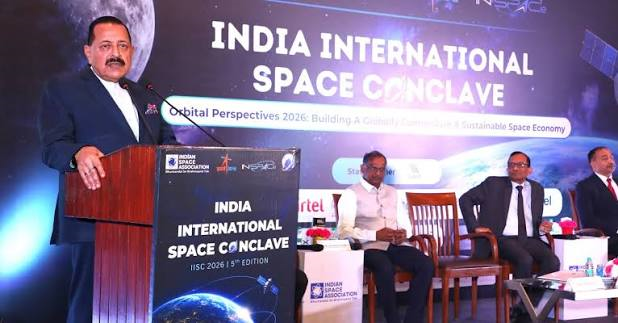
The fifth India International Space Conclave, organised by the Indian Space Association (ISpA) with ISRO and IN-SPACe as co-hosts, convened government, industry and investors around a globally competitive and sustainable space economy. Its headline proposition was expansive: India’s sector could reach $40-45 billion in less than a decade, according to Union minister Jitendra Singh. Yet, the day’s sharper message was less about the size of the destination than the infrastructure, financial and commercial, needed to reach it.
The central document, Space Economy 2036: The India Blueprint, was prepared by Starfleet India Capital Advisors and ISpA, with Akshat Johri as author and editor. Launched at the conclave by Lt Gen Anil Kumar Bhatt and Group Captain Shubhanshu Shukla, the report estimates that the sector needs $34-37 billion in investment from 2026 to 2036. Public funding may cover $14-15 billion; the remaining $19-21 billion must be mobilised from private investors and institutions. That translates to about $2 billion in private capital annually.

Reaching India’s $44 billion space economy target requires $34-37 billion in investment through 2036, demanding roughly $2 billion annually in private capital alongside public funds
The figures need careful reading. India’s $44 billion space-economy goal is a target for 2033, while the report’s financing horizon runs through 2036. The two are complementary, not interchangeable. Nor is the $2 billion annual requirement a promise of returns: it is the report’s estimate of capital needed to build infrastructure and businesses at scale. The gap is not simply “more money”. It is the lack of contracts, insurance, liability rules and financing instruments that allow long-term capital to judge space projects on familiar terms.
Johri’s diagnosis was direct: “Money is not the constraint. What is missing are the structures that let banks, insurers and pension funds price space risk.” The report therefore argues for moving beyond grants and early-stage venture capital toward debt, institutional investment and capital markets.
Its proposals include growth-stage funds, a dollar-denominated space growth fund at GIFT City, service procurement inspired by NASA’s Commercial Orbital Transportation Services programme, infrastructure finance, green bonds for climate-observation satellites and domestic space-insurance capacity. It also calls for clearer liability arrangements and a comprehensive legal framework, conditions that could make risk legible to lenders rather than leaving every mission to be assessed as an exception.
70-80% of ISRO launch and satellite budgets flowing to domestic industry, leadership urges expanding indigenous supply chains and accelerating navigation satellite orders to sustain private firms
Group Captain Shubhanshu Shukla, the Axiom Mission 4 pilot, drew a parallel with human spaceflight. The report’s proposals, he said, are about trust: giving lenders confidence in contracts, insurers confidence in missions and investors’ confidence in companies. Spaceflight itself depends on tested and documented systems; commercial finance, he argued, also needs evidence and dependable structures. His appeal to young Indians to design, build, finance and fly future missions joined national aspiration to the practical need for an investable ecosystem.

ISpA chairman AT Ramchandani was more blunt about the distance between ambition and commercial reality. India’s $44 billion goal faces funding and business-visibility gaps, he warned. Firms need to see a credible pipeline of customers and orders, not only policy announcements, before they can expand manufacturing or persuade lenders to back long-lived projects. His message aligns with the wider conclave debate: capability is necessary, but a business cannot scale on capability alone.
IN-SPACe chairman Pawan Kumar Goenka made demand creation the next policy priority. The first phase of reforms created an institutional pathway for private participation, he said; the next must generate “heavy demand”. He voiced less concern about industrial capacity being built than about whether enough customers will emerge to use it. With long gestation periods, he added, the sector also needs patient capital and policy stability. That shifts attention from counting start-ups to measuring orders, repeat business and viable downstream markets.

GalaxEye’s order of Bellatrix Aerospace electric propulsion systems for 30 satellites highlights the shift from one-off prototypes to repeatable, domestic commercial supply chains
ISRO chairman V Narayanan reinforced the importance of industrial participation while warning that private growth needs real work to sustain it. He said 70-80 per cent of the budget associated with a launch vehicle or satellite goes to Indian industry, and identified more satellite and rocket orders as essential to strengthening private firms. He also pointed to three additional navigation satellites expected over the following 18 months and the eventual need for a global navigation constellation. The operational implication is clear: public programmes can create demand and technical depth, but the supply chain must become dependable and indigenous in critical areas.
Union minister Jitendra Singh supplied the government’s growth case. India’s space economy, valued at nearly $9 billion, could reach $40-45 billion in less than a decade, he said, pointing to the expansion from a handful of start-ups to around 400-500. He credited reforms including NewSpace India Limited and IN-SPACe with opening a sector once dominated by government. Singh also argued that space technology’s economic value is not confined to launches and satellite sales: applications in infrastructure planning, communications, healthcare, education, transport and governance can generate savings and improve public services.
Lt Gen Anil Kumar Bhatt, ISpA’s director general, stressed the financing and risk dimension from the outset. India has technology and talent, he said, but becoming a global company depends on patient, informed capital that understands long development cycles and high risk. India also needs the capacity to assess and undertake space risk domestically. His emphasis on insurance is material: without a local ability to evaluate risk and manage losses, companies may face higher costs and investors may remain wary.
Alongside new partnerships with Luxembourg, Switzerland, and top Indian institutes, leaders emphasised that long-gestation space ventures require patient, informed capital and local risk assessment
International cooperation featured alongside finance. Christian Biever, Luxembourg’s ambassador to India, described space as a domain whose opportunities are global and whose challenges are shared, pointing to scope for cooperation in satellite communications, Earth observation, research and space resources. The conclave also saw institutional and industry agreements, including ISpA partnerships with Switzerland’s Space Systems Innovation Platform, IIT Tirupati and Chandigarh University, as well as collaborations involving Pixxel, IIT Kanpur, CS Tech and Centum Electronics.
A commercial announcement offered a concrete example of demand taking shape. GalaxEye selected Bellatrix Aerospace to supply electric propulsion systems for its next 30 satellites. The deal, described as a major private B2B order by satellite volume, links a constellation operator with a domestic propulsion provider and points toward repeatable supplier relationships. That is the kind of transaction that can help validate production capability, though one deal cannot by itself establish a broad, predictable order book.
The conclave’s sharpest lesson is therefore not that India lacks ambition or engineering talent. It is that the next phase depends on converting them into durable commercial demand. Procurement must be predictable, risks insurable, liability clear, and private firms able to graduate from prototypes to serial production. The blueprint offers a financing architecture, and the speakers identified the institutional and market gaps it must address. Whether India reaches its target will be decided less by the scale of its forecasts than by the contracts, customers and capital that follow.