

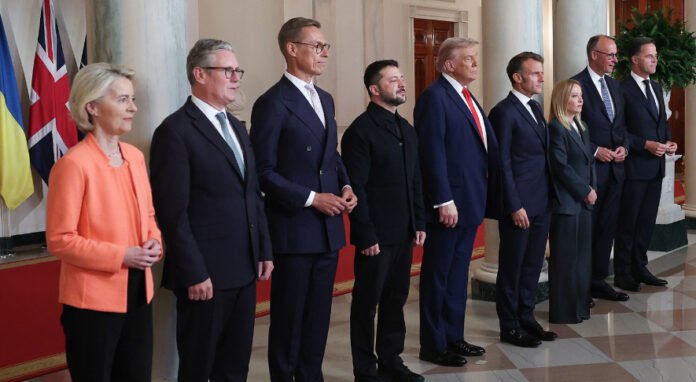
The Russia-Ukraine war is approaching its fifth year, yet the latest American-led diplomatic initiative has produced little reason for optimism. On November 10-11, Russian, Ukrainian and American representatives met in Abu Dhabi for the first trilateral negotiations since February. President Donald Trump had again suggested that an agreement was within reach. The talks, however, exposed a fundamental problem: Washington wants to end the war, but Moscow and Kyiv remain divided over the very security arrangements that would make peace possible.
The absence of a breakthrough is not a failure of diplomacy alone; it reflects incompatible strategic objectives.

Trump has repeatedly promised to end the conflict, but his latest push has generated apprehension in Kyiv and European capitals that the urgency to secure an agreement could come at Ukraine’s expense. The Abu Dhabi discussions covered post-war security, de-escalation and humanitarian issues. Yet there was no meaningful breakthrough on territory or the future security of Ukraine. Subsequent discussions involving American envoys Steve Witkoff and Jared Kushner and President Vladimir Putin did little to bridge the divide. Washington’s optimism has not been matched by a corresponding change in Moscow’s position.
The central disagreement is straightforward. Russia wants an end to NATO’s eastward expansion, restrictions on Western military deployments and weapons near its borders, and limits on Ukraine’s armed forces. It also wants Ukraine to abandon its NATO aspirations and accept neutrality
The central disagreement is straightforward. Russia wants an end to NATO’s eastward expansion, restrictions on Western military deployments and weapons near its borders, and limits on Ukraine’s armed forces. It also wants Ukraine to abandon its NATO aspirations and accept neutrality. These demands are not new. They echo Moscow’s position before its full-scale invasion in February 2022. Putin is seeking more than territorial concessions; he wants a fundamental alteration of Europe’s post-Cold War security architecture.
Ukraine wants precisely the opposite. It seeks credible, enforceable security guarantees, continued Western military assistance and the freedom to determine its own alliances. Kyiv has discussed maintaining an armed force of approximately 800,000 personnel and obtaining security assurances modelled on NATO’s Article 5, which treats an attack on one member as an attack on all. The proposed guarantees involve the United States and key European powers. For Ukraine, a ceasefire without credible deterrence would merely give Russia time to regroup and prepare for another offensive.
Europe’s position further complicates the negotiations. Britain, France, Germany and other European partners insist that they cannot be excluded from decisions affecting their continent’s security. Russia, however, has resisted their direct participation in the trilateral process, preferring to deal with Washington. Moscow’s demands for restrictions on NATO’s military posture extend well beyond Ukraine. European governments cannot easily accept an arrangement that gives Russia a veto over the security choices of sovereign states. Equally, Ukraine cannot be expected to accept guarantees that exist only on paper.

The battlefield is making the diplomatic task increasingly difficult. Russia continues to attack Ukraine’s power infrastructure, transport networks and civilian areas, while Ukraine has expanded its long-range drone campaign against Russian military and industrial targets
This is the fundamental contradiction that American diplomacy has yet to resolve. Washington is attempting to reconcile Russia’s demand for a strategically constrained Ukraine with Kyiv’s insistence on retaining the military capacity to defend itself. Economic incentives and diplomatic assurances may encourage negotiations, but they cannot substitute for agreement on the underlying balance of power. A settlement that ignores this contradiction risks becoming an interlude between two phases of war.
The battlefield is making the diplomatic task increasingly difficult. Russia continues to attack Ukraine’s power infrastructure, transport networks and civilian areas, while Ukraine has expanded its long-range drone campaign against Russian military and industrial targets. On November 28, both sides reported large-scale drone attacks, with Russia claiming to have intercepted 1,246 Ukrainian drones. Russian strikes killed civilians in Ukraine, including in Kyiv and Nizhyn. Ukraine is entering another winter with its energy infrastructure under severe pressure and its air-defence resources stretched. Its dependence on Western-supplied interceptors, particularly Patriot missiles against ballistic threats, remains a serious vulnerability.

The political calendar in Washington adds urgency. Following the November midterm elections, Democrats are due to assume control of Congress in January. This could intensify scrutiny of Trump’s Ukraine policy and complicate his freedom of action. For Putin, the present American administration may offer a more favourable negotiating environment than a Congress with stronger Democratic influence. For Trump, securing an agreement before that political transition would be a significant diplomatic achievement. Ukraine, meanwhile, remains sceptical that a breakthrough can be achieved without concessions that compromise its long-term security.
For India, the conflict has implications extending well beyond Europe. Russia remains an important defence partner, but the war has exposed the risks of dependence on a supplier whose military requirements and sanctions-related constraints can affect the availability of equipment, spares and technology
It would be a mistake, however, to assume that Moscow is necessarily eager to stop fighting. If Putin believes that continued military pressure can extract greater territorial and strategic concessions, he has little incentive to accept an unfavourable settlement. Ukraine faces the opposite calculation: accepting inadequate guarantees could leave it exposed to renewed aggression. The enormous human cost, destruction of infrastructure and economic dislocation make continued war increasingly difficult for both countries, but the costs alone have not produced political compromise.
For India, the conflict has implications extending well beyond Europe. Russia remains an important defence partner, but the war has exposed the risks of dependence on a supplier whose military requirements and sanctions-related constraints can affect the availability of equipment, spares and technology. Russian crude imports remain relevant to India’s energy security, while prolonged instability threatens global energy and food supply chains. The conflict also offers lessons in drone warfare, missile defence, electronic warfare and the vulnerability of critical infrastructure.
India has maintained its strategic partnership with Russia while deepening relations with the United States and Europe. Its interest lies in preserving this diplomatic flexibility without compromising its national interests or the principle of sovereignty. A ceasefire may stop the immediate fighting, but unless it addresses Ukraine’s security and the wider European balance, it will not necessarily deliver peace. The real test of Trump’s diplomacy is not whether he can bring the guns to a temporary halt, but whether he can negotiate an order in which neither side sees another war as its best strategic option.
The writer commanded 15 Punjab in Lebanon under United Nations Flag, commanded 27 Sector as DIG in Churachandpur and was Brigadier Operational Logistics in HQ Western Command. He is currently an analyst on geopolitics, international and defence affairs. The views expressed are personal and do not necessarily carry the views of Raksha Anirveda