


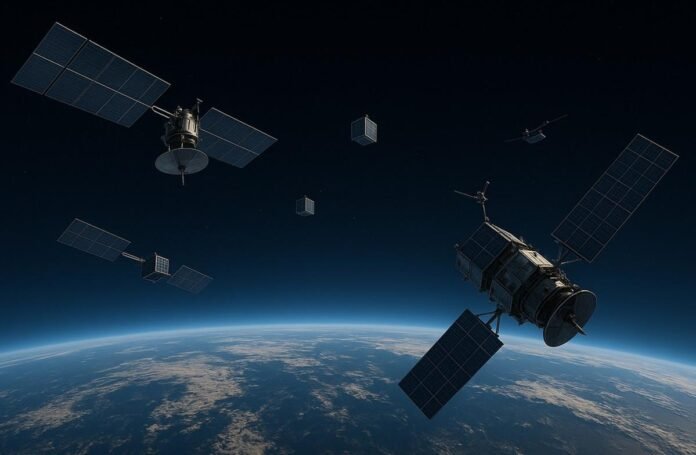
At the Tec-Verse 2026 event, Air Vice Marshal Manu Midha, Director General of the Defence Space Agency (DSA), called for collaboration with Indian research institutions and start-ups on technologies for a more secure space environment. The areas identified include anti-jamming payloads, quantum-safe cryptography and artificial intelligence capable of helping detect threats or debris in orbit. Midha urged prospective partners not to work in isolation or wait for conventional tender processes.
The appeal reflects the growing importance of satellites to military operations and the vulnerability of the services that depend on them. Satellite links support communications, navigation and surveillance; disruption to those links could affect both military activity and civilian services. Anti-jamming technology is intended to help preserve communications when signals face interference, while improved space surveillance can give operators a clearer picture of objects and activity in orbit.

Artificial intelligence could help process large volumes of orbital data and flag unusual activity for human review. Quantum-safe cryptography, meanwhile, is intended to protect communications against future advances in computing that could threaten some existing encryption methods. The agency’s reported interest in these fields points to a broad effort: not only monitoring space, but also protecting the information and communications systems that rely on it.
The DSA is an integrated agency drawing personnel from the Army, Navy and Air Force. Established to coordinate military space capabilities, it operates under the Integrated Defence Staff. Its remit includes space-based surveillance and satellite intelligence, making domestic access to relevant technologies a strategic consideration as India’s military reliance on space systems grows.
The initiative also sits within a wider shift towards involving private firms in India’s space sector. The Indian Space Policy 2023 opened more space activities to non-government entities, with the Indian National Space Promotion and Authorisation Centre (IN-SPACe) set-up to promote and authorise their participation. That framework offers a route for companies and research organisations to contribute expertise beyond established government laboratories.
Defence-focused programmes have already sought outside innovation. Mission DefSpace, announced in 2022 under the iDEX framework, presented challenges spanning satellite systems, communications, payloads, ground systems and software. Its model is designed to bring start-ups, smaller businesses and research institutions into the development of technologies relevant to defence needs.

A further marker of India’s plans is the Space-Based Surveillance programme. The government approved a project for 52 satellites, according to reporting on the programme, to expand the country’s space-based surveillance capacity. Such a constellation would increase the demand for reliable data processing, secure communications and systems capable of maintaining service despite interference.
However, turning a call for partners into operational capability will require more than identifying promising ideas. Defence technologies must be tested for reliability, security and performance under demanding conditions. They must also integrate with existing systems and meet the requirements of military users. For smaller companies, navigating those requirements and moving from prototype to procurement can be difficult; early engagement between developers and the services may help clarify needs.

The drive for indigenous technology is not simply a matter of replacing imported equipment. Domestic design and production can give India greater control over upgrades, maintenance and supply chains, while building local expertise in fields with both civilian and military applications. At the same time, space systems are global and technically complex, so partnerships will need to combine research capacity, manufacturing experience and operational feedback.
Midha’s call signals an effort to connect those capabilities earlier, rather than leave innovation to isolated projects or conventional procurement cycles. Whether it produces deployable systems will depend on sustained funding, testing and adoption. For now, the priority is clear: develop Indian expertise that helps protect satellite communications, identify orbital risks and keep essential space-based services dependable.