


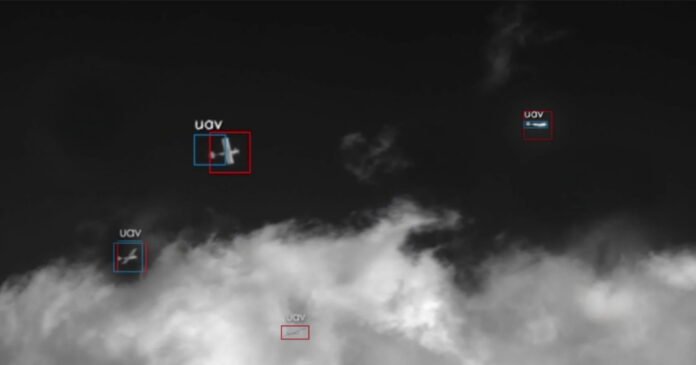
The use of small, low-cost drones has rapidly expanded across military and public safety environments, creating an urgent need for effective Counter-Unmanned Aerial System (C-UAS) solutions.
EO/IR sensors form the backbone of the C-UAS kill chain, and compares the trade-offs between lower-cost imaging systems and high-performance, multi-sensor architectures. It highlights the challenges of long-range detection, where drones may appear as only a few pixels, and performance is constrained by the Signal-to-Noise Ratio (SNR).

The limitations of both classical MTI and AI-based object detection lie at the edge of visibility. Finally, it underscores the essential role of advanced Image Signal Processing (ISP) in improving SNR, stabilising low-contrast targets, and extending effective detection and tracking range.
Drones’ Evolving Role
The drone threat is emerging across tactical and public safety scenarios. The proliferation of small, inexpensive, and manoeuvrable drones is a great challenge for both military planners and for the protection of public, commercial, and industrial vulnerabilities. It is not hyperbole to state that there is an arms race between offensive drones and C-UAS solutions.
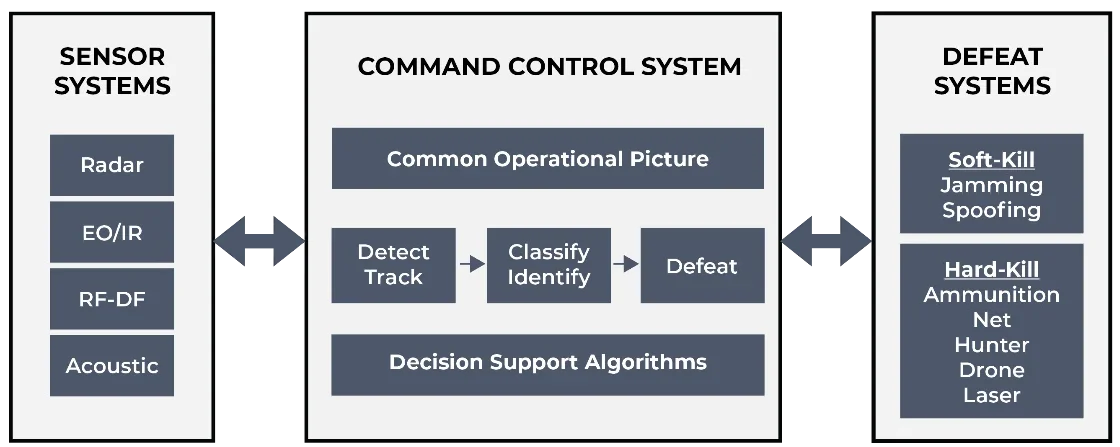
Electro-optical (EO) and thermal infrared (IR) imaging have become core technologies for detecting and tracking drones. To perform a cost/benefit analysis, developers need to understand the trade space of C-UAS systems, including detection range limitations, radar system capabilities, image signal processing, embedded processors, and Artificial Intelligence (AI) models. Although each air defence system is developed against a specific set of air threats, their kill-chains typically consist of three complex sub-systems: Sensor Systems, Command Control System, and Defeat Systems.
EO/IR Imaging Systems for Drone Detection
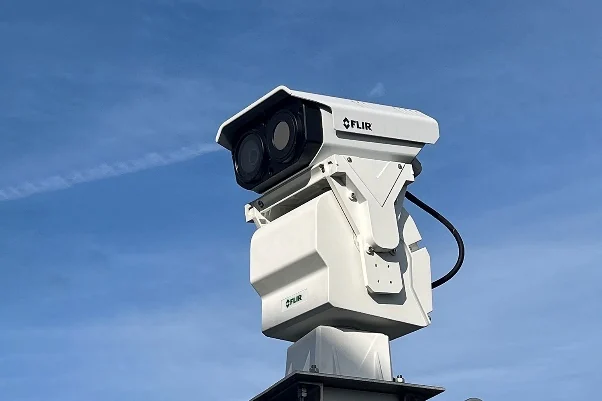
Cost-effective electro-optical (EO) sensors offer high resolution and appropriate focal length lenses. Passive infrared (IR) sensors are sensitive to thermal photon emissions instead of visible light, making IR ideal for 24/7 operations. EO cameras have higher angular resolution, which directly translates to pixels on target: this is a critical system parameter for early drone detection.

However, the SNR of the EO pixels on a small drone is often low due to limited contrast against a sky background. IR cameras can often detect drone motion represented by as small as a 2×2 pixel cluster, given the sky’s cold background. In addition, classification cues, including shape, motion patterns and thermal signatures, help IR distinguish drones from birds, aircraft and clutter to minimise false positives, which often diminish the effectiveness of imaging systems.
C-UAS Solution Design Considerations
C-UAS detection systems fall into two separate cost and performance categories: lower cost and high performance.

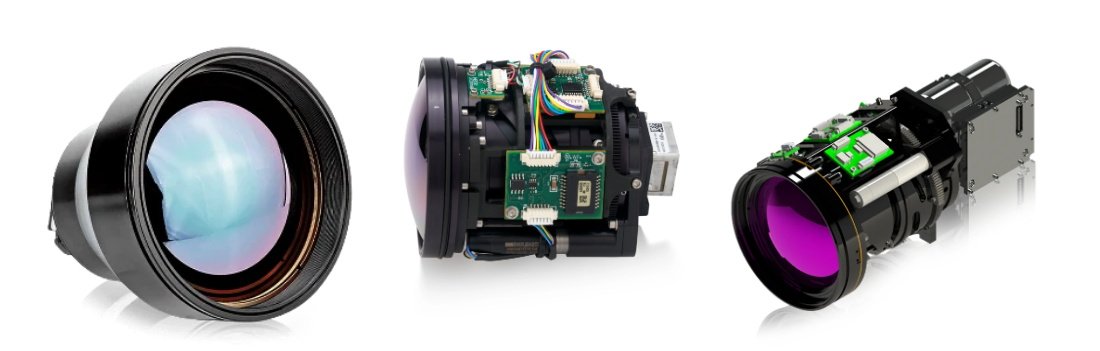
Lower-cost, imaging-only detection systems with <1000-metre drone detection distance integrate EO and Longwave IR (LWIR) uncooled sensors with fixed focal length lenses and cost between $50K and $150K. These systems are typically limited to a fixed field of view (FOV) or scanning 90 to 180 degrees horizontally, which is useful for perimeter monitoring.
Advanced, high-performance, multi-sensor detection systems with >1000-metre range incorporate EO and cooled Midwave IR (MWIR) cameras with continuous zoom (CZ) optics and radar. These systems cost between $150K and $1M and can be configured to provide a full 360-degree FOV for maximum situational awareness.
EO/IR Moving Target Indication at Low SNR
EO/IR C-UAS systems employ Moving Target Indication (MTI) algorithms as a first stage, using techniques including frame differencing or temporal differencing and background subtraction. Near the detection limit, noise is indistinguishable from motion, and pixel-level noise fluctuations can look like small moving objects from frame-to-frame, especially under high gain or low light. Background movements, including moving foliage, clouds, water, heat shimmer and shadows, generate “false motion”. Increasing detection thresholds keeps false positives manageable but can disproportionately suppress true detections at the edge of visibility.
Target Detection and Tracking Using EO/IR Object Detectors
Deep learning, AI-based object detectors are widely used for drone detection in EO/IR video systems and can follow the same ontology as the human perception classes of detection, recognition and identification. They incorporate multi-scale feature extraction:
Detection (>10×10 Pixels): Generalised classifiers (drone vs. bird vs. plane) and localisation (bounding box) for small to large targets based on limited training data
Recognition (~20×10 Pixels): Fine-grained classifiers for target classes such as quadcopter, fixed wing drone and airborne ISR aircraft
Identification (~30×20 Pixels): Fine-grained classifiers based on extensive high-resolution training data of application-specific classes such as Shahed, quadcopter make and model and fixed wing loitering targets
Limits of Detection for EO/IR
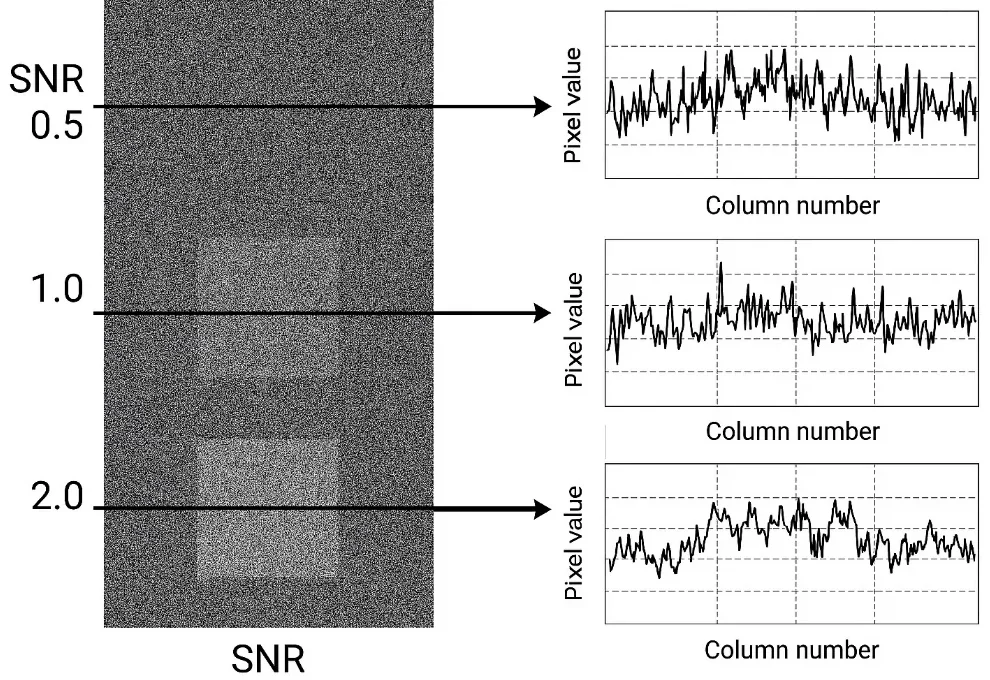
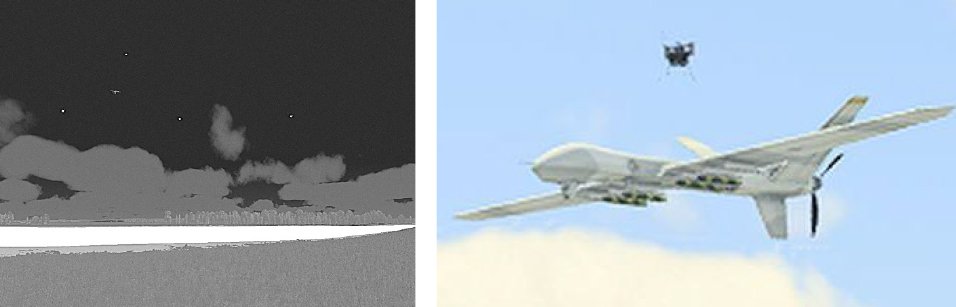
For drones at long range, EO/IR performance is often SNR- and resolution-limited, forcing the system to operate near the limit of detection. For a small quadcopter or fixed-wing drone, the angular size at long range may be only a few pixels or even sub-pixel. At that point, the drone’s apparent size is comparable to or smaller than the point spread function (PSF) of the optics. Atmospheric effects, including scattering, haze and turbulence, can further reduce contrast and introduce random blur.
Limit-of-detection conditions often correspond to: most object detectors degrade severely when the object is below approximately 10×10 pixels. At 3×3 or up to 5×5 pixels, the network has very little detail, shape cues are limited, texture is nonexistent and only gross motion/contrast remains. If network training does not include very small, noisy targets, the detector will miss targets or produce unstable outputs. Detectors trained using clean daytime imagery, specific backgrounds and strong contrast targets may be especially challenged or fail in low-light or night conditions, haze or humidity and background variations, e.g., desert vs. urban vs. maritime.

To improve performance, development teams can use data augmentation, including scaling, noise injection, blur and illumination changes. Training on synthetic data enables rendering drone models into realistic backgrounds and negative examples of birds, planes and clutter. Multi-frame or track-aware detectors can be employed using sequences instead of single frames.
EO/IR Image Signal Processing
ISP for EO/IR camera systems refers to the set of algorithms and hardware functions that convert raw sensor data into usable, high-quality imagery that supports detection, recognition, identification, measurement and automated decision-making. In EO/IR systems, especially thermal IR cameras, raw output from the focal plane array (FPA) is noisy, nonlinear and uncorrected. ISP transforms this raw data into stable, calibrated, visually optimised imagery in real time. SNR and network performance and reliability depend on the quality of ISP for improving target Detection, Recognition and Identification (DRI).
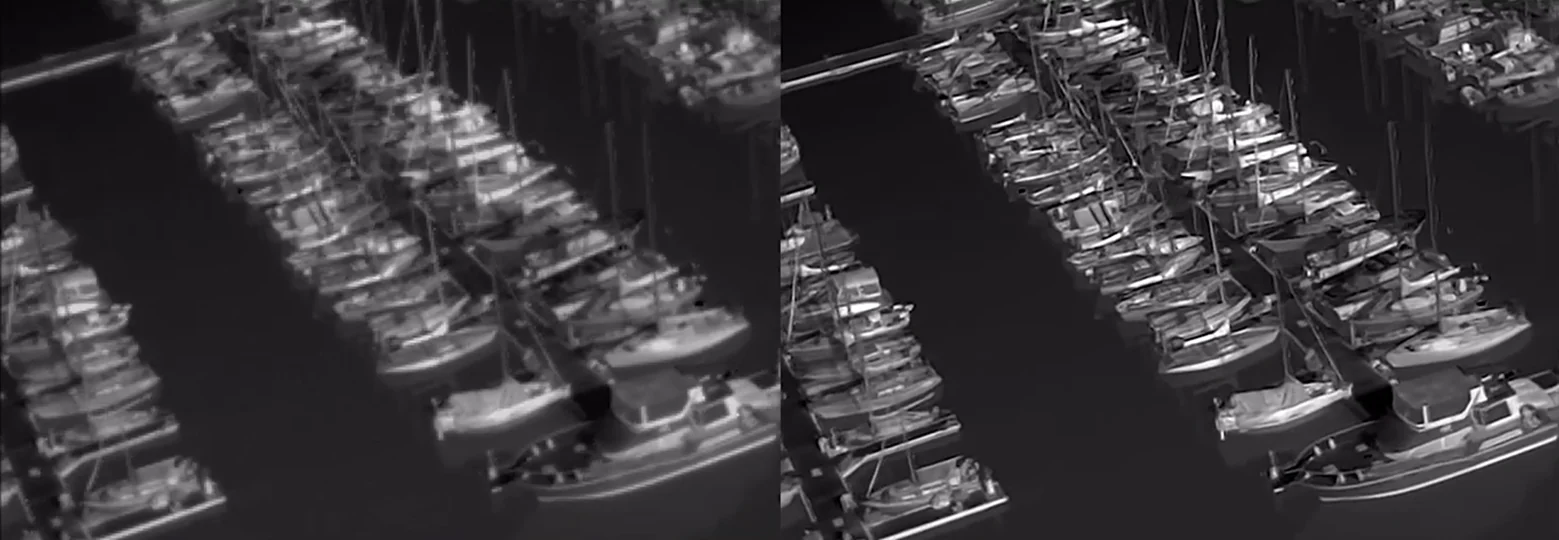
Teledyne FLIR OEM has developed IR ISP algorithms to improve the SNR and at the limits of detection (~2×1.5 pixels) that increase the range to initiate drone tracking by up to 20%. To learn more, please visit www.oem.flir.com/prism-family.