

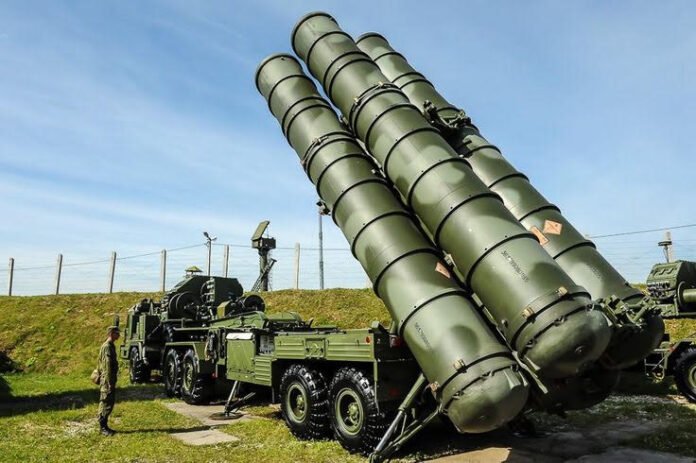
next month, a team of Indian Air Force officers in Russia will walk around giant missile launchers and radar vehicles, checking every detail before the equipment is shipped home. Their inspection carries the hopes of millions who live along India’s most sensitive frontier. If all goes to plan, India’s fifth S-400 air defence system will be ready for deployment by February 2027. This time, two senior officials say, it will stand guard over the 740 km Line of Control (LoC) in Jammu and Kashmir. As usual on national security matters, the Union government has said nothing.
To see why this matters, picture the S-400 as a vast invisible umbrella. Its powerful radars watch the sky, and its missiles can strike threats anywhere between 40 km and 400 km away. It can bring down fighter jets and ballistic missiles, which arc high into the sky before plunging towards their targets. It can also stop armed unmanned aircraft, kamikaze drones and loitering munitions, which are weapons that circle over an area like a hawk before diving onto their prey.

Three such umbrellas already shield Punjab, Rajasthan and Gujarat. A fourth, in Assam, protects the 1,126 km Line of Actual Control (LAC) in Arunachal Pradesh. The officials told Hindustan Times that India hopes to buy five more systems from Russia in the coming year.
The system has already proved itself in battle. During Operation Sindoor, not a single ballistic missile or rocket fired from Pakistan struck Indian soil. The S-400 also shot down Pakistani fighter jets and AEW&C aircraft, which are essentially flying radar stations that spot enemy planes from far away. It also brought down ELINT platforms, aircraft that secretly listen in on an enemy’s radio and radar signals. Some of these kills happened as far away as the western side of the Indus.
Behind this new deployment is a growing web of support around Pakistan, one of the officials explained to Hindustan Times. China and Turkey are supplying hardware. The United States is giving Pakistan’s F-16 fighters sharper teeth through an upgrade package. Saudi Arabia is releasing money, reportedly as a reward for Pakistan backing the Mecca Alliance against the Iranian-backed Houthis.
Pakistan is asking the International Monetary Fund for help and has low foreign exchange reserves. Even so, it is spending over $5 billion on eight Chinese-built Hangor-class submarines, a version of China’s Yuan class. These diesel-powered attack boats use air-independent propulsion (AIP), a technology that lets a submarine stay hidden underwater far longer, instead of surfacing often to recharge its batteries. One of them has been in service with the Pakistan Navy since June 2026. Turkey, meanwhile, is modernising Pakistan’s older Agosta 90B submarines and sending it long-range kamikaze drones. China has also delivered armed Wing Loong II drones that can fire missiles.

The skies ahead look even more crowded. China plans to hand J-35 fifth-generation fighters to Rawalpindi in 2027. These are stealth jets, shaped to slip past radar much like a figure in dark clothes blending into the night. China’s HQ-9BE, a long-range air defence system, adds another layer of concern.
India also remembers what happened during Operation Sindoor. The Pakistan Air Force paired Chinese J-10 fighters with Swedish airborne early-warning aircraft to fire PL-15E missiles. These missiles can fly 200 km and use a twin data link, which means they receive steering updates from two sources in mid-flight.

India’s answer is to build and buy two kinds of weapons. The first is long-range stand-off weapons, missiles fired from a safe distance so that pilots and soldiers never have to enter the enemy’s danger zone. The second is loitering munitions. A senior military officer put the lesson simply. Future wars will be fought without direct contact, using stand-off weapons, he said, and whoever has the longer-range missile and the stronger anti-missile shield will have the edge.
So, the plan goes beyond one battery. India has weighed the security picture created by Pakistan’s new purchases and the constant threat of cross-border terrorism. In response, it intends to strengthen its long-range stand-off weapons of three kinds: air-to-air, air-to-ground and ground-to-ground. It will also upgrade its border infrastructure along the LAC.
For the farmer in Poonch, the shopkeeper in Uri and the soldier on a frozen post above Kupwara, these decisions are not abstract. Every new radar sweep and every missile on standby means one more night when families can sleep knowing someone is watching the sky above them. A nation that has lived through decades of shelling and sudden alarms knows that peace is protected by those who refuse to be caught unprepared.

-The writer is an award-winning science communicator and a Defence, Aerospace & Geopolitical Analyst. He is the Managing Director of ADD Engineering Components India Pvt. Ltd., a subsidiary of ADD Engineering GmbH, Germany. You can reach him at: girishlinganna@gmail.com. The views expressed are personal and do not necessarily carry the views of Raksha Anirveda