


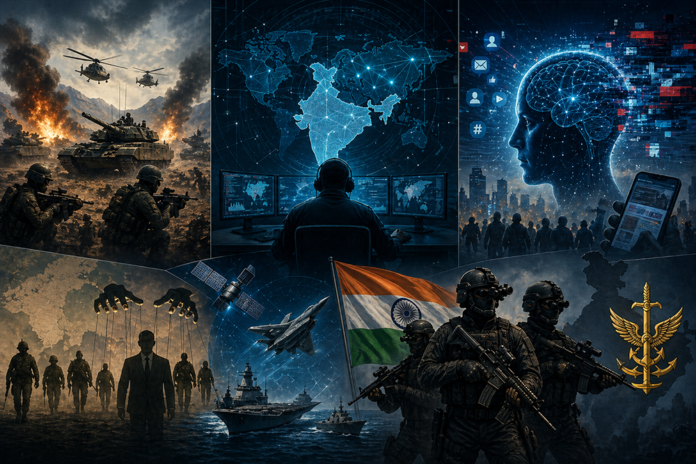
Victorious warriors win first and then go to War, while defeated warriors go to war first and then seek to Win – Sun Tzu
The twenty-first century has transformed warfare from physical battlefields to domains shaped by information, perception, and cognitive influence. Victory is no longer determined solely by territorial gains, but by the multifaceted ability to achieve long-term strategic effects through calibrated applications of military and non-military power. Modern conflicts increasingly emphasise narratives, information dominance, and integrated national power. India’s evolving security environment, marked by cross-border terrorism, hybrid warfare, and geopolitical competition demands rapid, precise, and covert military responses. Within this context, special operations forces have emerged as critical instruments of state power. However, their effectiveness is constrained by fragmented command structures and limited inter-service integration.

Changing Character of Warfare and Strategic Context
The contemporary security environment is characterised by a shift from conventional warfare to hybrid conflicts, where sub-conventional methods dominate the battlefield. As early as 2001, Pakistani strategists openly advocated tactics such as low-intensity conflict, guerrilla warfare, terrorism, and psychological operations as alternatives to direct military confrontation. Over protracted time, the high financial and human costs of traditional wars have pushed even major powers towards reliance on irregular forces and proxy warfare, increasing the strategic relevance of such methods across regions like the Middle East, Ukraine, and South Asia. Consequently, irregular forces have become central to modern conflict, with even advanced militaries like those of the United States and NATO engaged in prolonged struggles against them.
Within this evolving context, the China-Pakistan nexus has played a significant role in shaping the sub-conventional threats against India. China’s early advice to Pakistan to wage a prolonged proxy war laid the foundation for the use of jihadi groups as instruments of state policy. Over the decades, Pakistan has supported and nurtured multiple terrorist organisations, which have carried out numerous attacks across India, while maintaining plausible deniability by labelling them as “non-state actors”. Simultaneously, China has provided indirect support to insurgent groups within India and strengthened Pakistan strategically through initiatives such as the China-Pakistan Economic Corridor (CPEC) and its presence in Gilgit-Baltistan. This collusive strategy has expanded the scope of asymmetric warfare against India, including attempts to destabilise regions like the Northeast and exploit emerging vulnerabilities in the Indian Ocean region.
The role of external actors, particularly the United States, further complicates India’s security landscape. Despite acknowledging Pakistan’s duplicity in supporting myriad terrorist groups, US responses have remained limited and often inconsistent, with continued military aid to Pakistan and minimal pressure to act against perpetrators of major attacks such as 26/11. Analysts have argued that global powers may tolerate a degree of instability in India for broader strategic reasons, resulting in largely symbolic support against terrorism. This has reinforced a challenging geopolitical environment in which India must contend with both direct and indirect threats without reliable external backing.
A major concern is India’s inadequate strategic response to these challenges. Despite being subjected to sustained proxy warfare, India continues to rely heavily on conventional military power and diplomatic engagement, reflecting a lack of evolved strategic culture. This has created a significant asymmetry vis-à-vis China and Pakistan, both of which have developed advanced sub-conventional capabilities. India’s reluctance to fully recognise and respond to these threats has limited its ability to counter terrorism effectively. The persistence of such an approach has allowed adversaries to continue their strategy of inflicting damage through “a thousand cuts,” while India struggles to develop coherent long-term responses.

Finally, India faces a strategic dilemma arising from incoherent policies and insufficient institutionalised thinking. While adversaries increasingly employ hybrid warfare including cyber operations, proxy conflicts, and psychological tactics India’s responses remain reactive and fragmented. The lack of effective deterrence against irregular threats has reinforced perceptions of India as a “soft state” and exposed gaps in intelligence, coordination, and proactive strategy. Bridging this gap requires a shift towards realistic and proactive measures, including the use of special operations and the establishment of a dedicated Special Operations Command to counter sub-conventional threats and restore strategic balance.
India faces a complex spectrum of challenges, including cross-border terrorism, maritime competition in the Indo-Pacific, cyber threats, and space militarisation. Adversaries increasingly employ asymmetric tactics to exploit vulnerabilities while avoiding direct confrontation. As early as 2001, such approaches including low-intensity conflict, guerrilla warfare, and psychological operations were openly advocated as alternatives to direct military engagement. This evolving landscape necessitates integrated responses that combine kinetic and non-kinetic capabilities across domains (Joint Doctrine for Multi-Domain Operations, 2025).

Evolution of Special Forces in India
The evolution of Indian special forces is closely tied to the country’s changing security environment and the gradual recognition of unconventional warfare. In the early decades after independence, India primarily focused on conventional military capabilities, with limited emphasis on specialised forces for irregular operations. However, experiences such as the wars of 1962, 1965, and 1971, along with insurgencies in the Northeast and Jammu & Kashmir, highlighted the need for elite units capable of conducting covert, high-risk missions. Over time, India raised specialised units within each service, but their development remained largely service-specific rather than integrated. This lack of early institutional focus on unconventional warfare contributed to a gap in strategic capabilities, particularly when compared to adversaries that had already begun investing in proxy warfare strategies.
The strategic importance of special forces grew significantly as India faced sustained proxy war and terrorism, particularly from Pakistan, often supported by external actors. By the late 20th century and early 21st century, irregular warfare had emerged as a dominant form of conflict, with state-sponsored terrorism, insurgencies, and hybrid threats becoming central challenges. Even global powers began shifting from large conventional deployments to the use of proxies, underscoring the increasing relevance of special operations in achieving strategic objectives.
The lack of effective deterrence against irregular threats has reinforced perceptions of India as a “soft state” and exposed gaps in intelligence, coordination, and proactive strategy. Bridging this gap requires a shift towards realistic and proactive measures, including the use of special operations and the establishment of a dedicated Special Operations Command to counter sub-conventional threats and restore strategic balance
In India’s case, however, despite decades of exposure to sub-conventional conflict, the development of special forces capabilities remained fragmented, with inadequate integration between military and intelligence agencies. This limited the country’s ability to effectively employ special operations at the strategic level. Over time, elite units such as the Para Special Forces, MARCOS, and Garud Commando Force were established. However, their evolution remained service-centric, resulting in limited integration and coordination. Despite growing recognition of their strategic importance, the absence of a unified command structure has constrained their operational effectiveness and strategic employment.
Operational Lessons and Strategic Significance of Jointness
Indian Special Forces have demonstrated exceptional operational versatility with strategic insightfulness through a range of high-risk missions spanning counter-terrorism, rapid intervention, and cross-border strikes. One of the most prominent examples is Operation Black Tornado (2008), where National Security Guard (NSG) commandos conducted complex urban combat operations during the Mumbai terrorist attacks, involving hostage rescue, room-to-room clearance, and neutralisation of heavily armed militants. Despite significant challenges, including booby-trapped environments and prolonged engagement, the operation resulted in the elimination of terrorists and the rescue of numerous civilians, highlighting the effectiveness of specialised training in close-quarter battle and crisis response.
Similarly, Operation Cactus (1988) showcased India’s rapid deployment capability, where Para (Special Forces) were airlifted over 2,000 km to the Maldives within hours to thwart a coup attempt, securing key installations and restoring political stability with minimal casualties, thereby reinforcing India’s role as a regional security provider.
Another critical dimension of Indian Special Forces operations is their role in strategic deterrence and precision strikes. The 2016 surgical strikes across the Line of Control (LoC) in Pakistan-occupied Kashmir exemplify India’s shift toward proactive defence, where Para (SF) units conducted coordinated cross-border raids targeting terrorist launch pads with high precision and without sustaining casualties, demonstrating advanced planning, stealth, and execution capabilities. In addition, maritime operations by MARCOS in anti-piracy missions in the Indian Ocean highlight their expertise in amphibious warfare and ship-boarding tactics, contributing significantly to securing vital sea lanes and protecting global trade routes. These operations collectively underline the adaptability of Indian Special Forces across diverse theatres—urban, maritime, and cross-border—and their crucial role in safeguarding national security through swift, precise, and high-impact missions.
These recent operational experiences demonstrate the importance of integrated, multi-domain approaches to warfare. The use of precision strikes, information operations, and strategic signalling reflects a shift toward effect-based operations aimed at achieving deterrence without full-scale conflict. Global models provide valuable insights into the benefits of jointness. The United States Special Operations Command and Joint Special Operations Command exemplify how unified command structures enhance operational efficiency, intelligence integration, and rapid deployment capabilities. These models demonstrate that unity of command and operational autonomy are critical for success in modern warfare.
Need for an Indian Joint Special Operations Command (IJSOC)
In recent years, there has been a growing recognition of the need to transform and consolidate India’s special forces into a more cohesive and strategically oriented capability. The historical trajectory shows a shift from tactical, service-level employment towards the need for strategic, politico-military roles such as counter-terrorism, intelligence-driven operations, and asymmetric warfare. Special forces should not merely support conventional operations but serve as a central tool of national power, capable of achieving political and military objectives with precision and minimal visibility.
Despite this realisation, India’s special forces evolution remains incomplete, as the absence of a unified command structure and integrated doctrine continues to constrain their full potential. Thus, the history of Indian special forces reflects a gradual but incomplete transition from conventional warfighting support to a critical component of modern, asymmetric warfare strategy.
The need for a joint special forces command in India arises primarily from persistent gaps in inter-service integration and coordination. Existing doctrines highlight that the three services, Army, Navy and Air Force, continue to function largely within service-specific frameworks, leading to fragmented planning and execution. For instance, standard operating procedures (SOPs) remain service-centric and do not adequately address joint planning requirements, thereby hampering operational effectiveness in complex missions.
Over time, elite units such as the Para Special Forces, MARCOS, and Garud Commando Force were established. However, their evolution remained service-centric, resulting in limited integration and coordination. Despite growing recognition of their strategic importance, the absence of a unified command structure has constrained their operational effectiveness and strategic employment
Similarly, the broader joint doctrine framework has been criticised for making limited progress in actual force integration, with services often operating in silos and prioritising individual institutional interests over collective combat efficiency. A dedicated joint special forces command would very largely mitigate these issues by institutionalising unified command structures, ensuring seamless coordination, and enhancing the effectiveness of high-risk, precision operations.
Additionally, the evolving nature of warfare increasingly demands integrated, multi-domain capabilities that special forces are uniquely positioned to deliver. Modern conflict environments are characterised by simultaneous operations across land, air, sea, cyber, space, and cognitive domains, requiring rapid decision-making, interoperability, and technological integration. However, the uneven adoption of emerging modern warfare technologies such as artificial intelligence, cyber systems, and network-centric warfare across the services reflects a lack of unified institutional architecture. A joint special forces command would act as a centralised hub to integrate these capabilities, enabling real-time intelligence fusion, faster decision cycles, and coordinated execution of strategic missions such as counter-terrorism, deep strikes, and hybrid warfare operations.
Furthermore, the requirement is reinforced by the need for efficient utilisation of specialised resources and enhanced operational synergy. Joint doctrines emphasise that no single service possesses the full spectrum of capabilities required for complex operations, particularly those involving airborne, heliborne, or special operations tasks. Special forces missions often depend on assets such as airlift, maritime insertion platforms, cyber support, and intelligence networks that cut across service boundaries. Without a unified command, such operations rely on ad hoc coordination, reducing efficiency and increasing the risk of mission failure. A joint special forces command would ensure optimal allocation of resources, unified command and control, and enhanced interoperability, thereby significantly improving India’s ability to conduct precise, swift, and effective military operations in an increasingly complex security environment.
India’s current special forces framework operates within service-specific silos, leading to duplication of effort, slower coordination, and suboptimal resource utilisation. Studies indicate that jointness within the Indian Armed Forces remains limited, with services often functioning independently rather than as an integrated force. A unified IJSOC would address these limitations by enhancing inter-service coordination, enabling centralised planning, integrating intelligence, and improving rapid response capabilities. In an era of hybrid warfare, seamless integration across land, sea, air, cyber, and space domains is essential. Moreover, the uneven adoption of emerging technologies across services further underscores the need for a centralised structure to facilitate integration and innovation.
Structural and Institutional Challenges
Despite its strategic necessity, the establishment of a joint special forces command in India faces several structural and institutional challenges. One of the primary obstacles is the lack of deep-rooted integration and jointness among the three services, with persistent “turf issues” and competition over limited resources hindering unified decision-making and cooperation. The existing command structures allow each service to retain control over its assets, making them reluctant to cede authority to a centralised command. Additionally, past reforms such as the creation of the Integrated Defence Staff and other tri-service institutions have stopped short of achieving true operational integration, reflecting systemic inertia and bureaucratic resistance.
The problem is further compounded by insufficient joint training, lack of shared technological networks, and differing operational doctrines across services, all of which limit interoperability. Moreover, integration in India involves not just the military but also political leadership and civilian bureaucracy, making consensus-building complex and slow. These challenges indicate that while a joint special forces command is strategically necessary, its implementation requires overcoming deep institutional barriers, fostering a culture of jointness, and undertaking comprehensive reforms across the national security architecture.
The need for a joint special forces command in India arises primarily from persistent gaps in inter-service integration and coordination. Existing doctrines highlight that the three services, Army, Navy and Air Force, continue to function largely within service-specific frameworks, leading to fragmented planning and execution
Another significant set of challenges stems from political, structural, and doctrinal constraints within India’s national security framework. Despite repeated recommendations, including those of the Naresh Chandra Committee, the absence of strong political will and bureaucratic resistance, particularly within the Ministry of Defence, has delayed the creation of a unified Special Operations Command. Institutional issues such as the historically weak integration between civilian and military structures, and reluctance to empower a central authority like a Chief of Defence Staff, have further complicated reforms. Additionally, the lack of a coherent strategic culture and limited emphasis on sub-conventional warfare have restricted the effective conceptualisation of special operations at the national level.
Without proper integration of intelligence agencies, political leadership, and military capabilities, high-level coordination required for strategic special operations remains inadequate. Thus, beyond organisational restructuring, establishing a special forces command in India demands broader reforms in civil-military relations, strategic thinking, and inter-agency coordination.
In spite of possessing highly capable special operations units, the absence of a unified command structure remains a significant strategic limitation. The creation of an ‘Indian Joint Special Operations Command’ (IJSOC) is therefore not merely an institutional reform, but a strategic imperative which is prudently driven by operational, organisational, and geopolitical realities in the present conflict environment.
One of the most salient issues in India’s current military framework is the fragmentation of its elite forces. Units such as the Para Special Forces, MARCOS, and the Garud Commando Force operate under separate service commands, each with distinct doctrines, training standards, and operational priorities. While individually effective, this separation leads at times to duplication of capabilities, slower inter-service coordination, and inefficiencies in optimised resource utilisation. Indian strategic analyses have repeatedly highlighted that such fragmentation reduces the overall effectiveness of special operations and limits rapid response capabilities in crisis scenarios.
Closely linked to this is the broader challenge of limited jointness and ‘Purple leadership’ within the Indian Armed Forces. Although reforms, such as the establishment of the CDS and the strengthening of the Integrated Defence Staff have improved coordination, they yet fall short of creating a fully integrated operational environment with the anticipated responsiveness. Studies by the Centre for Land Warfare Studies emphasise that the absence of integrated theatre and functional commands continues to constrain India’s ability to conduct joint operations effectively. Gaps in intelligence sharing and technological interoperability also remain significant obstacles, reducing the effectiveness of coordinated operations.
Drawing on global best practices, particularly models such as the United States Special Operations Command, unified command structures have demonstrated significant improvements in operational effectiveness and rapid deployment capabilities. By aligning with India’s evolving defence reforms, the IJSOC would bridge existing gaps and significantly strengthen India’s deterrence posture and national security framework
The need for a unified special operations command in India arises from the rapidly evolving character of warfare and the increasing prominence of hybrid threats. Modern conflict is no longer confined to conventional battlefields; but extends into domains such as information warfare, cyber operations, and cognitive influence, where speed, precision, and integration determine success. India’s security environment demands highly coordinated and swift responses that individual service-specific special forces structures struggle to deliver effectively. While India possesses highly capable elite units across the Army, Navy, and Air Force, their fragmented employment limits their ability to generate cumulative strategic effects.
The growing importance of intelligence-driven operations, precision strikes, and covert missions highlights the necessity of a centralised framework capable of integrating all elements of national power for decisive outcomes. The gap lies primarily in the lack of institutionalised jointness, resulting in duplication of effort, slower decision-making, and suboptimal resource utilisation. Service-centric doctrines, limited interoperability, and inadequate intelligence integration further constrain operational effectiveness, particularly in fast-evolving scenarios requiring seamless coordination across domains.
This fragmentation is compounded by bureaucratic inertia and inter-service rivalry, which hinder the development of a cohesive operational architecture. The proposed solution is the establishment of IJSOC, which would unify all special forces under a single command structure with centralised planning, integrated intelligence, and standardised training doctrines. Such a command would enhance operational synergy, enable real-time decision-making, and provide the strategic agility required for modern warfare. Drawing on global best practices, particularly models such as the United States Special Operations Command, unified command structures have demonstrated significant improvements in operational effectiveness and rapid deployment capabilities. By aligning with India’s evolving defence reforms, the IJSOC would bridge existing gaps and significantly strengthen India’s deterrence posture and national security framework.
To be continued…
Lt Gen S K Gadeock is a distinguished military leader, global strategist, and scholar who served as the Commandant of the Defence Services Staff College. A decorated veteran and former Logistics Advisor to the Botswana Defence Force, he has held numerous high-ranking appointments including Director General of the Amity Institute of Defence & Strategic Studies. Serving on the Advisory Board of Raksha Anirveda, he is a prolific writer and motivational speaker.





