


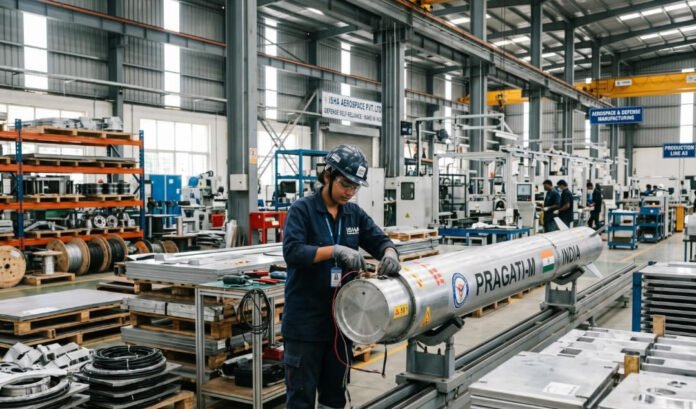
A new facility, being established by Mumbai-based Speed4 Defence Systems at Tulsibari in Rangia, is intended to manufacture equipment for the armed forces. At the November 25 foundation ceremony of the facility, Assam’s Chief Minister Himanta Biswa Sarma said a regional manufacturing base could help supply military units in the Northeast, where he stated that about one-fourth of India’s Army personnel are stationed.
The state government says the project will cover about 14 acres and begin with an investment of ₹50 crore. Production is targeted to start by January 2028. Planned products include drones, counter-drone systems, prefabricated structures and underground bunkers. The company’s chief executive said the equipment could be sold beyond Assam and India, though no export customers or agreements were announced.

Sarma’s argument rests on geography and logistics. The Northeast is strategically important, shares international borders and depends on transport links through the narrow Siliguri corridor to connect with the rest of India. A supplier located in Assam could, in principle, shorten some delivery routes for equipment and infrastructure products compared with sourcing them from distant manufacturing centres. But the plant’s actual contribution will depend on what the armed forces procure, where products are needed and how they are transported. The project announcement does not identify specific Army orders or delivery arrangements.
The proposed product mix points to a facility serving several kinds of requirements rather than a single weapons system. Prefabricated structures and protective infrastructure could support the establishment or upkeep of facilities; drones and counter-drone equipment represent a different technology category. The available announcements provide no detailed specifications, testing results or confirmed procurement volumes. They therefore establish the company’s stated production plans, not that any item has been approved for operational use.
The state government projects around 150 direct jobs in the initial phase, potentially rising to 500 as the plant reaches full capacity. It also expects local suppliers, small businesses and ancillary industries to participate. The Economic Times reported that the company aims for local suppliers and MSMEs to account for 25 to 30 per cent of production and supply-chain participation. That figure is a company plan, not a confirmed level of local sourcing already achieved.
The project also includes a proposed collaboration with the Indian Institute of Technology Guwahati on research and development. If developed into practical programmes, that partnership could link academic research with manufacturing, give students and researchers exposure to defence engineering challenges, and support the adaptation of technologies for production. Public reports, however, do not specify the projects, funding or timetable for the collaboration.

For Assam, the plant is being presented as an anchor investment in a larger industrial push. Sarma said the government was also discussing a dedicated defence park at Jagiroad, where land has reportedly been earmarked. The state has said it intends to amend its Aerospace and Defence Manufacturing Policy, 2025, to attract further investment. Those plans suggest an ambition to build a supply chain rather than rely on one factory, but discussions and policy changes are not the same as completed investments.
The broader challenge is converting a foundation ceremony into dependable output. The plant must be built, production must begin, and its products must meet military requirements before it can make a measurable difference to supply. Local employment and supplier participation will likewise depend on actual operations, not projections.

Sarma’s case is that locating manufacturing nearer to the Northeast’s military presence could improve access to selected equipment while creating industrial capacity in Assam. The Rangia project is an initial step toward that goal; its eventual value to the Army will be measured by delivery, quality and procurement, not by location alone.