

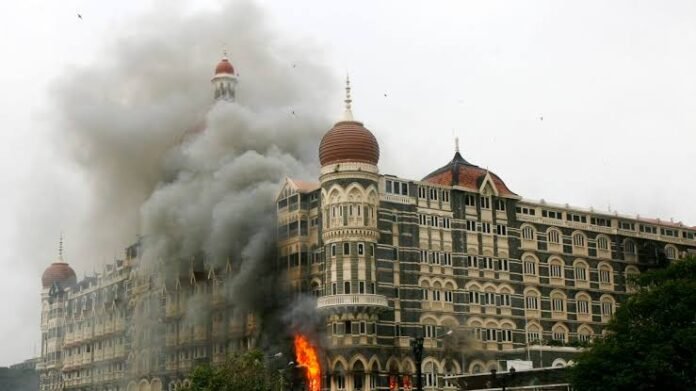
On the evening of November 26, 2008, ten-armed attackers reached Mumbai by sea after departing from Karachi and hijacking an Indian fishing vessel. They transferred to small boats, came ashore and split into teams. Their targets included Chhatrapati Shivaji Terminus, Leopold Cafe, the Taj Mahal Palace and Oberoi-Trident hotels, Cama Hospital and Nariman House.
A City Attacked from the Sea
The coordinated shootings, bombings and hostage-taking lasted roughly 60 hours, ending after security forces cleared the final site at the Taj. The attacks killed 166 people and injured hundreds; nine attackers died, while Ajmal Kasab was captured and later executed.

The operation exploited more than a coastline. It exposed gaps between agencies responsible for maritime surveillance, local policing and rapid response. Mumbai’s police were poorly equipped for a prolonged, multi-site siege, while the sea approach went undetected. The attackers’ use of ordinary maritime traffic and fishing craft made the security failure especially consequential: India’s coastline was not simply a perimeter to patrol, but a complex operating environment requiring shared information and coordinated action.
In the aftermath of 26/11, India replaced its fragmented coastal defences with a three-tier maritime patrol system, unified radar networks and joint operations centers linking the Navy, Coast Guard and marine police
From Fragmented Response to Layered Coastal Security
After 26/11, India strengthened coastal patrols and surveillance and formalised coordination among the Navy, Coast Guard, state marine police and other agencies. The government’s stated framework includes a three-tier maritime patrol system, greater technical surveillance, standard operating procedures for coordination, regular coastal-security exercises and involvement of coastal and fishing communities. A Coastal Surveillance Network links Navy and Coast Guard stations to improve maritime domain awareness and create a common operational picture.
These reforms address the attack’s clearest lesson: a sensor or patrol is useful, only if information reaches the right unit in time, and that unit can act. Yet, infrastructure alone cannot guarantee impermeability. India’s extensive coastline, busy ports and dense civilian maritime activity make constant monitoring difficult. The test is therefore not whether risk has vanished, but whether authorities can identify anomalies, share intelligence across jurisdictions and respond before a breach becomes a mass-casualty attack. The post-attack system is more layered than the patchwork described in assessments of 2008, but coordination and readiness remain ongoing tasks.
Marking the 18th anniversary, Air Chief Marshal Ashutosh Dixit contrasted 2008’s restraint with India’s current “new normal”, highlighting decisive cross-border retaliation like Operation Sindoor to deter future terror attacks
The Air Force Chief’s Blunt Comparison
On the 18th anniversary of the attack, Air Chief Marshal Ashutosh Dixit drew a sharp contrast between the response in 2008 and India’s current posture. “It happened in 2008, and we could not give a response,” he said, arguing that subsequent attacks had been met with a “befitting response.” He cited Operation Sindoor as the strongest example of the shift and described a “new normal” in which India seeks to deter terrorism through decisive action.

Air Chief’s remarks are a statement about political and military posture, not a claim that air power could have stopped the Mumbai gunmen as they attacked. The 2008 assault was a covert infiltration followed by urban violence and hostage-taking; its immediate demands were intelligence, police, command coordination and special-operations capability. Dixit’s point concerns the state’s response after an attack and the changed willingness to impose costs. That distinction matters: deterrence may shape an adversary’s calculations, but it does not replace prevention, investigation or preparedness on the ground.
External Affairs Minister S Jaishankar reiterated India’s zero-tolerance stance, underscoring ongoing global efforts to choke terror financing and hold state sponsors accountable at international forums
Jaishankar’s Message: Justice and Global Pressure
External Affairs Minister S Jaishankar’s anniversary message reiterated India’s commitment to combating terrorism “in all its forms and manifestations,” bringing those responsible to justice and maintaining “zero tolerance”. The wording echoes India’s longer diplomatic argument: terrorism must not be treated as a separate, negotiable instrument of statecraft, and those who support or enable it should face consequences. At the United Nations in September 2026, Jaishankar described state-sponsored cross-border terrorism as “a direct affront to the global order” and said governments involved must be held accountable.

India’s international approach has included pressing for UN sanctions designations against individuals and groups, seeking extradition and using multilateral forums to make terrorist financing and cross-border sponsorship a diplomatic issue. In 2022, India hosted the “No Money for Terror” ministerial conference, placing financing networks and international cooperation at the centre of its counter-terror agenda. India also requested Pakistan extradite Hafiz Saeed; Pakistan acknowledged receiving the request but cited the absence of a bilateral extradition treaty. These efforts can impose reputational and financial costs, but they do not automatically produce arrests, convictions or cooperation from the accused person’s country of residence.
Despite domestic terror-financing sentences in Pakistan, Lashkar-e-Taiba founder Hafiz Saeed has not been tried or extradited for the 26/11 conspiracy, leaving the pursuit of full legal justice incomplete
Hafiz Saeed and the Accountability Gap
The status of Hafiz Saeed, the founder of Lashkar-e-Taiba, which India blames for the attacks, remains central to that gap. Pakistani courts sentenced him on terrorism-financing charges, including a 31-year term in 2022, and he has been reported as imprisoned in Lahore. India has sought his extradition, while Pakistan has rejected the request on treaty grounds. The legal convictions in Pakistan are not a trial for the Mumbai conspiracy, and Saeed’s continued public profile and the reported freedom of other accused or alleged conspirators keep the question of meaningful accountability alive. Claims about the precise current status of every co-conspirator should be treated cautiously: arrest, prosecution and conviction are distinct, and news reports do not always establish which applies.
A Tougher Doctrine, Unfinished Work
India’s response to 26/11 has evolved across two tracks: reducing vulnerabilities at home and increasing the costs it says it will impose after cross-border attacks. The first depends on everyday capacity, intelligence-sharing, trained police, coastal monitoring, emergency command and resilient public institutions. The second depends on calibrated decisions under the risk of escalation, as well as sustained diplomatic efforts to isolate networks and secure prosecutions.
Eighteen years later, India pairs an assertive retaliatory doctrine with upgraded coastal infrastructure, yet true deterrence still relies on seamless intelligence-sharing and everyday institutional readiness
The government’s response has been practical as well as doctrinal. At sea, it put in place a three-tier security arrangement: the Navy leads overall maritime security, the Coast Guard coordinates in territorial waters, and state marine police cover shallow coastal areas. It increased coordinated patrols and surveillance, established agency-specific operating procedures, and expanded electronic monitoring through coastal and offshore radar chains, vessel-identification systems and long-range tracking.
It also created Joint Operations Centres at Mumbai, Visakhapatnam, Kochi and Port Blair, and established the Information Management and Analysis Centre in Gurugram to collate maritime information and help agencies build a shared operational picture. The Information Fusion Centre-Indian Ocean Region, launched in 2018, extends information-sharing with partner countries. Nationwide exercises such as Sea Vigil test coordination among the Navy, Coast Guard, marine police and other agencies; coastal communities and fishers are included in efforts to identify suspicious activity.
The anniversary’s language of resolve is politically potent, but deterrence cannot be measured by rhetoric alone. Its credibility rests on prevention, accurate attribution, lawful accountability and the ability to protect civilians without allowing terrorism to dictate policy. Eighteen years on, India has built a more integrated coastal-security architecture and adopted a more assertive response doctrine. The enduring challenge is ensuring those changes translate into reliable security, and that justice reaches beyond the lone gunman captured alive in Mumbai.

-The writer is a New Delhi-based senior commentator on international and strategic affairs, environmental issues, an interfaith practitioner, and a media consultant. The views expressed are personal and do not necessarily carry the views of Raksha Anirveda