


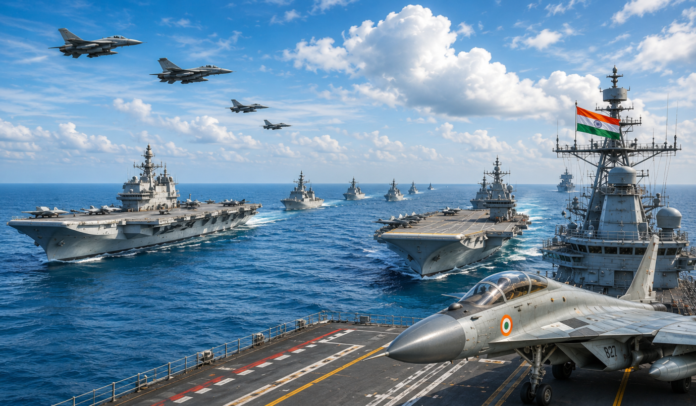
As India marks the first anniversary of Operation Sindoor, the debate is no longer merely about what was achieved during the operation. The larger strategic question now emerging is where the next phase of Indian military deterrence may unfold if another major confrontation is imposed upon the nation. Increasingly, the answer appears to lie not on the mountains of the Northern frontier, but in the waters of the Arabian Sea.
Over the last decade, India’s military doctrine has evolved from reactive defence to calibrated punitive capability. Surgical strikes, Balakot, integrated air-land responses, and maritime deployments have collectively demonstrated that New Delhi now seeks flexible options across multiple theatres. Future conflict, therefore, may not begin with massive troop mobilisation along the border. It may instead commence through naval positioning, maritime surveillance, cyber disruption, and long-range precision signalling from the sea.

The Arabian Sea today represents far more than a geographic space between India and Pakistan. It is the economic artery of Pakistan, the strategic gateway of Chinese maritime ambitions, and the operational theatre where India enjoys a distinct advantage in naval reach and power projection. In any future escalation, maritime dominance may become the instrument through which India imposes strategic pressure without immediately crossing into the risks of prolonged continental warfare.
The first anniversary of Operation Sindoor, therefore, arrives at a significant strategic moment. It compels India’s strategic community to examine whether the next decisive theatre of conflict in South Asia could be maritime rather than territorial.
Naval deployment allows coercive pressure without immediate territorial occupation. Warships can remain positioned for extended durations while retaining flexibility for escalation or de-escalation. Maritime power can influence trade routes, energy flows, and economic confidence without triggering immediate large-scale battlefield casualties. This makes the Arabian Sea particularly attractive in strategic terms
Uri to Balakot to Operation Sindoor
India’s response doctrine has undergone a visible transformation since the Uri attack of 2016. For decades, India largely remained constrained by strategic restraint despite repeated provocations. The fear of escalation, international pressure, and nuclear overhang often prevented overt military retaliation.
That paradigm gradually shifted with the surgical strikes across the Line of Control after Uri. The Balakot air strikes further expanded the spectrum by demonstrating India’s willingness to use air power across recognised boundaries in response to terrorism. Operation Sindoor subsequently reflected another stage in this evolution — one that integrated multiple military instruments while simultaneously maintaining escalation control.

This progression is strategically important because it reflects political willingness to employ force in calibrated ways rather than through full-scale conventional war. India is increasingly shaping a doctrine based on precision, signalling, speed, and controlled coercion.
Why Escalation Geography is Changing
The geography of conflict is also changing alongside doctrine. Traditional continental confrontation imposes severe costs. Large troop mobilisation is slow, expensive, diplomatically visible, and inherently escalatory. Mountain warfare and armoured offensives carry high attrition with uncertain political gains.

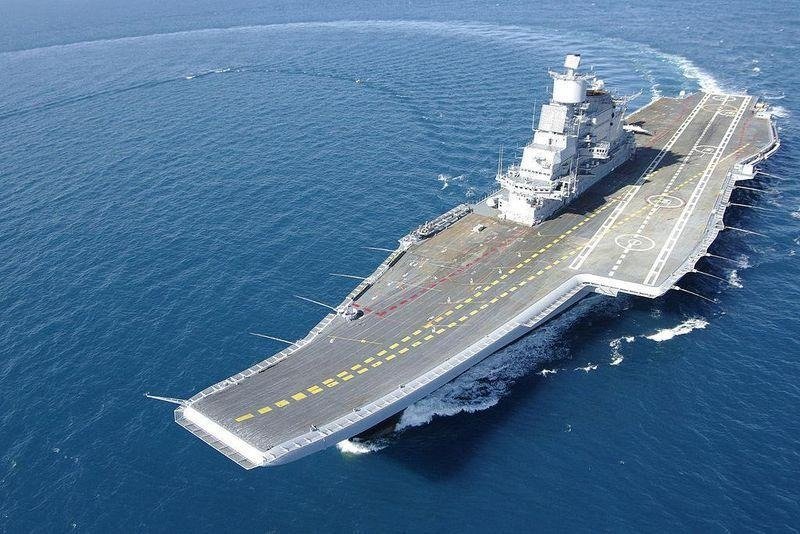
The Arabian Sea offers India a theatre where military leverage can generate disproportionate strategic effect. India enjoys considerable geographic and operational advantages in the Arabian Sea. The Western Naval Command, supported by carrier battle groups, long-range maritime patrol aircraft, nuclear and conventional submarines, and missile-equipped destroyers, provides India with a credible sea-control capability
The maritime domain offers a different strategic calculus. Naval deployment allows coercive pressure without immediate territorial occupation. Warships can remain positioned for extended durations while retaining flexibility for escalation or de-escalation. Maritime power can influence trade routes, energy flows, and economic confidence without triggering immediate large-scale battlefield casualties.
This makes the Arabian Sea particularly attractive in strategic terms. Unlike land borders that are heavily militarised and constantly monitored, maritime space provides operational ambiguity and manoeuvre flexibility. Naval signalling can impose pressure gradually while preserving political options.
Future crises may therefore witness the opening moves occurring at sea long before visible troop movements dominate headlines.
Why the Arabian Sea Matters More Than Ever
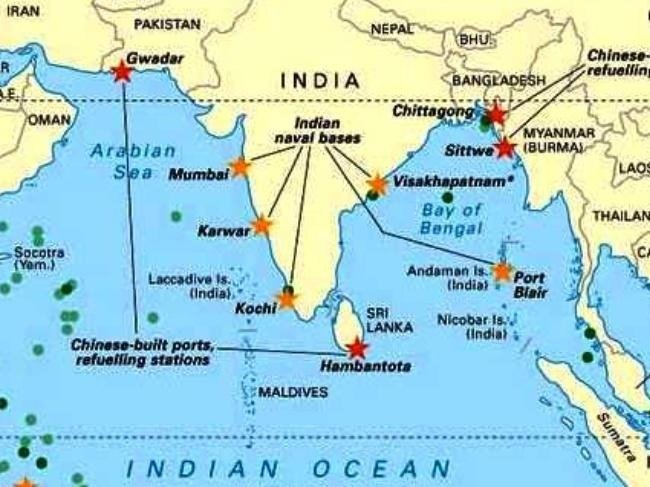
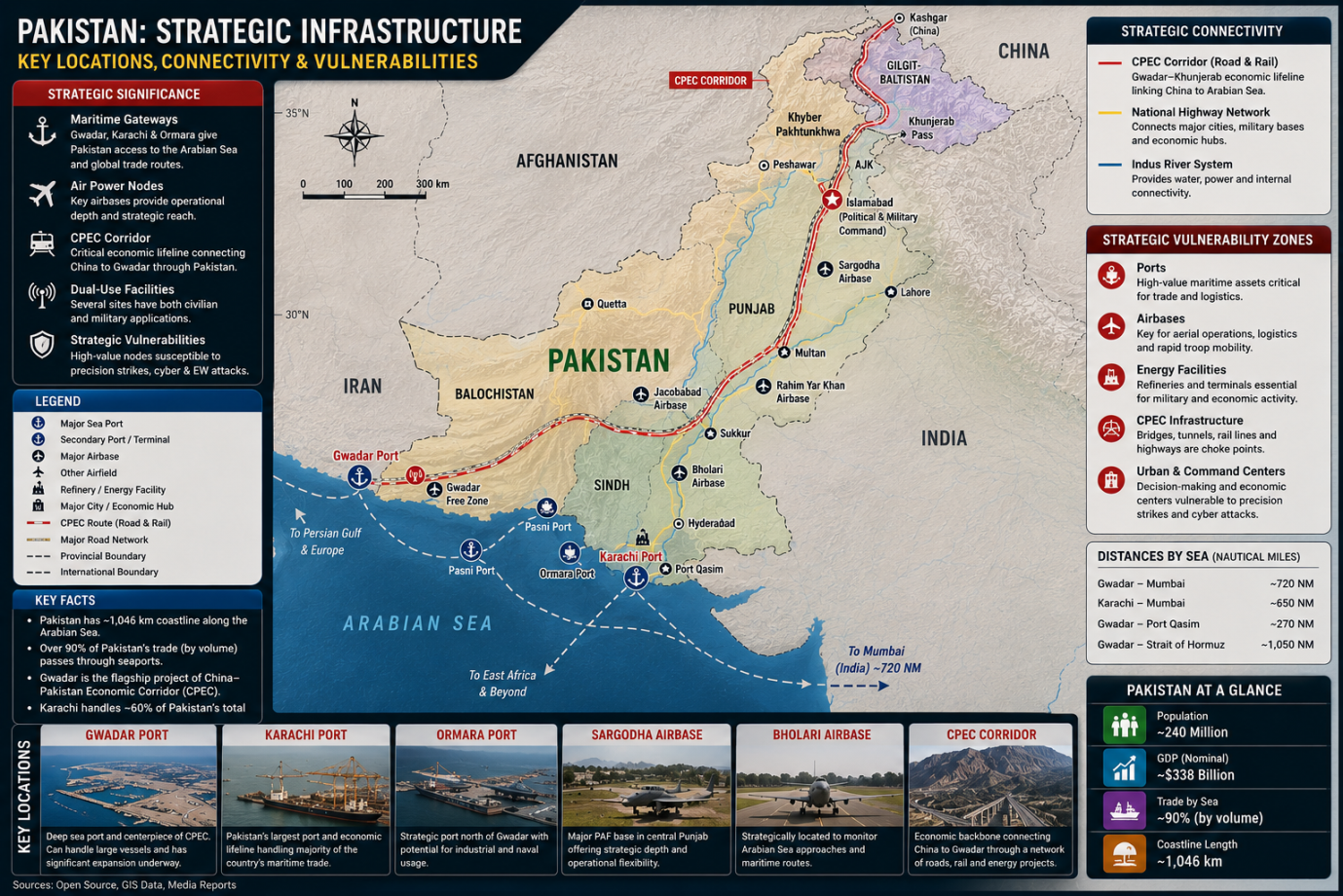
Pakistan’s Economic Vulnerability at Sea. Pakistan’s strategic vulnerability is deeply tied to the Arabian Sea. Karachi remains the country’s principal commercial and naval hub, while Gwadar has emerged as a critical node within the China–Pakistan Economic Corridor framework. A substantial portion of Pakistan’s fuel imports, maritime trade, and economic connectivity depends upon uninterrupted access to these sea lanes.
This creates a structural vulnerability. Any sustained maritime pressure during conflict could severely affect Pakistan’s economic stability, logistics chain, and energy security. Unlike territorial losses that may remain geographically contained, disruption at sea has nationwide economic consequences.
In strategic theory, economic strangulation often produces greater long-term pressure than limited territorial gains. The Arabian Sea, therefore, offers India a theatre where military leverage can generate disproportionate strategic effect.
India’s Geographic Advantage. India enjoys considerable geographic and operational advantages in the Arabian Sea. The Western Naval Command, supported by carrier battle groups, long-range maritime patrol aircraft, nuclear and conventional submarines, and missile-equipped destroyers, provides India with a credible sea-control capability.
India’s peninsular geography naturally projects power into the Northern Indian Ocean. Naval bases on the Western coast allow rapid deployment and sustainment. At the same time, India’s maritime surveillance capabilities have expanded significantly through satellite integration, airborne reconnaissance, and network-centric systems.
This creates a strategic asymmetry in India’s favour. While Pakistan possesses capable naval assets, it lacks comparable depth, reach, and sustainment capability in prolonged maritime confrontation.
The Arabian Sea can no longer be viewed purely through the prism of India-Pakistan rivalry. The expanding Chinese strategic footprint has fundamentally altered the region’s geopolitical character. Gwadar port, developed under the China-Pakistan Economic Corridor, is not merely an infrastructure project. It represents China’s long-term attempt to secure strategic access to the Arabian Sea and the wider Indian Ocean Region
The Energy Lifeline Factor. The Arabian Sea is not merely a military theatre; it is an energy corridor of global importance. Oil shipments from the Gulf traverse these waters before reaching South Asia and beyond. Any instability immediately affects shipping insurance, investor confidence, and energy pricing. Control over maritime space, therefore, translates into economic influence. Even limited naval signalling can alter regional strategic calculations.
At the same time, India itself remains dependent upon Gulf energy imports. This imposes a balancing factor. India’s objective in any maritime crisis would likely not be indiscriminate disruption but calibrated pressure designed to retain escalation dominance while avoiding uncontrolled regional instability.
That balance between coercion and restraint is precisely why maritime strategy is becoming central to modern Indian deterrence.
The Silent Rise of India’s Maritime Doctrine
From Coastal Defence to Blue Water Strategy. For decades after independence, India’s military focus remained overwhelmingly continental. The traumatic experiences of Partition, repeated wars with Pakistan, and the long Himalayan frontier with China ensured that the Army dominated strategic planning and defence expenditure.
The Indian Navy largely operated within a defensive coastal framework despite important successes during the 1971 war. However, the rise of China, the expansion of Indo-Pacific competition, piracy threats, and growing economic dependence on maritime trade gradually transformed Indian thinking.
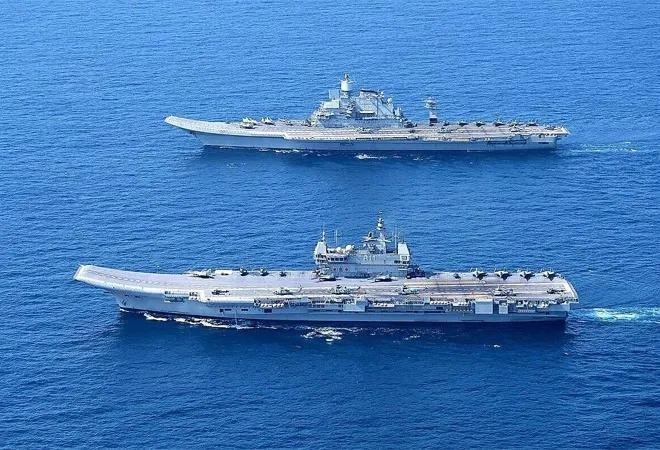
India today increasingly aspires to function as a blue-water naval power capable of sustained operations across the Indian Ocean Region. Aircraft carriers, long-range submarines, anti-ship missile systems, and overseas strategic partnerships now form part of a wider maritime doctrine aimed at securing influence far beyond coastal defence.
Operation Sindoor reinforced this shift by demonstrating that maritime deployment is no longer supplementary to continental operations. It is becoming central to strategic signalling itself.
Sea Denial and Sea Control. India’s emerging doctrine combines two interconnected concepts — sea denial and sea control.
- Sea Denial seeks to prevent an adversary from operating freely within contested waters. Submarines, anti-ship missiles, drones, and maritime strike aircraft become critical tools in this approach.
- Sea Control, by contrast, aims to dominate the maritime environment sufficiently to secure one’s own movement, logistics, and strategic freedom.
In the Arabian Sea, India possesses growing capability in both dimensions. This dual capability gives policymakers multiple options during crisis management — ranging from silent surveillance to visible coercive deployment.
The future battlefield in South Asia may therefore not be defined only by tanks crossing borders or fighter aircraft engaging overhead. It may increasingly be determined by which side controls information, surveillance networks, undersea positioning, and maritime access corridors.
The China Factor Behind the Arabian Sea Equation
Gwadar and the Strategic Arc of the Indian Ocean. The Arabian Sea can no longer be viewed purely through the prism of India-Pakistan rivalry. The expanding Chinese strategic footprint has fundamentally altered the region’s geopolitical character. Gwadar port, developed under the China-Pakistan Economic Corridor, is not merely an infrastructure project. It represents China’s long-term attempt to secure strategic access to the Arabian Sea and the wider Indian Ocean Region.
India is simultaneously strengthening infrastructure in the Andaman and Nicobar Islands while improving surveillance across critical sea lanes. The objective is clear: maintain maritime awareness and strategic flexibility across the broader Indian Ocean. The Arabian Sea, therefore, forms part of a much larger strategic chessboard where regional conflict and great-power competition increasingly overlap
For Beijing, Gwadar reduces dependence on vulnerable Eastern maritime chokepoints, while simultaneously extending Chinese strategic reach closer to the Gulf region. For Pakistan, Chinese investment provides economic and military reassurance against India. But for New Delhi, Gwadar represents the gradual emergence of a potential dual-use strategic facility barely a few hundred kilometres from India’s Western seaboard.
The maritime domain has therefore become deeply interconnected with the larger Indo-Pacific contest.
The Two-Front Maritime Challenge. India’s traditional two-front concern historically referred to simultaneous pressure from Pakistan and China along land borders. That concern is now increasingly maritime as well.
In a future crisis, India cannot entirely discount the possibility of coordinated strategic pressure in the Indian Ocean Region. Even indirect Chinese naval presence or intelligence support could complicate operational calculations in the Arabian Sea.
This is why Indian naval modernisation today is not only about Pakistan. It is equally about ensuring credible deterrence against extra-regional influence within India’s primary maritime sphere.
Indian Response to Maritime Encirclement. India’s response has steadily evolved through multiple layers. Strategic partnerships with the QUAD nations, enhanced logistics agreements with friendly navies, and growing operational cooperation across the Indo-Pacific reflect New Delhi’s effort to prevent maritime isolation.
Simultaneously, India is strengthening infrastructure in the Andaman and Nicobar Islands while improving surveillance across critical sea lanes. The objective is clear: maintain maritime awareness and strategic flexibility across the broader Indian Ocean.
The Arabian Sea, therefore, forms part of a much larger strategic chessboard where regional conflict and great-power competition increasingly overlap.
Drones, Missiles and the New Maritime Battle-space
The Rise of Unmanned Naval Warfare. The future maritime battle-space will not be dominated solely by large warships. It will increasingly involve autonomous systems, underwater drones, loitering munitions, AI-enabled surveillance, and long-range unmanned strike platforms. Operation Sindoor already reflected the growing importance of drones in surveillance, targeting, and precision engagement. In the next phase of warfare, unmanned systems may become even more central to maritime operations.
Naval drones can monitor shipping lanes, detect submarine activity, gather electronic intelligence, and conduct precision strikes with lower political risk and reduced human exposure.
This transformation is altering the very nature of naval power.
Precision Strike Capability at Sea. India’s growing missile capability significantly strengthens maritime deterrence. Long-range precision systems capable of targeting naval assets, ports, and logistics infrastructure create strategic pressure without requiring full-scale invasion.
The Arabian Sea offers an ideal environment for such a stand-off capability. Warships positioned at sea provide mobility, survivability, and unpredictability. Combined with space-based surveillance and real-time targeting networks, precision strike capability allows calibrated coercion at multiple levels.
Modern conflict is increasingly about disabling systems rather than occupying territory. Maritime warfare perfectly complements that logic.
Cyber and Electronic Warfare in Naval Conflict. The next maritime confrontation may begin invisibly. Cyber disruption, satellite interference, electronic warfare, and communication denial could precede any visible military engagement.
Naval platforms today are heavily dependent on digital integration. Ships, drones, aircraft, logistics chains, and missile systems operate through interconnected information networks. Disrupting those networks can produce operational paralysis without firing the opening kinetic shot.
Future conflict in the Arabian Sea, therefore, may involve simultaneous contests across physical, cyber, electronic, and space domains.
Why a Maritime Strategy Is Geopolitically Conducive
Escalation Without Immediate Territorial Occupation. One of the greatest advantages of maritime strategy lies in escalation management. Naval deployment allows governments to demonstrate resolve without immediately entering the politically dangerous territory of territorial conquest or prolonged land war.
Warships positioned in strategic waters create pressure while preserving room for diplomacy. This flexibility is particularly valuable in a nuclearised environment like South Asia, where uncontrolled escalation remains a constant concern.
Maritime coercion, therefore, provides policymakers with an intermediate option between symbolic protest and total war.
Economic Pressure Without Full-Scale War. Modern warfare increasingly targets economic resilience rather than merely battlefield destruction. The ability to threaten shipping routes, energy access, and trade connectivity creates strategic leverage without necessarily engaging in sustained combat.
For India, this approach aligns with broader strategic objectives. It enables pressure on adversarial infrastructure while minimising the enormous costs associated with prolonged continental operations.
In many ways, maritime strategy reflects the changing character of 21st-century conflict — where economics, logistics, technology, and information are as decisive as territorial control.
The Domestic Political Dimension. There is also a domestic political factor. Public expectations in India have changed considerably after Uri, Balakot, and Operation Sindoor. There now exists a strong expectation that major provocations must invite a visible and credible response.
Maritime power offers an effective instrument for such signalling. Aircraft carriers, submarines, missile destroyers, and naval deployments project national confidence and strategic reach. They symbolise state capacity without immediately creating images of prolonged battlefield casualties.
This makes maritime coercion politically sustainable during limited crises.
Risks of an Arabian Sea Escalation
Threat to Global Shipping and Energy Routes. Despite its advantages, maritime escalation carries substantial risks. The Arabian Sea is one of the world’s most critical commercial corridors. Any instability affects global shipping, energy markets, insurance rates, and investor confidence.
Even limited confrontation could create ripple effects far beyond South Asia, drawing concern from Gulf nations, global powers, and international markets.
Nuclear Signalling Risks. Pakistan’s strategic doctrine has historically relied upon asymmetric escalation to offset conventional imbalance. Sustained maritime pressure against critical economic infrastructure could potentially trigger dangerous signalling dynamics.
This makes crisis management extremely sensitive. The challenge for India would be to maintain strategic dominance without crossing thresholds that create uncontrolled escalation pressure.
Danger of External Intervention. A major crisis in the Arabian Sea would inevitably attract external diplomatic and strategic intervention. The United States, China, Gulf powers, and European stakeholders all possess strong interests in maritime stability and uninterrupted energy flows.
This means future conflict may unfold under intense international scrutiny and pressure for rapid de-escalation.
What Operation Sindoor 2.0 Could Actually Look Like
Multi-Domain Opening Moves. If a future Operation Sindoor 2.0 were ever undertaken, it would likely begin through integrated multi-domain activity rather than immediate large-scale combat.
The opening phase could involve cyber disruption, intensified maritime surveillance, drone deployment, electronic warfare activity, and forward naval positioning in the Arabian Sea.
Such actions would seek to establish information dominance and psychological pressure before overt escalation.
Despite its advantages, maritime escalation carries substantial risks. The Arabian Sea is one of the world’s most critical commercial corridors. Any instability affects global shipping, energy markets, insurance rates, and investor confidence. Even limited confrontation could create ripple effects far beyond South Asia, drawing concern from Gulf nations, global powers, and international markets
Strategic Isolation Rather Than Occupation. The central objective may not be territorial conquest. Instead, it could focus on strategic isolation — restricting operational flexibility, imposing economic costs, and demonstrating escalation dominance.
This reflects the broader evolution of modern warfare, where strategic effect increasingly matters more than physical occupation.
Limited Duration High-Intensity Operations. Future operations are also likely to be shorter, sharper, and technologically intensive. Long-duration wars impose severe economic and diplomatic costs on all sides.
The emphasis will remain on punitive precision operations combined with rapid de-escalation mechanisms.
The Arabian Sea May Shape Op Sindoor 2.0
The Centre of Gravity is Shifting Seaward. The strategic centre of gravity in South Asia is gradually shifting towards the maritime domain. Future conflict may increasingly revolve around sea lanes, energy security, cyber capability, drones, satellites, and economic coercion rather than purely territorial offensives.
The Arabian Sea is emerging as the theatre where military power, economic vulnerability, and geopolitical competition intersect simultaneously.
India’s Naval Moment has Arrived. For decades, the Indian Navy remained secondary within the national strategic discourse. That phase is changing rapidly. The requirements of Indo-Pacific competition, Chinese expansion, and modern deterrence are pushing maritime power to the forefront of Indian strategy.
If the coming decade belongs to technological and maritime competition, then India’s naval modernisation may become as critical as its continental defence posture.
Final Strategic Thought. The first anniversary of Operation Sindoor, therefore, carries significance beyond remembrance. It marks a transition in strategic thinking itself.
In the next major crisis, the Arabian Sea may not simply support the conflict. It may shape the outcome before armies fully engage.

Lt Gen Rajeev Chaudhry (Retd) writes on contemporary national and international issues, strategic implications of infrastructure development towards national power, geo-moral dimension of international relations, and leadership nuances in a changing social construct. The views expressed are of the author and do not necessarily reflect the views of Raksha Anirveda





