


Tel Aviv: Political considerations may affect the Japanese decision on the acquisition of UAVs. Israeli-made UAVs are favoured by the Japanese armed forces, but criticism about Israeli operations in Gaza may result in the selection of another system.
As part of its military modernisation efforts, Japan has been aggressively assessing Israeli UAVs, especially to improve ISR capabilities and relieve manpower shortages.

Five contracts for multipurpose and small attack UAVs intended for search, identification, and quick airborne reaction were given to Israeli businesses by Japan’s Ministry of Defence in 2024, which set aside $64 million for UAV verification testing.
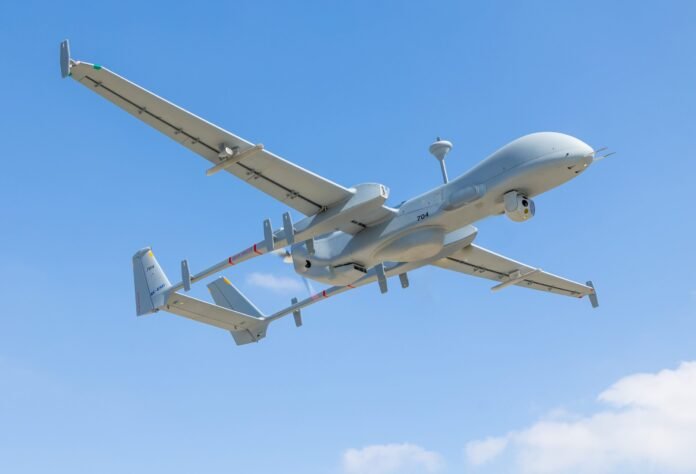
The first known test of an Israeli military platform on Japanese territory occurred in August 2025 when a Heron-Mk 2 UAV from Israel Aerospace Industries (IAI) with Israeli registration and Kawasaki Heavy Industries markings was seen on camera at a Japanese airport. The Heron-2, a long-range, high-altitude drone for ISR, was evaluated against rivals such as Turkey’s Bayraktar TB2, which Kawasaki may produce locally.
Japan’s FY2026 budget called for spending $690 million on drone purchases, specifically taking into account Turkish and Israeli Heron-Mk 2 possibilities to replace outdated equipment like the Apache fleet. Due to regional concerns in the Western Pacific, Japan, which has historically relied on US equipment, is diversifying.
There is currently no verified large-scale purchase of Israeli UAVs; assessments are ongoing, but transactions have been hindered by political pressures and alternatives such as Ukrainian, Australian, or Turkish. Joint development agreements exist, indicating possible future cooperation, and Japan has previously purchased Israeli defence components.

Japan tested and budgeted for Israeli UAVs like the Heron- Mk 2 through 2025-2026, but has not completed a full purchase amid public backlash and competing options.
The Heron Mk 2 is used extensively by the Israeli air force, and recently, another squadron has been formed to meet operational needs.


-The writer is an Israel-based freelance journalist. The views expressed are of the writer and do not necessarily reflect the views of Raksha Anirveda





