


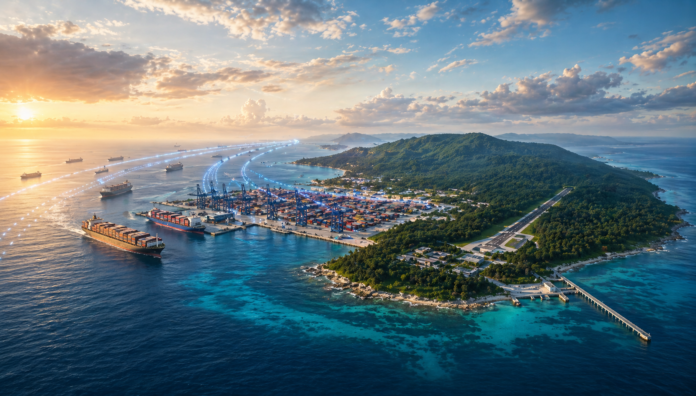
The Economics of Geography: India’s Missed Maritime Advantage: India handles over 1.6 billion tonnes of cargo annually across its ports, yet remains a minor player in global trans-shipment economics. Despite being the world’s fifth-largest economy and a major trading nation, India has historically failed to convert its geographic advantage into maritime economic power.
Nearly 30–35% of India’s container traffic is trans-shipped, and of this, an estimated 70–75% is handled at foreign ports, primarily Singapore, Colombo and Port Klang. This structural gap results in both direct financial losses and indirect economic inefficiencies.

Geographically, India sits adjacent to the East–West shipping corridor, which carries a substantial share of global container trade between Asia, Europe and the Middle East. Yet, most Indian cargo is first routed away from its natural path before being reintegrated into global routes via foreign hubs.
Great Nicobar changes this equation.
Located just 150–200 nautical miles from the Strait of Malacca, one of the busiest maritime chokepoints in the world, it lies directly along the trajectory of global shipping. Unlike mainland ports, which require deviations of several hundred nautical miles, Great Nicobar offers a near-zero diversion advantage.
In economic terms, this translates into:

- Lower fuel costs for shipping lines.
- Reduced turnaround time.
- Higher attraction for mainline vessels.
For the first time, India has the opportunity to align its geography with global trade flows. The question is no longer whether India has the location, but whether it can monetise it effectively.
India’s Trans-shipment Deficit: The Cost of Dependence
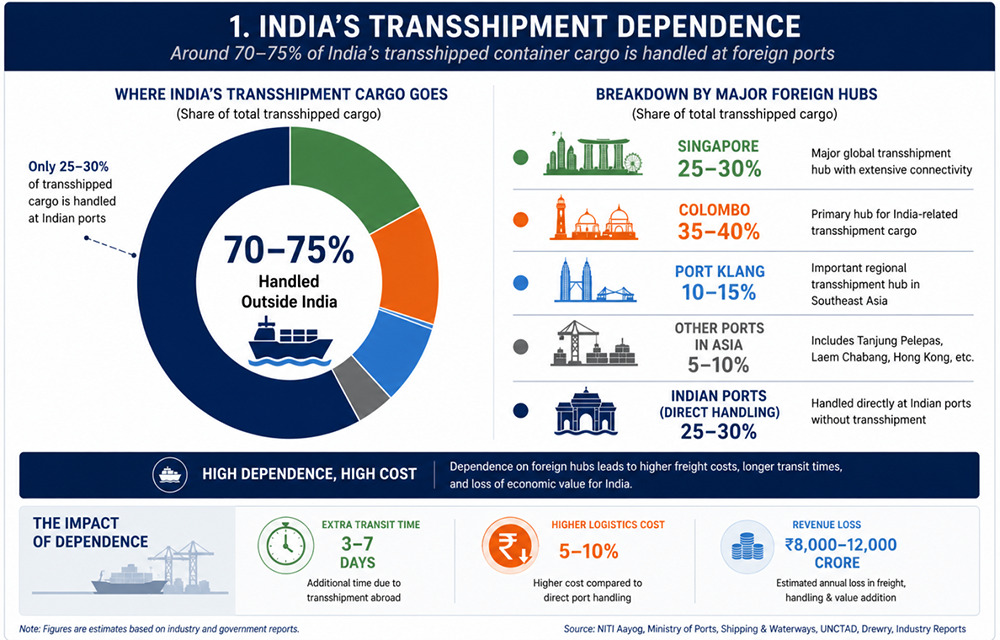
The majority of India’s container cargo continues to be transhipped through foreign ports

India’s reliance on foreign trans-shipment hubs is not a marginal inefficiency; it is a systemic economic drain.
Of India’s total container throughput of approximately 20–22 million TEUs (twenty-foot equivalent units) annually, nearly 75% of trans-shipped cargo is handled outside the country. Colombo alone handles a significant share of India-linked containers, with Indian cargo accounting for 60–70% of its trans-shipment volume.
Nearly 30-35% of India’s container traffic is trans-shipped, and of this, an estimated 70-75% is handled at foreign ports, primarily Singapore, Colombo and Port Klang. This structural gap results in both direct financial losses and indirect economic inefficiencies
Singapore, the world’s largest trans-shipment hub, handled over 37 million TEUs in 2022, much of it linked to regional trade, including India. Port Klang in Malaysia also captures a steady share of Indian cargo flows.
The implications are threefold:
- Revenue Loss: India loses substantial port revenues, estimated in billions of dollars over time, as handling charges, storage fees, and associated logistics income accrue to foreign ports.
- Higher Logistics Costs: India’s logistics costs remain at 13–14% of GDP, significantly higher than global benchmarks of 8–9%. Trans-shipment inefficiencies contribute directly to this gap.
- Time Delays: Routing cargo via foreign hubs increases transit time by 3–7 days, affecting supply chain efficiency, particularly for time-sensitive exports.
More critically, this dependence creates structural vulnerability. In times of geopolitical disruption or congestion, India’s trade flows remain exposed to decisions taken outside its control.
The absence of a major domestic trans-shipment hub is therefore not just a logistical shortcoming — it is an economic constraint on India’s global competitiveness.
Great Nicobar: A Natural Economic Interceptor
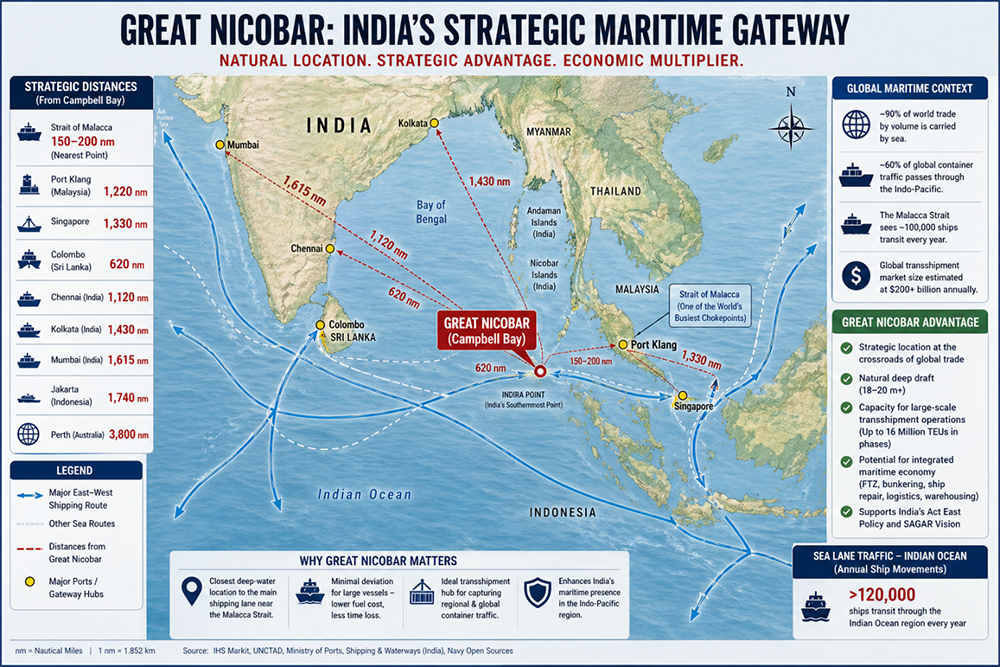
Great Nicobar at the crossroads of global sea lanes
The proposed International Container Trans-shipment Port (ICTP) at Great Nicobar is designed to address this structural gap by leveraging geography, scale and modern infrastructure.
The project is planned with a capacity of up to 16 million TEUs in phases, placing it in the league of major global ports. For comparison:
- Colombo handles ~7–8 million TEUs
- Port Klang ~13 million TEUs
- Singapore ~37 million TEUs
Even partial realisation of this capacity would significantly alter India’s maritime position.
Key Economic Advantages
1. Minimal Deviation Cost: Shipping lines prefer ports that require minimal deviation from main routes. Great Nicobar’s proximity to Malacca offers a closer on-route location, unlike mainland ports that require detours.
2. Deep Natural Draft: The availability of natural depths exceeding 18–20 metres reduces dredging costs and allows accommodation of ultra-large container vessels (ULCVs), which dominate global shipping economics.
3. Hub-and-Spoke Model Integration: The port can function as a mother port, with feeder services connecting to:
- Chennai
- Vizag
- Kolkata
- Paradip
- And Southeast Asian ports
This aligns with global shipping models, where large vessels dock at hub ports, and smaller ships distribute cargo regionally.
4. Scale Efficiency: Modern ports derive advantage from scale. Higher throughput reduces per-unit handling cost, making the port more competitive.
Economic Potential
If Great Nicobar captures even 20–25% of India’s trans-shipment traffic, it could:
- Save significant foreign exchange
- Reduce logistics costs
- Generate substantial port revenues
For decades, India participated in global trade without controlling the infrastructure that underpins it. Its cargo has flowed through foreign hubs, and its logistics costs have remained elevated. The development of a trans-shipment hub at Great Nicobar signals a departure from this pattern
Beyond direct earnings, the port has the potential to anchor a maritime economic cluster, multiplying its economic impact across sectors.
At its core, the logic is simple:
Great Nicobar does not need to generate demand — it needs to intercept it.
Economic Multipliers: From Port to Maritime Economy
A trans-shipment port of the scale envisaged at Great Nicobar is not merely a logistics facility — it is a platform for layered economic activity. Globally, successful port ecosystems demonstrate that the majority of value is generated not at the quay, but in the ancillary economy that surrounds it.
The proposed Great Nicobar project, with an estimated investment exceeding ₹70,000 crore, is expected to catalyse a range of economic sectors:
- Logistics and Warehousing: Modern ports operate as integrated logistics hubs. Container storage, consolidation, and redistribution facilities can significantly enhance efficiency. Globally, logistics services account for 20–30% of total port-related economic value.
- Free Trade and Industrial Zones: Ports such as Singapore and Dubai have demonstrated how free trade zones (FTZs) can drive manufacturing and re-export industries. India’s experience with SEZs suggests that proximity to ports reduces export costs by 5–10%, improving competitiveness.
- Bunkering and Marine Services: The global bunkering market is estimated at over $150 billion annually. Singapore alone sells over 45 million tonnes of marine fuel per year. A strategically located bunkering hub at Great Nicobar could capture a share of vessels transiting the Malacca corridor.
- Ship Repair and Maintenance: Ship repair is a high-value segment, with Asia dominating the market. Even a modest facility at Great Nicobar can tap into vessels requiring maintenance along one of the busiest sea routes.
- Employment and Skill Creation: Large ports generate significant employment multipliers. Studies suggest that one million TEUs of port capacity can generate 3,000–5,000 direct and indirect jobs. At full capacity, Great Nicobar could support tens of thousands of jobs across logistics, engineering, and services.
The global bunkering market is over $150 billion annually. Singapore alone sells over 45 million tonnes of marine fuel per year. A strategically located bunkering hub at Great Nicobar could capture a share of vessels transiting the Malacca corridor
The cumulative impact of these activities is substantial. Ports like Singapore derive a significant portion of their GDP from maritime services, estimated at over 7% of national GDP.
For India, the Great Nicobar project represents an opportunity to replicate such a model on its eastern maritime frontier, transforming a remote island into a multi-sector economic engine.
Competing with Global Hubs: Reality and Opportunity
Entering the trans-shipment domain places Great Nicobar in direct competition with some of the most efficient ports in the world.
Benchmarking the Competition
Singapore
- Throughput: ~37 million TEUs
- Global leader in efficiency and connectivity
Colombo
- Throughput: ~7–8 million TEUs
- Handles a large share of India-related cargo
Port Klang (Malaysia)
- Throughput: ~13 million TEUs
- Strong regional integration
With Asia dominating the ship repair market, even a modest facility at Great Nicobar can tap into vessels requiring maintenance along one of the busiest sea routes
These ports benefit from decades of infrastructure development, regulatory efficiency, and established shipping networks. Shipping lines prefer reliability, predictability, and cost efficiency — areas where new ports often struggle initially.
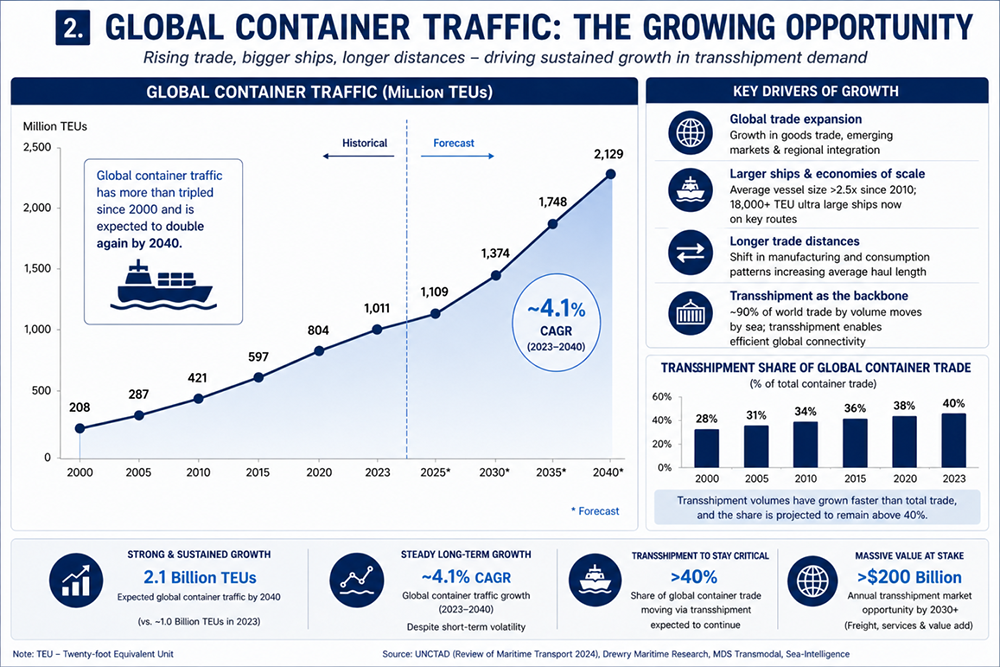
Where Great Nicobar Can Compete
Despite this competition, Great Nicobar holds structural advantages:
- Location Advantage: Unlike Colombo, which depends heavily on Indian cargo, Great Nicobar sits directly along global shipping routes, offering a natural interception advantage.
- Capacity for Scale: Planned capacity of up to 16 million TEUs positions it among major regional players, enabling economies of scale.
- Sovereign Control: India can align policy, tariffs, and infrastructure development to support national economic objectives without external dependencies.
The Execution Challenge
However, success is not guaranteed. Key factors will determine competitiveness:
- Turnaround time (global benchmark: <24 hours)
- Cost efficiency vs Singapore/Colombo
- Ease of doing business and customs clearance
- Integration with the domestic port network
Without operational excellence, geographic advantage alone will not suffice.
In essence, Great Nicobar has the potential to compete — but must earn its place through performance.
Conclusion: India’s Maritime Economic Inflection Point

Great Nicobar represents a rare convergence of geography, economics and timing.
For decades, India has participated in global trade without controlling the infrastructure that underpins it. Its cargo has flowed through foreign hubs, its logistics costs have remained elevated, and its maritime potential has been underutilised.
The development of a trans-shipment hub at Great Nicobar signals a departure from this pattern. It reflects an understanding that in a globalised economy, control over logistics nodes translates into economic advantage.
The margin for error is narrow. Ports succeed not because they are built, but because they are used. Operational efficiency, policy support, and private sector participation will be decisive
The timing is equally significant. The Indo-Pacific has emerged as the centre of global economic activity, with Asia accounting for a dominant share of container traffic. As supply chains evolve and shipping patterns adjust, new hubs have the opportunity to emerge — provided they combine location with efficiency.
Great Nicobar offers precisely such a possibility.
If executed effectively, the project can:
- Reduce India’s dependence on foreign ports
- Lower logistics costs
- Capture a greater share of maritime value
- Stimulate regional economic development
However, the margin for error is narrow. Ports succeed not because they are built, but because they are used. Operational efficiency, policy support, and private sector participation will be decisive.
Ultimately, the economic argument is straightforward:
Great Nicobar is not about creating trade — it is about positioning India where global trade already flows, and ensuring that value accrues at home.

Lt Gen Rajeev Chaudhry (Retd) writes on contemporary national and international issues, strategic implications of infrastructure development towards national power, geo-moral dimension of international relations, and leadership nuances in a changing social construct. The views expressed are of the author and do not necessarily reflect the views of Raksha Anirveda





