

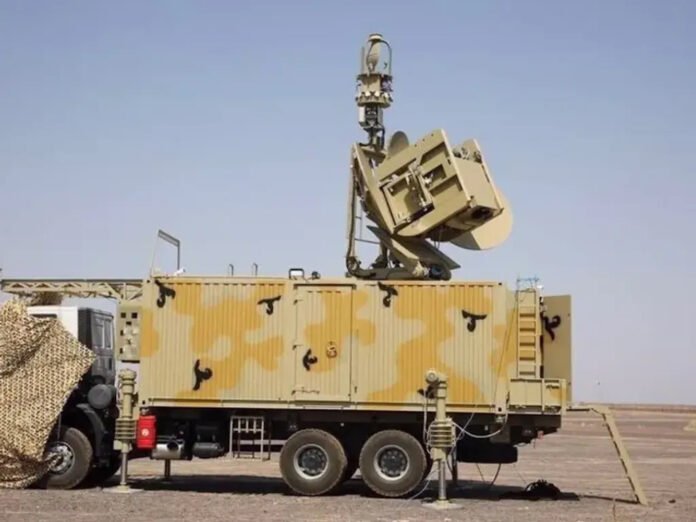
Tel Aviv: Israel is closely following the deployment of advanced Russian made EW systems in Iran. According to intelligence sources, Russia has supplied its Krasukha and Murmansk-BN systems to Iran.
This after the 12 days war in which Israel and the US have attacked the Iranian nuclear sites and other military assets. Before the regime change in Syria, Russia has deployed some advanced EW systems in this country. These have created disruptions in some communication systems in Israel, like the one serving the civil aviation.

Israeli sources said that Moscow’s willingness to transfer such advanced EW systems signals a strengthening of Moscow-Tehran ties and marks a notable shift in the Middle Eastern electronic warfare and air defense landscape. According to recent reliable reports, Iran received new, cutting-edge electronic warfare (EW) devices from Russia in 2024–2025. The two most prominent of these are the Murmansk-BN and Krasukha systems.
The Krasukha is a truck-mounted broadband EW jammer designed primarily to disrupt or degrade airborne radars, satellite links, and the communication channels of intelligence, surveillance, and reconnaissance (ISR) assets—including AWACS, high-altitude drones, and satellite communications. Its effective operational range is estimated at 150–300 km, depending on the specific variant and conditions. The system’s arrival represents a significant escalation in Iran’s ability to contest air and electronic superiority, potentially obstructing surveillance and precision weapon targeting by Israel, the US, and Gulf states.
Reports from 2024 and 2025 indicate that Iran has also acquired the Murmansk-BN, considered Russia’s most powerful long-range communications jamming system. The Murmansk-BN, mounted on a multi-truck platform, can jam and intercept high-frequency radio signals, GPS, satellite communications, and military networks at ranges up to 5,000 km. Its main function is to disrupt high-frequency (HF) communications, especially those beyond the line of sight, which are critical for US and NATO operations.
The bar for intelligence, surveillance, and precise strikes against Iran by regional enemies is significantly raised by these deployments. They might make it more difficult to conduct ISR (Intelligence, Surveillance, and Reconnaissance) missions over sensitive regions like the Persian Gulf, Iraq, and the Strait of Hormuz, as well as along Iran’s frontiers.

Russia’s willingness to transfer such advanced EW systems signals a strengthening of Moscow-Tehran ties and marks a notable shift in the Middle Eastern electronic warfare and air defence landscape. According to Israeli sources, the deployment of the Russian made advanced EW systems in Iran gives Tehran significant new capabilities to jam, disrupt, and deny the use of modern communications and surveillance systems in its airspace and surrounding regions.

-The writer is an Israel-based freelance journalist. The views expressed are of the writer and do not necessarily reflect the views of Raksha Anirveda






