

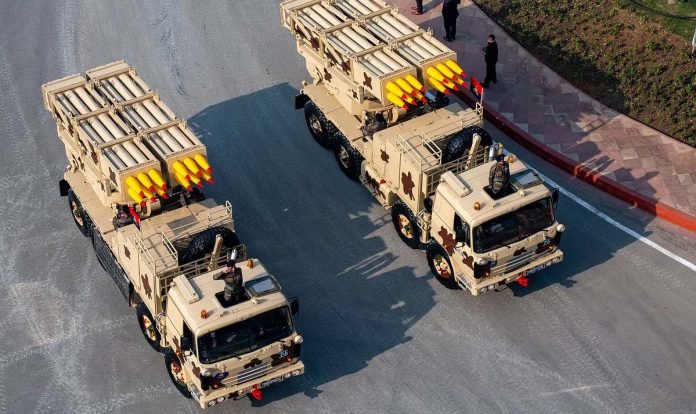
New Delhi: India’s ongoing expansion of its Pinaka multi-barrel rocket launcher (MBRL) system marks a pivotal phase in the country’s artillery modernisation and deep strike capabilities. On June 24, 2025, the Indian Army operationalised two additional Pinaka regiments, reinforcing its shift from Soviet-era platforms to advanced indigenous solutions.
Developed by the Defence Research and Development Organisation (DRDO) and produced by Bharat Earth Movers Limited (BEML), TATA Power Company Limited (TPCL), and Larsen & Toubro (L&T), the Pinaka system is designed for rapid, high-volume saturation attacks and is now a core component of India’s long-range fire support doctrine.

Each Pinaka battery contains six launchers, capable of firing 72 rockets in just 44 seconds, saturating an area of nearly 800 by 1000 metres. The rockets have a base range of up to 38 kilometres at sea level, with significantly extended reach in mountainous regions like Ladakh, thereby enhancing deep strike options along sensitive borders. The system’s integration of Automated Gun Aiming & Positioning Systems (AGAPS) and digital command posts allows for rapid deployment and precise targeting, making it especially effective in complex and high-altitude terrains.
The induction of these regiments is part of a broader modernisation plan that aims to replace the aging Russian BM-21 Grad systems with a total of 22 Pinaka regiments by 2042, ensuring that the Pinaka becomes the backbone of India’s rocket artillery. This transition is supported by substantial government investment, including contracts worth over ₹10,000 crore in 2025 for munitions and system upgrades, and previous orders for thousands of rockets and associated equipment.
The ongoing development of the Extended Range (ER) Pinaka, capable of striking targets up to 75 kilometres away, and future plans to reach ranges of 90 to 120 kilometres, further underline India’s commitment to indigenous capability enhancement and self-reliance. Strategically, the deployment of additional Pinaka regiments enhances India’s deterrence posture against both Pakistan and China, enabling rapid, high-impact strikes deep into adversary territory and compensating for terrain-imposed limitations.
The Pinaka’s superior range, digitised fire control, and mobility offer clear advantages over legacy systems like the Grad-21, and its domestic production ensures supply chain sovereignty and aligns with the “Aatmanirbhar Bharat” (self-reliant India) policy.

The expansion of the Pinaka rocket artillery system represents a transformative leap in India’s military modernisation, reducing dependency on foreign suppliers, enhancing operational flexibility, and asserting India’s ambition to become a regional defence manufacturing hub. As Pinaka regiments become the mainstay of the Army’s Rocket Force, they not only bolster India’s deep strike and deterrence capabilities but also signal a decisive shift toward technological self-sufficiency and strategic autonomy.






