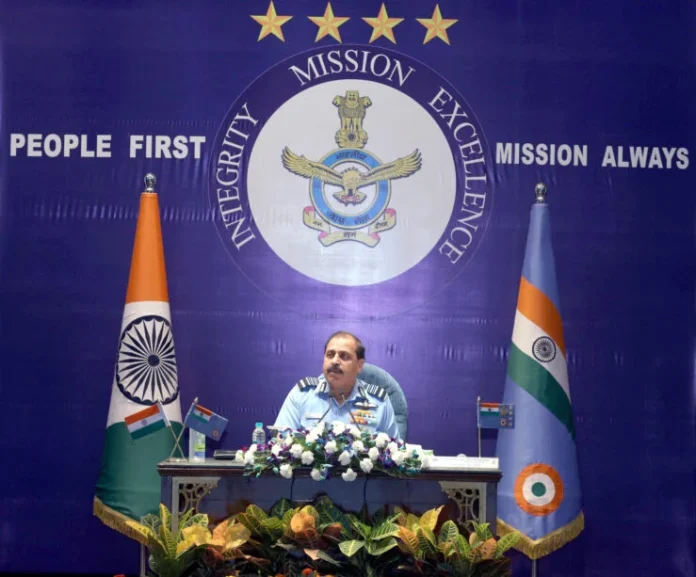
New Delhi: The use of artificial intelligence can bring enormous changes in the way wars are fought and the Indian Force has started looking at its applications in a range of areas, including training and threat monitoring, Chief of the Air Staff (CAS) Air Chief Marshal RKS Bhadauria said.
The chief of air staff said his force is also looking at using artificial intelligence (AI) in areas of data and intelligence fusion, maintenance as well as in its decision support system.

“These are huge areas of focus for our immediate future,” he said at a FICCI seminar on use of AI for air warriors.
Air Chief Marshal Bhadauria also urged the industry to work on developing various military applications of AI.
“Smart technologies like AI have the potential to totally change the way we train and fight future wars. We are living through some interesting times,” he said.
“It is the right time for all of us, the military operators, the industry, the think-tanks and all the AI specialists for creating next-generation AI enablers for air war,” the IAF chief said.

He said it was time to plant a “robust tree” for development of AI in the country.
At the same time, he mentioned that different nations with different threat perceptions would have different requirements and this would have evolved over a period of time and experience.

“We have already embarked on an AI journey and having gone through some of the important automation projects in the recent past, we have started testing AI and AI- based applications on some projects which are in different stages,” he added.
ACM Bhadauria elaborated that AI is being developed in multiple areas in the air domain to accrue diverse and asymmetrical operations benefits.
He added that currently AI has not matured to an extent where completely autonomous missions can be executed.
“However, there is a need to address some questions to this effect- whether algorithms can be trained to effectively execute mission planning behaviours in unpredictable scenarios; can machines be taught combat strategies; can sufficiently generalised representations be built to capture the richness of the planning problem itself across the threat matrix,” he said.
“The answer to these questions will help us firm up our requirement specifications that will essentially be a starting document vis-a-vis the expected outcomes. If we tend to utilise AI heavily in combat aviation, we may need to redefine or even abandon certain traditional principles,” he added.
The Ministry of Defence (MoD) has been focusing on application of AI in the three services.