

New Delhi: The recent submission of a Russian technical report to Hindustan Aeronautics Limited (HAL) has marked a potentially significant step in India’s involvement with fifth-generation fighter aircraft production.
The document, prepared by a delegation from the Sukhoi Design Bureau and other Russian defence entities, concludes that HAL already possesses close to 50 per cent of the manufacturing capacity required to locally produce the Su-57E stealth fighter. The report was handed over to HAL in October, ahead of Russian President Vladimir Putin’s scheduled visit to India in early December.

The Russian experts visited key HAL facilities in September to assess production capabilities, technological readiness, and the availability of skilled manpower. They conducted a detailed evaluation of HAL’s existing infrastructure developed over two decades of licensed production of the Su-30MKI.
The Nashik division, which serves as the final assembly line for the Su-30MKI, showcased its high-level integration and production experience, while the Koraput division demonstrated its capability in the manufacture and overhaul of the AL-31FP turbofan engines. These capabilities have served as the foundation of India’s modern fighter aircraft production ecosystem.
The delegation also inspected HAL’s Strategic Electronics Factory in Kasaragod, Kerala. This facility is responsible for the production of avionics components such as mission computers, display processor units, and other airborne electronics vital to modern aircraft platforms.
The Russian team reportedly noted the technological sophistication of these facilities and their potential adaptability for Su-57-related production with necessary upgrades and new tooling.

Based on these findings, HAL has begun preparing its own internal report to assess the requirements for achieving full-scale Su-57E production capacity in India. This report will include estimates of the investments needed for infrastructure enhancement, procurement of specialised machinery, research and development, workforce training, and local supply chain establishment.
The final assessment is expected to be submitted to the Ministry of Defence by the end of November for further consideration at the policy level.

This development comes at a strategically important juncture, with President Putin scheduled to arrive in New Delhi on 5–6 December for the 23rd annual India–Russia summit. Discussions are anticipated to cover a wide spectrum of defence cooperation topics, including the Su-57E proposal, advanced radar collaboration, and future-oriented technologies such as anti-drone systems and precision-strike weaponry.
The upcoming summit is viewed as a potential platform for new agreements that could reshape the trajectory of Indo-Russian defence partnerships.
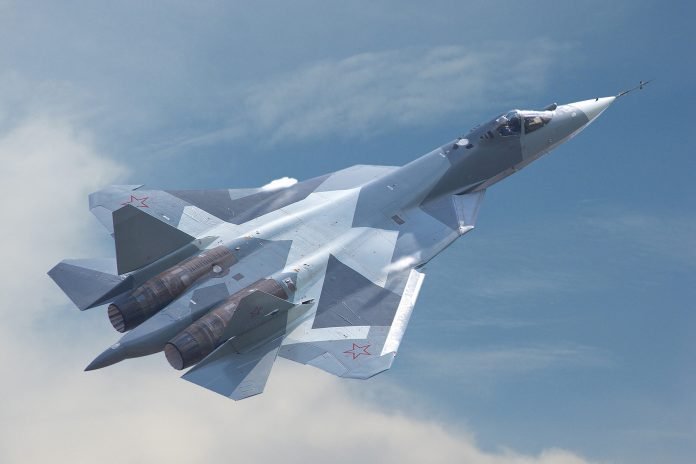
The Su-57, built by the Komsomolsk-on-Amur Aviation Plant in the Russian Far East, remains Russia’s flagship fifth-generation multirole fighter. Its export-oriented variant, the Su-57E, was prominently displayed at Aero India 2025 in Bangalore earlier this year, where it made its debut before Indian defence officials and industry experts.
The fighter’s appearance coincided with the American F-35’s participation at the same airs how, highlighting India’s unique position amid competing offers from major global powers in the stealth fighter domain.
During the event, Russian representatives emphasised their readiness to integrate local production of the Su-57E within India’s emerging industrial ecosystem. They argued that such collaboration would complement India’s indigenous Advanced Medium Combat Aircraft (AMCA) programme rather than compete with it, by offering technology transfer, early experience in stealth manufacturing, and exposure to next-generation avionics systems.
Russian Ambassador Denis Alipov later reinforced this position at a public engagement on 16 October, asserting that Moscow’s proposal represents a natural extension of the longstanding India–Russia defence cooperation model.
The ambassador’s remarks underscored the evolution of bilateral relations from traditional buyer-seller arrangements to joint development and co-production frameworks. He indicated that Russia sees the Su-57E project as an opportunity for both nations to advance together in fifth-generation fighter technology. Meanwhile, Moscow’s readiness to align with India’s Make in India and Aatmanirbhar Bharat initiatives lends the proposal additional strategic weight.
Within India’s defence establishment, evaluations are still underway regarding the Su-57E’s operational suitability and potential overlap with the AMCA.
Sources suggest that India’s participation may focus on a limited co-production arrangement initially, possibly for a few aircraft units to serve as technology demonstrators for stealth assembly techniques and radar-absorbent material application. Parallel to this, discussions may also extend to joint research in sensors, data fusion systems, and electronic warfare suites relevant to both the Su-57E and AMCA platforms.
Should the project gain governmental approval, HAL could emerge as a regional centre for advanced composite structure fabrication and stealth material integration under Russian technical supervision. Such collaboration would not only strengthen India’s aerospace industrial base but also reduce dependence on external supplies for sensitive components in the long term. For Russia, facilitating partial production in India could help offset international production limitations and strengthen its long-term export footprint in Asia.
Experts believe the Russian report’s positive assessment is intended to signal confidence in India’s industrial maturity and readiness to handle sophisticated fifth-generation systems. The coming months will likely determine whether this proposal transitions into a concrete bilateral framework.
The timing, ahead of President Putin’s visit, points to a coordinated diplomatic and industrial effort aimed at reviving deep collaborative momentum in the defence sector.






