


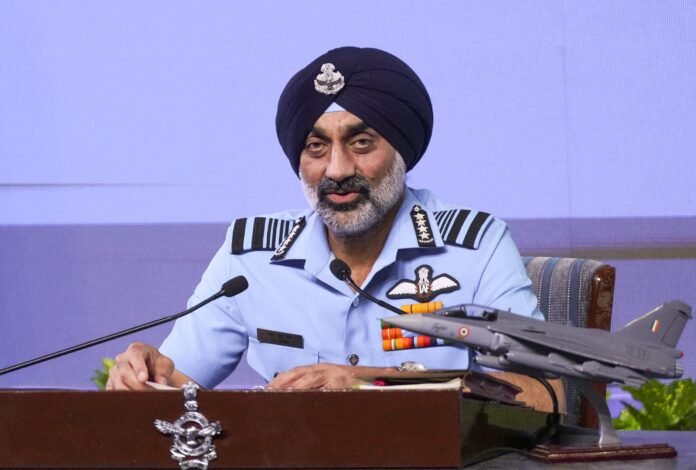
Indian Air Force Chief Air Chief Marshal AP Singh says drones are transforming warfare from surveillance tools into offensive combat systems. Singh said that drones and unmanned aerial systems (UAS) are no longer merely “eyes in the sky” but have evolved into “claws in the sky,” underlining a major transformation in modern warfare and India’s evolving military doctrine.
Speaking at a defence seminar on unmanned aerial systems and counter-UAS operations in New Delhi on May 15, the Air Chief stressed that future conflicts would increasingly rely on autonomous systems, integrated air defence networks and seamless coordination between the armed forces.

The seminar, organised by the Centre for Aerospace Power & Strategic Studies (CAPSS) and the Indian Military Review (IMR), focused on the growing significance of drones, swarm technologies and counter-drone capabilities amid rapidly changing battlefield conditions.
“We are shifting from concentrated air power to a decentralised and autonomous way of warfare,” Singh said, highlighting how drones are now becoming an extension of conventional air power rather than just surveillance assets.
The remarks come amid growing global military reliance on drones following conflicts in Ukraine, West Asia and the Indo-Pacific region, where unmanned systems have demonstrated their ability to conduct surveillance, precision strikes, electronic warfare and saturation attacks at comparatively low cost.
Referring to India’s own operational experience during Operation Sindoor, the IAF chief said that recent military engagements had reinforced the importance of drones and integrated defence systems. He noted that India’s success during the operation was possible because of strong inter-service coordination and the functioning of the Integrated Air Command and Control System (IACCS) as the central operational nerve centre.

According to Singh, enemy drones and weapons systems were successfully neutralised because Indian forces operated within a coordinated and networked command structure capable of tracking and countering aerial threats in real time.
The Air Chief also underlined the importance of “domain awareness” in modern warfare, warning that the absence of real-time situational awareness could lead to catastrophic outcomes, including friendly-fire incidents. He referred to the March 1 incident involving US F-15E Strike Eagles over Kuwait as an example of the dangers posed by poor coordination in contested airspace.

His comments reflect a broader shift within military thinking globally, where drones are increasingly viewed not merely as reconnaissance platforms but as offensive combat assets capable of directly shaping battlefield outcomes.
Military analysts say the growing role of drones is also altering traditional concepts of deterrence and force projection. Swarm drones, loitering munitions and autonomous attack systems can overwhelm sophisticated air defence systems while imposing relatively low operational costs on the attacking side.
India has significantly accelerated its indigenous drone development efforts in recent years. The armed forces are currently integrating multiple unmanned platforms for surveillance, logistics, precision strikes and swarm operations. Indigenous projects such as the HAL Combat Air Teaming System (CATS), long-range swarm drones and AI-enabled combat systems are part of this broader transformation.
The Air Chief acknowledged that drone warfare has created a constant “cat-and-mouse game” between offensive and defensive technologies. As drone capabilities improve, counter-UAS systems must also evolve rapidly to prevent adversaries from gaining operational superiority.
He emphasised that future battlefields would require continuous innovation, particularly in electronic warfare, radar systems, artificial intelligence and integrated command networks.
At the same time, Singh cautioned against the assumption that drones alone could replace manned aircraft entirely. He stressed that the future lies in “manned-unmanned teaming” where fighter aircraft, autonomous drones and AI-driven systems operate together in coordinated combat environments.
“You cannot take man completely out of the loop,” he said, indicating that human oversight would remain essential in combat decision-making despite rapid advances in autonomy and artificial intelligence.
Defence experts believe this hybrid approach is becoming central to the operational strategies of major military powers. The United States, China, Russia and several European nations are already investing heavily in loyal wingman drones, autonomous strike platforms and AI-assisted combat systems.
For India, the challenge is particularly significant because of its complex security environment involving both China and Pakistan. The increasing deployment of drones along India’s western and northern borders has already transformed surveillance and counter-infiltration operations.
Recent years have also seen repeated incidents involving cross-border drone intrusions, including the smuggling of weapons, narcotics and surveillance equipment. In response, India has expanded investments in anti-drone technologies, including directed-energy systems, electronic jammers and integrated radar-based detection networks.
The IAF chief’s remarks indicate that India now views drones not simply as support systems but as central components of future warfare doctrine. Analysts say Operation Sindoor may have served as an important operational testing ground for integrated drone and air defence coordination.
India’s military modernisation plans increasingly prioritise indigenous defence technologies under the “Aatmanirbhar Bharat” initiative. Drone manufacturing, AI-enabled systems and autonomous warfare technologies are now among the fastest-growing segments of India’s defence sector.
The emphasis on drone warfare also reflects changing battlefield economics. Traditional fighter aircraft and missile systems remain extremely expensive, while drones can often perform surveillance and strike missions at a fraction of the cost.
However, Singh also pointed out that the true cost in warfare is not merely the value of the incoming weapon system but the strategic value of the target it is intended to destroy.
His comments suggest that India’s future military doctrine will likely combine traditional air superiority with distributed autonomous warfare systems capable of operating across multiple domains simultaneously.
As military technologies evolve rapidly, the IAF chief’s “claws in the sky” remark may come to symbolise a broader transformation underway within the Indian armed forces – one where unmanned systems move from the margins of warfare to the centre of the combat strategy.






