


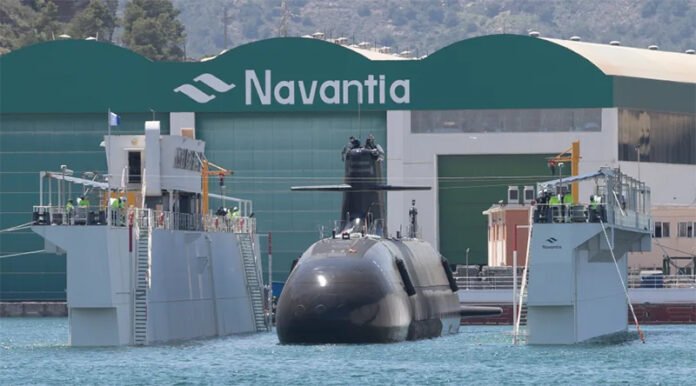
New Delhi: Navantia, the Spanish shipbuilding firm, is positioning itself as a key player in India’s submarine manufacturing landscape, particularly through its involvement in the Project 75(I) initiative.
This project aims to enhance the Indian Navy’s capabilities by constructing six advanced conventional submarines equipped with Air Independent Propulsion (AIP) systems.

Navantia is proposing its S-80 class submarine as the basis for the Project 75(I). This design is notable for being the only 3000-ton AIP submarine currently under construction globally, which aligns closely with the Indian Navy’s requirements. The S80 is designed to conduct various missions, including anti-surface warfare and land attacks, and can be equipped with advanced weaponry such as Tomahawk missiles.
Recently, Navantia achieved a significant milestone by completing the
installation of a Hydrogen-based Air
Independent Propulsion System (AIP) into an S80 class submarine. This marks the first installation of a third-generation AIP in a submarine.

Navantia‘s AIP system, branded as BEST (Bio-Ethanol Stealth Technology), is a cutting-edge energy production plant that allows the submarine’s batteries to recharge while submerged. Navantia’s third-generation technology does not require storing hydrogen onboard. It generates hydrogen on demand, enhancing the submarine’s tactical advantage, safety, and strategic autonomy.
The firm emphasises its commitment to India’s “Make in India” initiative. Navantia has engaged over 100 Indian companies for potential collaborations in indigenising equipment and materials necessary for submarine construction. This approach not only supports local industry but also aligns with India’s strategic goals of self-reliance in defence manufacturing.

Navantia has a history of technology transfer in India, having previously collaborated on the Scorpene submarines built by Mazagon Dock Shipbuilders Limited (MDL) in Mumbai. The company aims to replicate this success by offering robust technology transfer opportunities under the Project 75(I) framework.
Despite its strong offering, Navantia faces stiff competition from Germany’s thyssenkrupp Marine Systems (TKMS), which has a more established track record in submarine construction. TKMS has built over 170 submarines globally and offers proven AIP technology that has been operationally validated. Reportedly, TKMS due to its operational reliability and advanced technologies, including lithium-ion batteries and sophisticated stealth features is considered to be ahead in competition.

Raksha Anirveda's editorial desk team brings in the collective experience of creative professionals - a fine mix of senior copy editors, writers, proofreaders and designers. Working as a team, they continuously create, manage, and curate content to sustain the magazine's profile and reputation in line with market trends and achieve magazine's goal.





