

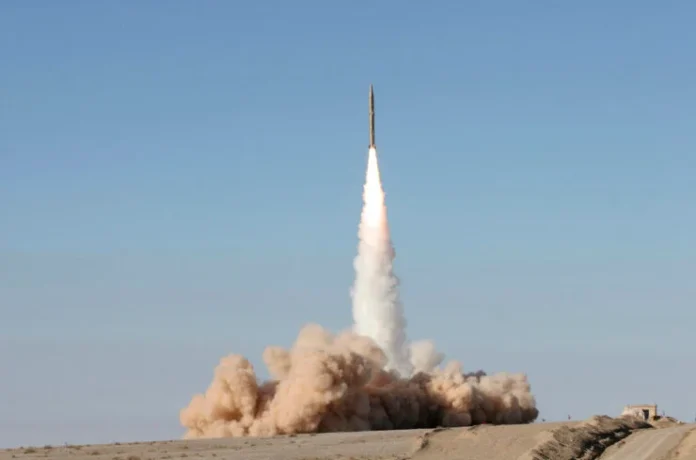
Tel Aviv: While galloping to the bomb, using the never ending Vienna talks, Iran is stepping up the development of its long range ballistic missiles to be able to hit targets in Europe. According to Israeli experts,
newspapers worldwide headlined on January 23, 2022, “Iran launched Solid-Fuel Satellite Carrier Rocket into Space,” quoting the official IRNA news agency. Within two days, however, the IRNA account was removed. No rocket left the earth, but a significant static solid-fuel engine test was carried out successfully.

According to Lt. Col. (Ret.) Michael Segall, from the Jerusalem Centre for Public Affairs, while negotiations in Vienna on the nuclear issue continue sluggishly without a breakthrough, Iran continues to exert pressure and threaten the negotiating partners. “Moreover, Iran is more than just implying that it has other options if no arrangement is reached, including linking the advanced nuclear capabilities it has reached in the past year and its ballistic missiles that could reach Europe.”
According to the Israeli expert, a conservative Iranian newspaper close to the regime recently reported that a solid-fuel engine tested in Iran could increase Iranian missile range to 5,000 kilometres (3,000 miles), threatening European countries. The newspaper also praised President Raisi’s government, which, unlike its predecessor, exhibits an uncompromising negotiating position with the West, particularly in the realm of developing Iran’s missile capabilities.

The experts added that through the recent engine tests and the launch of satellites, at the end of December 2021 – in the midst of nuclear negotiations – Iran has made it clear that it does not intend to compromise on the issue of missile development during the nuclear deal negotiations.

Iran’s Farhikhtegan newspaper reported on January 15, 2022, that Iran aspires to increase its ballistic missile range and that its development of a 5,000-km-range missile is “closer than ever.” The newspaper, which belongs to the Open University (Azad-e-Islami) and is associated with the conservatives of the Iranian regime, quoted recent remarks by Brig Gen Amir Ali Hajizadeh, commander of the Revolutionary Guards’ Aerospace Corps. They interpreted his remarks as an indication that Iran plans to increase its range of ballistic missiles.
Gen. Hajizadeh announced a “successful test” of a new Satellite Launch Vehicle (SLV) engine called the “Raafe.” Hajizadeh appeared before clerics in Qoms and said that over the past two years, a series of tests had been carried out on a solid-fuelled satellite launcher rocket. The commander of the Revolutionary Guards’ Aerospace Corps also revealed that the body of the new satellite launcher is of composite design, not metallic. The design and removal of liquid fuel pumps lighten the rocket, allowing for longer ranges or larger payloads. Hajizadeh added that Iran’s aviation and missile ability could not be curbed through “assassinations, threats, and sanctions.”
According to the Farhikhtegan newspaper, the test indicates significant progress in the missile field. The newspaper added that, although Iran has announced that it does not want to build ballistic missiles with a range of more than 2,000 kilometres, the new engine could allow it to pass that range and even approach the 5,000 km range.
The Israeli expert says that the United States considers Iran’s satellite launchers to be a violation of Security Council Resolution 2231, which was approved in July 2015. According to the resolution, Iran was “called upon” not to take any action involving ballistic missiles “designed to be capable of delivering nuclear weapons.”
“Iran’s space programs, which were “dormant” under Rouhani, were accelerated as part of the Iranian response to the U.S. exit from the nuclear deal and now also serve as leverage for pressure on the West during the nuclear talks.”
On December 30, 2021, Iran launched a liquid-fuelled Simorgh space launch vehicle (SLV). However, it appears that the launch failed because its satellites failed to enter into orbit. Following the launch, Iran fended off criticism in the West of the launch, arguing Iran had the right to launch satellites. The US Defense Intelligence Agency found that “the new Simorgh (Safir-2) SLV could be capable of ICBM ranges if configured as a ballistic missile.”

-The writer is an Israel-based freelance journalist. The views expressed are of the writer and do not necessarily reflect the views of Raksha Anirveda





