


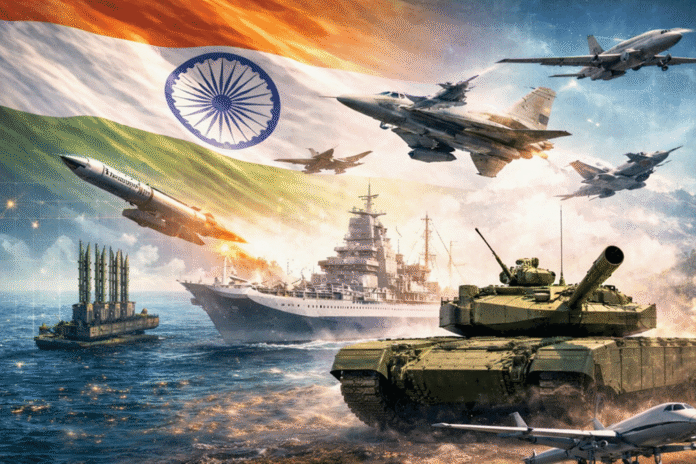
The Draft Defence Acquisition Procedure 2026 (DAP 2026) was released by the Ministry of Defence (MoD) on February 11, seeking comments on the proposed changes by March 3. The final version of the manual, to which a procedure for acquisition of aerospace systems will be added later, is awaited.
From an 84-page document, when the first Defence Procurement Procedure (DPP) was promulgated in 2002 to regulate capital acquisitions for the armed forces and the Indian Coast Guard, it has swelled into 800-odd pages of a complex document, split into two volumes: one containing the procurement policies and the other, instructions, formats and appendices related to various procedural aspects.

For a doorstopper like this, which took more than six months to take shape, opening a 20-day window for the interested readers to soak-in its contents and offer their comments seemed more like ticking a box and not an earnest attempt to solicit genuine professional feedback.
Be that as it may, amidst all the proposed changes, the manual’s objective remains virtually unchanged from what it has always been: timely acquisition of military equipment, systems, and platforms with due regard to performance, capabilities, quality standards, and optimum utilisation of allocated budgetary resources.
What distinguishes draft DAP 2026 from its earlier version of 2020, however, is the shift in focus from ‘Make in India’ to ‘Owned by India’ by prioritising co-development and Intellectual Property (IP) ownership by the Indian companies as the basis of acquisition decisions. Various measures, such as incentives for offering products with indigenous design, have been introduced to promote this concept.
It is not easy to make a system based on incentives and weightages work. A system of weightages in determining the lowest bid was introduced in 2016 for bidders who offered products meeting pre-defined enhanced performance parameters, but the system did not seem to have worked as well as it was intended to. It will require sustained efforts to make the proposed incentive for indigenous design work.

Right from the first DPP of 2002, the procurement architecture is built around classification of capital acquisitions into various categories, which have mutated and multiplied over the years. In keeping with this trend, the draft DAP 2026 proposes to replace ‘Buy (Indian)’ and ‘Buy and Make (Indian)’ categories with ‘Buy (Indian) and Manufacture in India’. This change in nomenclature seems as cosmetic as the replacement of the ‘Buy and Make’ category with ‘Buy (Global – Manufacture in India)’ category in 2020, as the defining characteristics of these categories remain fundamentally unchanged.
Other categories, like ‘Buy (Indian- Indian Designed, Developed and Manufactured)’, ‘Buy (Global – Manufacture in India)’, ‘Design and Development by DRDO/ DPSUs’, and ‘Make’ have been retained, and Technology Readiness Level (TRL) introduced as one of the determining factors for categorisation, except in ‘Buy (Global)’ category. Given the transience of the procurement personnel, it may be a challenge to deal with this added procedural complexity.

The requirement of indigenous content (IC) in the products to be procured by the MoD has been increased from 50% to 60% under various procurement categories. In ‘Buy (Global)’ category, which currently entails no obligation, IC requirement has been introduced and pegged at 30%. Some incentives have also been introduced for achieving the requisite IC levels. However, considering that there are reports of the vendors facing difficulty in achieving the currently prescribed levels of IC in their products, a 10% jump in IC requirement seems somewhat ambitious.
The existing DAP 2020 contains several other stand-alone procurement categories and special procurement procedures. The stand-alone categories include ‘Make’ category along with its three sub-categories, including Leasing, and the Strategic Partnership Model (SPM). There are special procedures for acquisition of systems designed and developed by DRDO and DPSUs, acquisition of ICT products and systems, and defence shipbuilding. There is also a Fast Track Procedure in place, apart from a ‘Other Capital Procurement Procedure’.
Some additions are proposed to this multitude. A new category called ‘Low-Cost Capital Acquisition (LCCA)’ is proposed for acquisition of equipment exclusively from the Indian vendors for trial and evaluation before its induction in bulk, for financial powers will be exercised by the Services Procurement Board. A Long-Term Bulk Acquisition (LTBA) procedure is also proposed to be introduced for acquisition of capital-intensive, Hi-Tech, and complex equipment, systems, platforms, and ammunition, from Indian and foreign sources over a long term and in multiple tranches, with progressive indigenisation and upgrades.
What distinguishes draft DAP 2026 from its earlier version of 2020, however, is the shift in focus from ‘Make in India’ to ‘Owned by India’ by prioritising co-development and Intellectual Property (IP) ownership by the Indian companies as the basis of acquisition decisions. Various measures, such as incentives for offering products with indigenous design, have been introduced to promote this concept
In DAP 2020, ‘Innovation’ was treated as a branch of the ‘Make’ category, but in the draft DAP 2026, there is a separate chapter detailing the procedure for acquisition of technologies and products developed by Indian entities under the Innovations for Defence Excellence (iDEX) initiative and Technology Development Fund (TDF), or by the Services through their own internal R&D organisations.
The offset policy, which requires foreign vendors to plough back a certain percentage of the contract value into the Indian defence sector by procuring ‘Made-in-India’ eligible defence products from the Indian companies, investing in them in kind or cash, or via transfer of technology (ToT) to them or to DRDO, is conspicuous by its absence in the first volume of the Draft DAP 2026, additionally there are disjointed references to offsets in the second volume, which creates confusion.
Introduced two decades ago, the offset policy has increasingly lost its relevance. Only one offset contract has been signed since 2021 and, more to the point, the policy did not lead to any meaningful ToT as the vendors opted for easier options to discharge their offset obligations. The exemption granted in DAP 2020 to all foreign procurements under inter-governmental agreements, including Foreign Military Sales Programme of the US Government, from offsets, may have dealt a final blow to the policy.
Considering these facts, it will not be surprising if the MoD intends to phase out defence offsets, but SPM and Make I procedure, which never really took off, have been retained. SPM was adopted in 2017 for a roll-out in four manufacturing segments – aircraft, helicopters, submarines, and armoured fighting vehicles or main battle tanks- but not a single SPM project has matured since then.
Likewise, under Make I procedure – an offshoot of the original Make procedure which was adopted in 2006 to promote indigenous prototype development of futuristic equipment by harnessing available technologies – no major project has fructified so far. It is not known if the utility of persisting with these categories was considered by the MoD, especially since the objectives of these categories can also be achieved via other procurement categories. That, of course, is a discussion for another day.
The stages, from formulation of the Services Qualitative Requirement (SQR) to the signing of the contract, which constitute a typical acquisition cycle have been retained. Some of these stages, like formulation and approval of services qualitative requirements, technical and staff evaluations, field trials, and contract negotiations are prone to delay. While the acquisition programmes will continue to follow more or less the same routine as before, refinement of the processes linked with these stages envisaged in the draft could help cut down delays.
Under a wider perspective, multiplicity of the agencies involved in the acquisition process with each one of them following a different chain of command, absence of an overarching procurement organisation managed by procurement professionals, absence of outcome-oriented execution of financially viable acquisition plans, and several other related factors have been the bane of acquisition programmes in the past. However, in the long run, MoD will have to address these issues to improve the efficacy of the acquisition system
The Standard Contract template has been updated to incorporate a provision for resolution of disputes under the provisions of the Mediation Act, 2023, for which policy directives were issued by the Procurement Policy Division of the Ministry of Finance on June 3, 2024. This may possibly make the dispute resolution mechanism nimbler. However, some earlier textual ambiguities remain unaddressed, as in the case of the Adequacy Clause.
Proliferation of procurement categories, complexity of the conditionalities attached to each one of them, and multiplicity of the special procedures has created a virtual bureaucratic maze. It was probably unavoidable, and in any case, it is too late to address these issues in the final version. However, MoD can address the lack of textual clarity at many places in the draft as it militates against uniformity in interpretation of various provisions of the manual and prolongs the deliberations at various stages.
Under a wider perspective, multiplicity of the agencies involved in the acquisition process with each one of them following a different chain of command, absence of an overarching procurement organisation managed by procurement professionals, absence of outcome-oriented execution of financially viable acquisition plans, and several other related factors have been the bane of acquisition programmes in the past. These issues were beyond the remit of the committee which prepared the draft DAP 2026, but in the long run, MoD will have to address these issues to improve the efficacy of the acquisition system.

–The writer is a former Financial Advisor (Acquisition), Ministry of Defence. The views expressed are personal and do not necessarily reflect the views of Raksha Anirveda





