


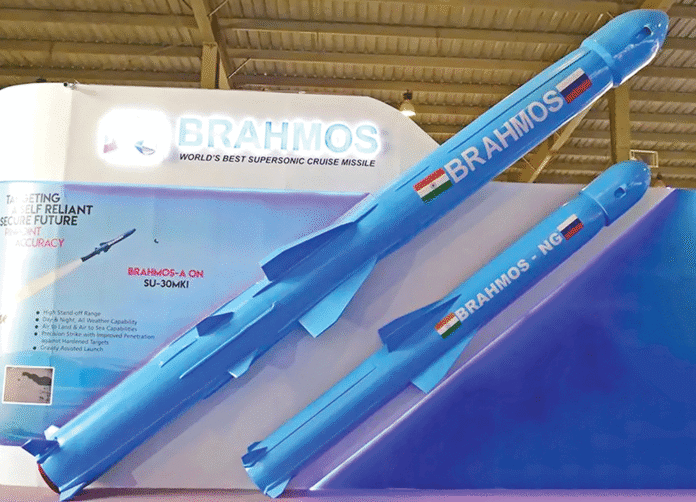
As India edges closer to major BRAHMOS missile agreements with Vietnam and Indonesia, New Delhi’s defence exports are rapidly evolving from commercial transactions into instruments of strategic influence. The proposed deals, reportedly worth nearly $450 million collectively, underline how India is leveraging indigenous military technology to deepen partnerships across Southeast Asia while subtly countering China’s expanding maritime assertiveness.
For decades, India remained one of the world’s largest arms importers. Today, however, it is positioning itself as an emerging defence exporter capable of supplying advanced missile systems, naval platforms, surveillance equipment, and military technologies to countries anxious about growing instability in the Indo-Pacific. At the centre of this transformation stands the BRAHMOS supersonic cruise missile – now widely seen as the flagship of India’s defence diplomacy.

The BRAHMOS missile, jointly developed by India and Russia, has become a potent symbol of India’s military-industrial ambitions. Capable of speeds approaching Mach 3 and precision strikes against naval and land targets, the missile offers a credible deterrent against hostile naval manoeuvres in contested waters such as the South China Sea
The BRAHMOS missile, jointly developed by India and Russia, has become a potent symbol of India’s military-industrial ambitions. Capable of speeds approaching Mach 3 and precision strikes against naval and land targets, the missile offers a credible deterrent against hostile naval manoeuvres in contested waters such as the South China Sea. For Southeast Asian nations facing increasing Chinese maritime pressure, the system represents both strategic capability and political reassurance.
Vietnam’s growing interest in BRAHMOS is particularly significant. Hanoi has long been cautious in balancing relations with China, despite repeated confrontations over territorial claims in the South China Sea. China’s aggressive patrols, island militarisation, and coercive maritime tactics have compelled Vietnam to modernise its deterrence capabilities. India’s willingness to provide advanced missile systems, therefore, offers Hanoi a valuable alternative to dependence on Russian or Western suppliers.
Unlike the United States or European powers, India is often perceived in Southeast Asia as a less intrusive and politically safer defence partner. Analysts argue that New Delhi’s strategic approach lacks the ideological conditions or geopolitical coercion frequently associated with major arms suppliers. This perception has enhanced India’s appeal across ASEAN capitals seeking military modernisation without becoming entangled in great-power rivalry.
Unlike the United States or European powers, India is often perceived in Southeast Asia as a less intrusive and politically safer defence partner. Analysts argue that New Delhi’s strategic approach lacks the ideological conditions or geopolitical coercion frequently associated with major arms suppliers
Indonesia’s move toward procuring BRAHMOS missiles similarly reflects changing regional security calculations. Jakarta has traditionally pursued strategic autonomy while avoiding overt military alignments. However, repeated Chinese incursions near the Natuna Islands have increased concerns over maritime sovereignty. Acquiring BRAHMOS missiles would significantly strengthen Indonesia’s coastal defence and anti-access capabilities, enhancing deterrence without dramatically escalating regional tensions.

The Philippines deal signed earlier had already demonstrated the export viability of the BRAHMOS system. That agreement, valued at approximately $375 million, marked India’s first major missile export and established a precedent for future deals. The success of the Philippine contract boosted confidence in India’s defence manufacturing ecosystem and encouraged other Southeast Asian states to explore Indian systems.
The growing demand for BRAHMOS also reflects broader shifts in the global arms market. Several countries are attempting to diversify suppliers amid uncertainties surrounding Western military commitments, rising costs, and geopolitical tensions involving Russia and China. India, benefitting from competitive pricing and operationally proven systems, is emerging as an attractive middle-ground supplier.

New Delhi’s expanding defence footprint in Southeast Asia aligns closely with its Act East Policy and Indo-Pacific strategy. By supplying advanced weaponry to regional partners, India seeks to reinforce a multipolar security architecture capable of balancing China’s growing military influence. The missile agreements therefore serve both economic and geopolitical objectives.
For India, the strategic implications go beyond exports alone. Defence cooperation typically generates long-term military relationships involving training, maintenance, logistics, technology transfers, and joint exercises. BRAHMOS sales could thus pave the way for broader defence collaboration involving naval shipbuilding, radar systems, drones, cybersecurity, and maritime domain awareness.
The success of BRAHMOS diplomacy also carries symbolic importance for India’s strategic ambitions. Historically viewed as a security consumer dependent on foreign suppliers, India is increasingly positioning itself as a net security provider in the Indian Ocean and beyond. Missile exports enhance India’s credibility as a serious military-industrial power capable of influencing regional security dynamics
Vietnam in particular offers India a broader defence export opportunity extending beyond missiles. Hanoi is believed to be interested in offshore patrol vessels, naval modernisation support, submarine-related systems, and maintenance infrastructure. India’s growing capabilities in these sectors may allow it to emerge as a long-term defence partner for Vietnam’s military modernisation programme.
The economic benefits are equally substantial. India’s defence exports have surged dramatically over the past decade, driven by government initiatives promoting indigenous manufacturing under the “Make in India” framework. Defence exports reportedly crossed ₹21,000 crore recently, compared to marginal figures a decade ago. BRAHMOS has become the crown jewel of this export drive, demonstrating that Indian defence products can compete globally in terms of capability and reliability.
The success of BRAHMOS diplomacy also carries symbolic importance for India’s strategic ambitions. Historically viewed as a security consumer dependent on foreign suppliers, India is increasingly positioning itself as a net security provider in the Indian Ocean and beyond. Missile exports enhance India’s credibility as a serious military-industrial power capable of influencing regional security dynamics.
China, unsurprisingly, is closely monitoring these developments. Beijing regards growing India-ASEAN defence cooperation as part of broader efforts to constrain Chinese influence in the Indo-Pacific. While India avoids openly framing BRAHMOS exports as anti-China measures, the strategic message remains unmistakable. The deployment of high-speed anti-ship missiles by Southeast Asian states complicates Chinese naval operations and raises the costs of coercive maritime behaviour.
Yet, India’s defence export ambitions are not without challenges. Production capacity remains a critical issue. As demand rises, India must ensure timely delivery schedules, robust after-sales support, and sustained manufacturing capabilities. Delays or quality concerns could undermine confidence among prospective buyers.
Another complication involves Russia’s role in the BrahMos joint venture. Although the missile is heavily indigenised, Moscow’s involvement may pose risks amid evolving global sanctions and geopolitical realignments. India will need to carefully navigate these complexities while expanding exports to countries maintaining sensitive relations with Western powers.
The Vietnam and Indonesia negotiations therefore represent more than arms contracts. They embody the rise of India’s defence-industrial diplomacy as a new pillar of its regional strategy. If managed effectively, BRAHMOS could become for India what the Bayraktar drone became for Turkey – a globally recognised symbol of indigenous military capability and strategic outreach
Competition is also intensifying. South Korea, Turkey, Israel, China, and Western manufacturers are aggressively targeting Southeast Asia’s expanding defence market. Turkish drones, South Korean submarines, and Israeli missile systems are already gaining traction across the region. India must therefore move beyond symbolic deals and establish itself as a dependable long-term supplier with integrated support ecosystems.
Nevertheless, the geopolitical momentum appears favourable for New Delhi. Southeast Asian countries increasingly seek strategic diversification amid uncertainty over US-China competition. India’s image as a democratic, relatively non-coercive regional power enhances its attractiveness as a defence partner.
Importantly, BRAHMOS exports signify a deeper psychological transformation in Indian strategic thinking. For decades, India’s defence policy remained inward-looking and heavily import-dependent. Today, military technology is becoming a diplomatic instrument capable of advancing foreign policy objectives, strengthening alliances, and projecting influence far beyond South Asia.
The Vietnam and Indonesia negotiations, therefore, represent more than arms contracts. They embody the rise of India’s defence-industrial diplomacy as a new pillar of its regional strategy. If managed effectively, BRAHMOS could become for India what the Bayraktar drone became for Turkey – a globally recognised symbol of indigenous military capability and strategic outreach.
In an increasingly contested Indo-Pacific, where maritime power and deterrence define geopolitical equations, India’s missile diplomacy is emerging as a consequential force. The BRAHMOS may travel at supersonic speed, but its strategic impact on Southeast Asia’s evolving balance of power could endure far longer.

-The writer is a New Delhi-based senior commentator on international and strategic affairs, environmental issues, an interfaith practitioner, and a media consultant. The views expressed are personal and do not necessarily carry the views of Raksha Anirveda





