


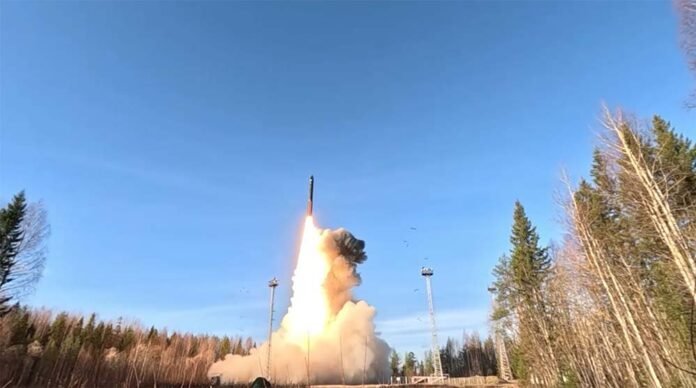
Vienna: Russia launched its largest nuclear exercises in years, mobilising nearly 65,000 troops, over 200 missile launchers, 140 aircraft, 73 surface vessels and 13 submarines, including eight strategic nuclear submarines, in a three-day drill.
The Russian Defence Ministry announced the manoeuvres without prior public notice on May 19, framing them as a rehearsal for “the preparation and use of nuclear forces in the event of a threat of aggression.” The exercises involve the Strategic Missile Forces, the Northern and Pacific Fleets, Long-Range Aviation Command, and units from the Leningrad and Central Military Districts, according to the ministry statement. Live launches of ballistic and cruise missiles at ranges inside Russia are planned as part of the drills.

The timing is conspicuous on multiple fronts. Russia had not previously announced nuclear exercises for May; its annual strategic nuclear drill − informally known as “Grom” − has traditionally been held in October since 2022. The last time Moscow staged a surprise nuclear exercise was in the summer of 2024, when it focused on non-strategic weapons apparently timed to Western debates over supplying long-range missiles to Ukraine. Analysts at the Institute for the Study of War assessed that the current drills are similarly aimed at “influencing NATO decision-making and masking Russia’s own weaknesses,” characterising them as an information-pressure operation at least as much as a purely operational readiness check.
The exercises kicked off as President Vladimir Putin was enroute to Beijing for a two-day visit with Chinese President Xi Jinping, a diplomatic tableau that military expert Dmitry Kornev described to the Russian newspaper Izvestia as deliberately synchronised. The dual messaging − nuclear muscle-flexing at home, high-profile diplomacy abroad − fits a pattern the Kremlin has used repeatedly since the full-scale invasion of Ukraine began in February 2022.
Russia’s strategic weapons ensure it a place among the great powers. Its nuclear arsenal is the world’s largest, with the Federation of American Scientists estimating last week that Russia currently has a total active stockpile of 4,400 nuclear weapons.
A new dimension of these drills is the explicit integration of Belarus. The Belarusian Defence Ministry announced its own parallel exercise on May 18, with units practicing the delivery and preparation of nuclear munitions “from unprepared positions on Belarusian territory” in coordination with Russian forces. Russia has stationed its Oreshnik intermediate-range ballistic missile in Belarus since 2025, following an agreement made two years earlier. It can deliver either conventional or nuclear warheads.

The exercises also follow a successful Sarmat ICBM test launch on May 12, just one week prior, after a series of earlier failures, including a silo-destroying misfire in September 2024. Putin personally confirmed after that test that the Sarmat would be placed on combat duty “at the end of the current year.”
Russia’s Deputy Foreign Minister Sergei Ryabkov escalated the rhetoric in parallel with the drills, warning in an interview with Russian state-owned news agency TASS that “strategic risks are mounting, as is the danger of a head-on clash between NATO and our country, with all the potentially catastrophic consequences that would entail.”

Moscow has pointed to statements by Lithuania’s foreign minister about a potential strike on Kaliningrad, as well as broader European rearmament and debates surrounding nuclear sharing, as justifications for the drills.
Western analysts and Ukrainian officials have taken a more sober view. Ukrainian sources cited by ISW suggest one secondary purpose of the exercises may be to create a threat from the northern direction − via Belarus − thereby drawing Ukrainian reserves away from the front ahead of a planned Russian summer offensive. The Kremlin, for its part, insists the drills are defensive in nature and directed at no specific country.






