


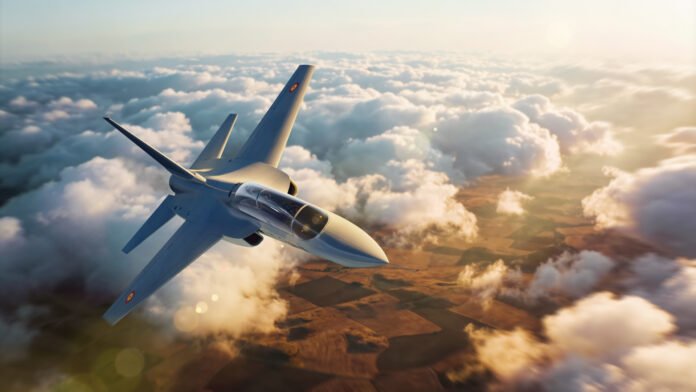
The ITS-C programme, based on a co-development agreement between Airbus, as the prime contractor, and Turkish Aerospace (TA), as the manufacturer of the HÜRJET training aircraft, covers the entire advanced training process for Spanish fighter pilots. This ranges from the Spanish-specification customisation of the 30-aircraft fleet—designated nationally as the SAETA II—to the provision of an integrated suite of operation and maintenance services.

In addition to the conversion and integration of new equipment in the aircraft, Airbus will lead the redesign of the Fighter and Strike school Training Centre at the Talavera la Real Air Base in Extremadura, Spain. The centre, which will include state-of-the-art simulators developed in collaboration with Indra, will provide logistical support for operations and maintenance of both the aircraft and synthetic training systems to ensure maximum fleet availability.
“As a result of this national programme, Spain achieves three strategic milestones: we ensure technology transfer in key areas, we obtain a deep-reaching industrial return, and, above all, we provide the programme with the strategic sovereignty and independence necessary to manage the sustainment and any future evolution of the system,” said Marta Nogueira, Head of Business Spain, Airbus Defence and Space.
During her speech, the Spanish Secretary of State for Defence, Amparo Valcarce, highlighted the programme’s strong national component, underlining that “it is a project that mobilises our industry, generates knowledge, employment, and opportunities throughout the entire value chain.” Furthermore, Valcarce emphasised the national industry’s capacity to participate in the development of complex systems, noting that the project “strengthens our strategic autonomy by allowing us to design, integrate, and evolve our own capabilities, reducing critical dependencies.”
Two phases: Aircraft “brain” modification and nationalisation of the system

The initial phase, set to begin in 2028, focuses on the delivery of an initial batch of 21 aircraft. One of these first aircraft will be used by Airbus as a prototype for the integration of next-generation avionics and mission equipment. In parallel, efforts will be ongoing in the development and manufacture of a ground-based training system, scheduled to enter operation during the 2029-2030 academic year.
In a second phase, all 21 of these aircraft, plus the remaining nine aircraft on order, will undergo the conversion to Spanish standards, along with an update of the simulators to this updated version. Deliveries of the completed Spanish variant SAETA II, along with its ground-based training system, will take place between 2031 and 2035.

Technological sovereignty and national integration
Spanish industry, led by Airbus, will independently manage the maintenance, currency and evolution of this fleet.
Beyond the manufacturing of primary parts, electrical wiring, and the design and construction of the conversion center, Spanish industry will be responsible for integrating key national technologies for the avionics and mission systems: GMV (Inertial/GPS and mission computer), Sener (DataLink), Aertec (remote interface unit), Grupo Oesía (audio management), Orbital (VMDR mission recorder) and Indra (Identification Friend or Foe system).






