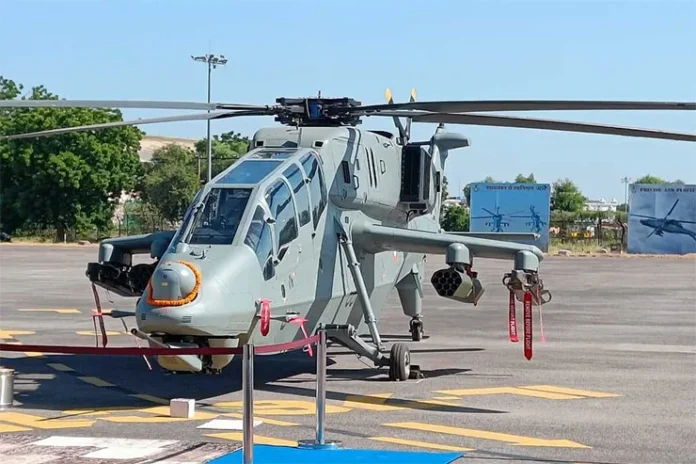
New Delhi: In a boost to defence industry, defence public sector undertaking Hindustan Aeronautics Limited (HAL), has successfully completed the production of 15 units of Light Combat Helicopter (LCH) Prachand into the Armed Forces, ahead of the contracted schedule.
Just last year, in March 2022, the Cabinet Committee on Security (CCS) granted approval for the production of 15 LCHs — 10 allocated to the IAF and 5 designated for the Indian Army, with a budget of Rs 3,837 crore.

Designed as an attack helicopter, the LCH is equipped to carry an arsenal of weaponry, including 70mm unguided rockets, laser-guided rockets, anti-tank guided missiles, air-to-air missiles, and a 20mm machine gun.
Functioning primarily as a close air support (CAS) aircraft in high-altitude terrain, it excels in roles such as conducting destruction of enemy air defence (DEAD) missions, executing high-altitude bunker-busting operations, and intercepting slow-moving remotely piloted aircraft (RPAs).
Setting a remarkable global precedent, the LCH Prachand stands as the only helicopter in the world with the capability to operate at altitudes above 5,000 to 6,000 metre while carrying a substantial offensive payload.
It holds the distinction of executing successful landings at forward camps situated at Siachen, an altitude of 4,700 meters above sea level, while carrying a 500 kg payload.

The inception of the concept of light attack helicopters for high-altitude regions traces back to the Kargil war. It was during this conflict that the limitations of the attack versions of Mi-8 and Mi-17 helicopters became evident, as they struggled to operate effectively in the challenging high-altitude terrains of Kargil. These helicopters encountered formidable challenges when attempting to scale towering Himalayan mountains in their fully loaded configurations. Consequently, the forces had to strip down the helicopters, painstakingly reducing their weight to a level that would enable them to bear the substantial loads of fuel and ordnance required for their missions.
At present, the indigenously designed and developed LCH boasts an indigenous content of 45 per cent by value, with strategic initiatives underway to enhance this proportion to over 55 per cent, thereby strengthening its home-grown identity and capabilities.