


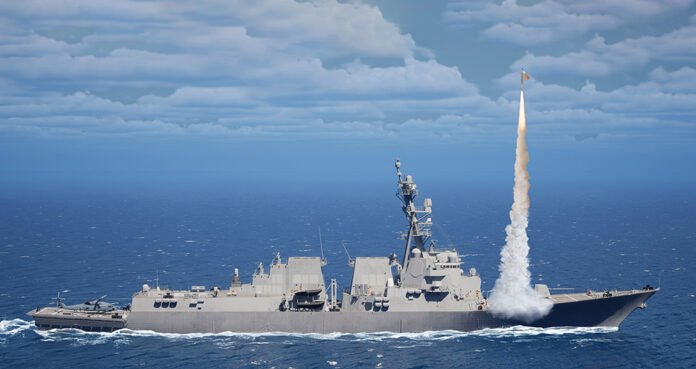
Tel Aviv: Lessons from recent armed conflicts in the Middle East and with an eye on China, the US Navy is enhancing its capability to protect its ships and the surrounding areas from aerial threats like hypersonic missiles.
The US government announced a contract with Lockheed Martin for the development, integration, and testing of PAC-3 Missile Segment Enhancement (MSE) into the Aegis Combat System. This move places the US Navy among the ranks of PAC-3 MSE users around the world, including the US Army and 16 partner nations, giving US Navy warships an advantage.

The PAC-3 MSE is a high-velocity, hit-to-kill interceptor originally developed for the US Army’s ground-based Patriot air and missile defence system. It excels at intercepting ballistic missiles, cruise missiles, drones, and aircraft in the terminal phase using kinetic energy rather than explosives. Its compact size and advanced seekers make it ideal for dense threat environments.
The Aegis Combat System, deployed on Arleigh Burke-class destroyers and Ticonderoga-class cruisers, uses the Mk 41 Vertical Launching System (VLS) to fire missiles guided by SPY-1 or SPY-6 radars.
The recent US Navy contract with Lockheed Martin enable PAC-3 MSE launch from these VLS cells, adding a layered defence option alongside SM-2, SM-3, SM-6, and ESSM missiles. This expands Aegis’s capacity to handle hypersonic, manoeuvring, and swarm threats without new hardware.
This upgrade addresses evolving threats like Chinese hypersonic anti-ship missiles and drone swarms in high-intensity conflicts like the Pacific and Red Sea.


-The writer is an Israel-based freelance journalist. The views expressed are of the writer and do not necessarily reflect the views of Raksha Anirveda





