


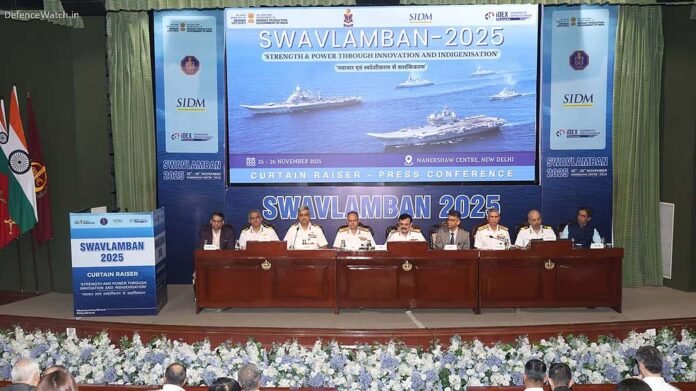
The Indian Navy’s fifth Swavlamban seminar will build on a growing national effort to connect technological talent with the requirements of the maritime domain. Across two days, its exhibition and deliberations are intended to encourage direct engagement between the Navy, other services, security agencies and the people and organisations developing new technologies.
The focus is not simply on showcasing innovation. Swavlamban aims to help promising solutions progress towards testing, production and operational deployment, while strengthening the domestic capacity to manufacture, sustain and upgrade critical systems. Its central ambition is to bring India’s innovation ecosystem closer to the practical demands of military operations – and to help build a more self-reliant Indian Navy.

A growing national platform
Swavlamban has expanded substantially since its first edition, which drew around 800 participants. Nearly 3,000 attended last year, reflecting the wider engagement of India’s defence ecosystem. More than 100 stalls are expected at the 2026 event, with participation anticipated to grow further.
That expansion represents more than an increase in numbers. A larger gathering creates more opportunities for innovators to meet potential users, hear operational feedback and explore partnerships with industry, academia and investors. For the Navy and other participating organisations, it offers a setting in which to examine emerging technologies and consider how they might address real capability needs.
The seminar has also been supported by the Government of India, the Ministry of Defence, the Society of Indian Defence Manufacturers and the Defence Innovation Organisation. Their involvement reflects the broad collaboration behind Swavlamban and the shared interest in strengthening indigenous defence innovation. Each edition has built on the progress of the previous one, widening participation and creating new avenues for cooperation between the Navy and the country’s innovation ecosystem.
From proposals to projects
The Innovation for Defence Excellence framework, or iDEX, is an important part of this wider effort. More than 4,000 proposals have been received from Indian innovators, with around 150 MSMEs and start-ups involved. Acceptance of Necessity has been accorded for projects worth more than ₹3,500 crore, while contracts worth over ₹1,900 crore have been concluded.

These figures point to both the interest of Indian enterprises in defence challenges and the scale of the opportunity available to them. They also underline a key purpose of Swavlamban: creating stronger connections between innovative ideas and the processes through which defence requirements are addressed.
For developers, engagement with the armed forces can provide insight into operational needs and the conditions a system must withstand. For users, interaction with innovators can offer an early view of possible solutions and a chance to share feedback. When sustained, this exchange can help align development with practical requirements, rather than leaving promising technologies disconnected from the environments in which they may eventually be used.

Meeting increasingly complex challenges
The work associated with Swavlamban is also becoming more technically ambitious. Challenges highlighted for the programme include Quantum Positioning Systems, High-Power Microwave directed-energy systems, an Extra-large Autonomous Underwater Vehicle and indigenous Ramjet engines for fixed-wing aerial platforms.
Such technologies illustrate the increasing sophistication of the problems being tackled. They also reflect the changing character of warfare, where advances in unmanned systems, artificial intelligence, sensors and networked capabilities are influencing how forces gather information, make decisions and operate.
The maritime domain is part of this transformation. For the Indian Navy, responding to technological change means more than acquiring new equipment. It requires the ability to develop, integrate and employ capabilities suited to operational requirements-and to do so with speed. Swavlamban provides a forum for examining how domestic innovation can contribute to that effort.
Speed and spiral development
Two themes will be particularly important as the Navy pursues the integration of advanced technologies: speed and spiral development.
Speed means making the journey from an idea to a usable capability more efficient. Promising concepts must be able to move through prototyping, testing and production towards deployment in a way that is responsive to the needs of both the Navy and industry. Faster pathways do not remove the need for sound engineering or rigorous trials; rather, they aim to help useful ideas progress through development without unnecessary delay.
Spiral development recognises that technology and operational needs continue to evolve. A system can be improved over successive stages by incorporating feedback from users, lessons from trials and advances in technology. This approach makes development an ongoing process: each stage can help refine what came before and inform what comes next.
Both themes depend on sustained engagement. Regular communication among the Navy, industry and innovators can help developers understand user experience and enable users to assess how a technology performs. Together, speed and spiral development can support a more responsive route from innovation to capability.
Alongside these two priorities, scale and sophistication complete what the Navy describes as four guiding aspects of its technology absorption effort. Scale reflects the growing participation in Swavlamban and related initiatives. Sophistication points to the complexity of the challenges being addressed. Speed and spiral development describe how solutions can progress and improve.
Two days of interaction and deliberation
The Swavlamban 2026 exhibition will offer the Indian Navy, the other three services and security agencies an opportunity to meet innovators, industry, academia and investors directly. These interactions can help participants explore new technologies and consider their operational relevance.
The accompanying deliberations will address obstacles that can affect the progress of promising ideas. Areas of discussion include cybersecurity vulnerabilities, supply-chain vulnerabilities and access to funding for development and production. Addressing such hurdles matters because a promising design must be supported by the means to develop, manufacture and sustain it.
The event’s intended outcome extends beyond the exhibition itself. The aim is for promising technologies to move closer to deployment and for Indian industry to develop the capacity to produce, support and upgrade them. Domestic enterprises are being encouraged to demonstrate their expertise, expand their capabilities and become dependable partners across the maritime domain.
Building lasting capability
For industry and academia, the Navy’s message is to bring forward disruptive solutions grounded in operational understanding, supported by sound engineering and backed by a commitment to reliable delivery. That emphasis links innovation to the practical demands of service: a technology must not only be novel, but also useful, dependable and capable of being supported over time.
Self-reliance, in this context, is a continuing national effort. It rests on the ability to design, manufacture, sustain and improve critical technologies within the country. Each successful partnership can contribute to that capacity, while giving innovators a clearer path to engage with defence needs.
Swavlamban 2026 will carry this effort forward through its exhibition, discussions and opportunities for collaboration. Its measure of success will ultimately lie not only in participation or the technologies displayed, but in whether engagement helps promising ideas become practical capabilities-and strengthens the domestic ecosystem needed to maintain them.






