


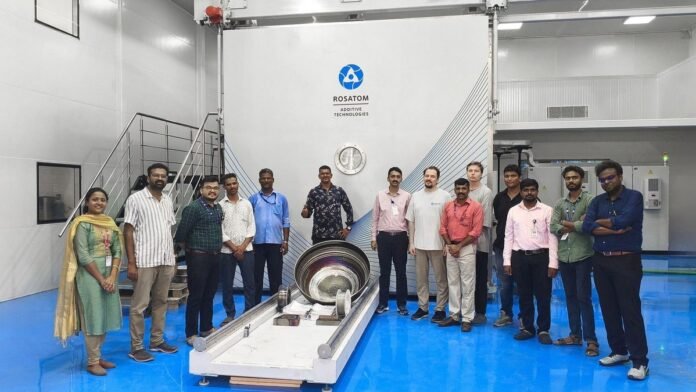
Russia’s State Atomiс Energy Corporation – Rosatom, has made a significant entry into India’s additive manufacturing market by delivering its RusBeam 2800 industrial 3D printer to the Indian Space Research Organisation (ISRO).
This advanced Electron Beam Additive Manufacturing (EBAM) system, commissioned in April 2026, is designed to fabricate large, complex metal components for India’s aerospace and space programmes, including the Gaganyaan mission and the Bharatiya Antariksh Space Station.

Rosatom’s Entry into India’s Additive Manufacturing Sector
The RusBeam 2800 is India’s largest vacuum-operated electron-beam wire deposition printer, capable of fabricating parts up to 2.8 metres in height and weighing four tons using advanced titanium, nickel, and cobalt-chrome alloys.
It features a print speed of 50 mm/s, allowing a 50 kg part to be produced in just five hours, which significantly reduces production time and material waste compared to traditional subtractive methods.
This collaboration, following the December 2025 summit between Russian President Vladimir Putin and Indian PM Narendra Modi, which also includes discussions for joint R&D, potential localisation of equipment manufacturing in India, and a possible 50:50 joint venture.
Technical Capabilities and Impact
This technology enables near-net-shape fabrication of components that are difficult to produce otherwise, allowing for rapid prototyping and production of aerospace structures. This represents a “significant leap” in ISRO’s capabilities, ensuring material integrity for extreme space conditions.

Strategic Collaboration and Future Plans
The deal follows the December 2025 summit between the Russian President Vladimir Putin and Indian PM Narendra Modi, which emphasised deeper technological cooperation. Alexey Likhachev, Director General of Rosatom, stated that the win in an international tender highlights the global competitiveness of Russian technology.
Beyond the supply of hardware, Rosatom is in active discussions with Indian partners for:

Joint R&D in additive technologies,
Localisation of equipment manufacturing in India, and
A potential 50:50 joint venture, as previously indicated by Ilya Kavelashvili of Rosatom, to produce both 3D printers and metal powders for domestic and regional markets
Broader Industrial Engagement
Rosatom is also expanding its footprint through partnerships with Indian industry. In March 2026, it signed an MoU with HMT Limited, a public sector engineering company, to manufacture additive technology machines in India. This collaboration aims to boost domestic production, reduce import dependence, and support India’s Aatmanirbhar Bharat initiative across aerospace, defence, and automotive sectors.
India Seeks Self-Reliance, Rosatom Offers Advanced Tech
This deal highlights Russia’s strategic position to supply advanced technology to India amid changing global politics. As India pushes its Aatmanirbhar Bharat initiative, partnerships for critical technologies like additive manufacturing are vital. The global aerospace 3D printing market is expected to grow significantly.
Rosatom’s specific EBAM technology places it in a strong niche. Major competitors in the broader metal additive manufacturing sector include GE Additive, Nikon SLM Solutions, and 3D Systems, with companies like Nikon developing large platforms for others. GE Additive has also invested heavily in expanding its production.
However, Rosatom’s offer of a complete ecosystem – hardware, software, materials, and services – is attractive for partners seeking end-to-end solutions. While India and Russia have an existing defence relationship, this technology cooperation is expanding. India’s domestic metal additive manufacturing market is also projected for growth, with aerospace and defence as key drivers. Government policies encouraging indigenous manufacturing and private sector involvement in space further emphasise the importance of such international technology transfers.
Concerns Over Reliance on One Supplier and Future Challenges
While the Rosatom-India collaboration marks a technological step forward, it also raises concerns about India potentially becoming too dependent on a single foreign supplier for critical aerospace manufacturing.
India’s historical reliance on Russia for defence equipment, though decreasing, shows the complexities of such partnerships in a world with shifting alliances and sanctions. The Aatmanirbhar Bharat initiative aims for self-sufficiency, but acquiring cutting-edge technology often requires external help, creating a difficult balance.
Future cooperation could also be affected by geopolitical pressures and potential restrictions from Western nations on related dual-use technologies. Although EBAM offers advantages, it demands specialised skills and infrastructure, which could lead to training and maintenance challenges. Competitors are also advancing rapidly in large-format metal printing, meaning technological leadership can change quickly.
For India’s long-term strategic independence in this field, the extent of true technological indigenisation and potential local manufacturing by Rosatom will be key factors to watch. The current global climate also presents risks for stable long-term supply chains and potential price changes.
Strengthening Indo-Russian Cooperation and Local Production
The successful setup of the RusBeam 2800 is expected to drive more collaboration between Rosatom and its Indian partners. Discussions may focus on joint research into additive technologies and potentially localising equipment manufacturing within India.
This aligns with India’s ambition to become a global hub for commercial space activities and its drive for domestic production in strategic sectors. As India’s aerospace and defence industries continue to grow, driven by new programmes and demand for complex parts, advanced additive manufacturing solutions like EBAM will be essential.
Future progress could see these technologies more deeply integrated into India’s space programme, supporting upcoming missions and furthering its self-reliance goals.






