

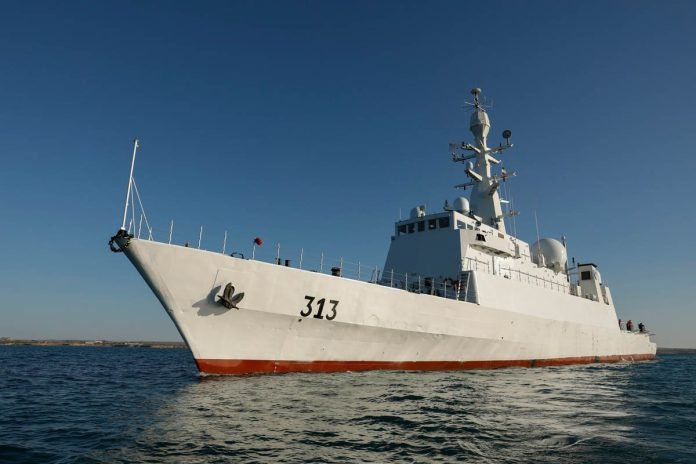
Tel Aviv: On Saturday, June 24 – the Israeli Air Force destroyed the Iranian intelligence ship ‘Zagros’ while it was anchored in the Bandar Abbas port. The Iranian Islamic Revolutionary Guard Corps (IRGC) for some years made efforts to deploy locally built ships to collected intelligence on marine traffic in the Red Sea and Gulf of Aden.
Since 2016, two of these ships—M/V Saviz and M/V Behshad—have been spotted off the coast of Yemen almost constantly and have been connected to giving the Houthis direct assistance. These ships are able to maintain an accurate maritime picture by combining all-source intelligence with Automatic Identification System (AIS) data collected from passing commercial vessels. This information was shared with the Iranian proxy in Yemen , the Houthis and helped this terror organisation to attack commercial ships.

Zagros is based on the hull of a Mowj-class frigate, which is unusual for a SIGINT ship. Most intelligence-gathering vessels are typically converted from commercial vessels, but Iran has chosen to use the hull of a warship for this purpose. This approach likely provides more space for sensors and sensor operators, as well as increased power generation capabilities. As a signals intelligence vessel, the Zagros is equipped with electronic sensors designed to collect, decode, and analyse radio signals emitted by hostile or suspicious sources. It features seven spherical domes protruding from its upper superstructure, which house various antennas and satellite communications systems.
One of the Zagros’ most notable features is its ability to conduct cyber warfare operations, although details of this capability remain scarce. The inclusion of cyber warfare capabilities underscores Iran’s increasing focus on both traditional intelligence gathering and countering modern digital threats. The ship also has a flight deck and hangar that can accommodate a helicopter, adding to its operational flexibility. This addition could be used for logistical support during extended deployments, for force protection, or even as a platform to carry additional sensor payloads.

-The writer is an Israel-based freelance journalist. The views expressed are of the writer and do not necessarily reflect the views of Raksha Anirveda





