


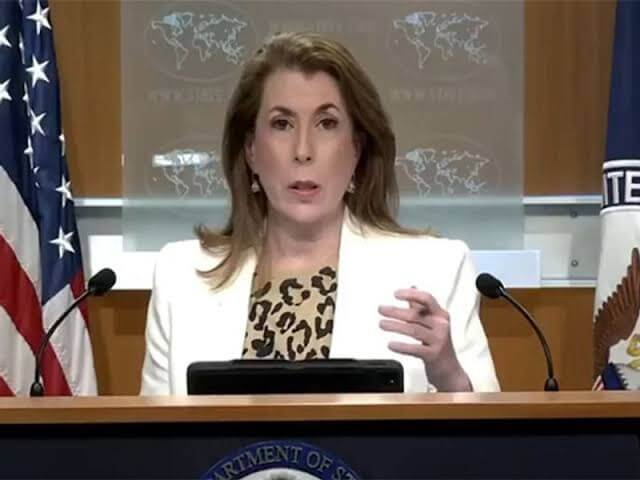
Washington: The US State Department has openly criticised India’s stance that Washington played no role in the recent ceasefire agreement between India and Pakistan, calling such claims “potentially misguided.”
During a press briefing on July 8, 2025, State Department Spokesperson Tammy Bruce addressed the diverging narratives from Indian and Pakistani officials regarding US involvement in brokering a peace deal after heightened tensions following the April 22 Pahalgam Terror Attack and India’s subsequent ‘Operation Sindoor’ targeting terror camps in Pakistan and Pakistan-occupied Kashmir.

Bruce emphasised the transparency of modern international affairs, stating: “So many comments speak for themselves. That’s one of the good-news aspects of our modern world is people can see what’s really occurring. You’re not reliant on a comment to know what has really happened. The world is playing out in front of us in real time on big screens and small screens. Everyone will have an opinion. That’s an opinion. Some opinions are wrong. Mine rarely are but other people’s opinions can be wrong.”
She further highlighted the involvement of key US figures in the ceasefire negotiations, specifically naming Donald Trump, Secretary of State Marco Rubio, and the Vice President, all of whom were said to have participated in talks with both Indian and Pakistani leadership.
According to the US, the ceasefire was brokered with their direct diplomatic engagement, with both countries agreeing to immediate cessation of hostilities and to commence talks at a neutral venue. Despite these US assertions, India has consistently refuted claims of American mediation, maintaining that the agreement was reached independently after Pakistani military officials initiated contact with India for dialogue.
The US, however, has reiterated its view that it played a crucial role, with President Trump publicly stating that his administration’s intervention prevented the conflict from escalating to a potentially nuclear confrontation, and that peace was achieved partly through leveraging trade relations.

This episode underscores ongoing tensions between the US and India regarding the narrative and credit for the de-escalation, with the US State Department taking a firm public stance against India’s dismissal of American involvement.






