


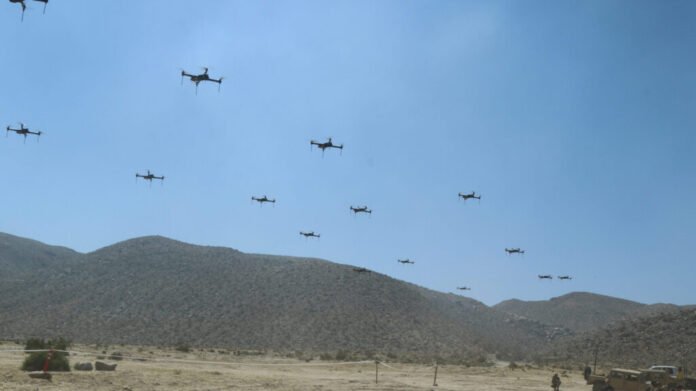
Washington: Early next year, the US Air Force will see a demo of a new Honeywell system that combines kinetic interceptors, directed energy and electronic warfare capabilities to protect high-value targets from swarms of inbound drones.
The company used this year’s Air & Space Forces Association conference outside of Washington, DC, to announce its Stationary and Mobile Unmanned Aerial System (UAS) Reveal and Intercept capability that cobbles together host technologies from other vendors.

“Modern warfare is rapidly changing, and the threat swarm drones pose to high-value assets can have a devastating effect on military operations,” Matt Milas, Honeywell Aerospace defence and space president, said in a press release. The scalable configuration, he added, is designed to be integrated onto vehicles, as well as fixed-based platforms to protect sensitive targets from incoming drones.
Although Honeywell did not disclose the technologies on the new system, key pieces of equipment are coming from Blue Halo, Leonardo DRS, Pierce Aerospace, Silent Sentinel, Walaris, Rocky Research and Versatol.
In a statement a Honeywell spokesperson said the system marries up radar, electro-optical/infrared, and artificial intelligence detectors, and then knocks the drones down by either launching a kinetic interceptor, using a directed energy weapon or severing the radio contact back to the controller.
“This system’s multi-layered defensive capabilities set it apart in the industry and enable it to not only track and detect, but also defeat multiple threats,” Milas said in the press release.

The Air Force Global Strike team has now tasked Honeywell with demonstrating the system in January 2025, at which time the C-UAS system will be used to first detect an unspecified number of drones moving at a high speed before disabling them.
The growing role of drones on the battlefield inside Ukraine and in the Middle East has not only pushed the US military to ramp up its hunt for new capabilities, but also systems to defeat them. Part of that focus has revolved around existing kinetic options like Stinger missiles, while also testing out new directed energy ones like high-energy laser and high-powered microwaves that may one day drive provide a cheaper per unit kill option.


Raksha Anirveda's editorial desk team brings in the collective experience of creative professionals - a fine mix of senior copy editors, writers, proofreaders and designers. Working as a team, they continuously create, manage, and curate content to sustain the magazine's profile and reputation in line with market trends and achieve magazine's goal.





