


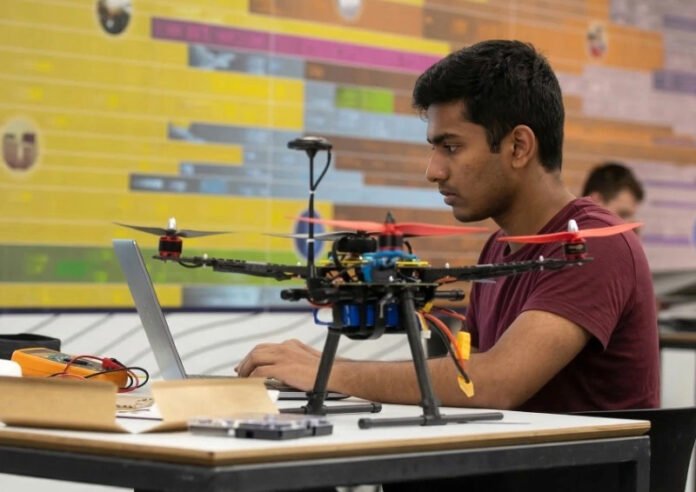
the meagre mention of the word drone has now become synonymous with a raging battlefield. Drones are now the go-to option for advanced militaries, paramilitaries, militias, drug cartels, and criminal gangs alike. A remote split operation that once required an exquisite networked platform like the Predator, costing millions, has now found its match in cheap yet highly effective low-observable drones such as the Shahed, versions of which multiple nations are fielding.
Some argue that drone warfare signals the end of infantry and armoured manoeuvre. That is far from the truth. Today, drones are vital frontline equipment for immediate tactical effect and then transform into tools of attrition for long-term strategic impact. Recent conflicts in Ukraine, Operation Sindoor, and the Persian Gulf have shown how combinations of drones and missiles can devastate targets and how quickly warfare has shifted from borders to cities, enabled in large part by the drone.

Counter-drone technology has witnessed a tremendous upsurge, but remains largely restricted to modern militaries that can afford advanced sensors, effectors, and sustained training. Drone versus anti-drone is now the order of the day. For most readers, drone warfare evokes images of the Shahed or Predator in the sky, yet drones today prowl the surface of the water and the depths beneath. Ukraine has used naval drones to effectively halt Russian naval operations, destroying prized warships in the early phase of the conflict.
India’s drone market is projected to reach ₹12,000–₹15,000 crore this year, yet the consumer segment in STEM education, gaming, and entertainment remains almost entirely untapped. At the same time, India’s education system serves 24.8 crore students across 14.72 lakh schools, an enormous latent base for drone-based learning and talent development
Look deeper, and a pattern emerges. A country with a highly trained generation of drone-enabled enthusiasts, gamers, and technicians is perhaps the most essential ingredient for achieving drone supremacy or at least parity with nations already in the mix. A generation initiated into the nuances of drone technology will help maintain an edge in design, development, and operational deployment. Many grandiose designs can be conceived on drawing boards, but whether they work in high-pressure, high-stakes environments is often better understood by gamers already flying missions in their virtual skies, racing arenas, or engaging in casual competition within their peer group.
The drone narrative has also shifted. Drones were supposed to be the pathway to advanced aerial robotics, culminating in autonomous air taxis and unmanned ground, underwater, and surface vehicles for civilian and commercial use. That vision remains, but it now sits alongside the hard operational lessons of contemporary conflict.
India is at an inflection point. The domestic drone market is projected to reach ₹12,000–₹15,000 crore this year, yet the consumer segment in STEM education, gaming, and entertainment remains almost entirely untapped. At the same time, India’s education system serves 24.8 crore students across 14.72 lakh schools, an enormous latent base for drone-based learning and talent development.

GoDronz is built with a long-term vision: to enable India’s drone-ready generation. As unmanned systems evolve from niche technologies to everyday infrastructure across civil airspace and defence environments, GoDronz prepares individuals at the intersection of aerospace, security, and education
This is where GoDronz, a young Indian startup, steps in. GoDronz is building an integrated platform for aerial robotics, taking cues from Ukraine’s “heavyweight champion” status in drone innovation but adapting them for India’s classrooms and communities rather than its battlefields. The intent is clear: create national-scale human capital for a future low-altitude economy and, indirectly, for any defence-industrial requirements that follow.
GoDronz One App is a full-stack aerial robotics skill development ecosystem that seamlessly integrates STEM education, gameplay, engineering and innovation. It is designed to bridge the gap between theoretical learning and real-world drone applications through an intelligent, hands-on, and immersive platform.

The ecosystem brings together the entire lifecycle of aerial robotics learning, designing, building, coding, and safe flying into a unified experience. By normalising interaction with drones, GoDronz aims to develop a generation that is not only skilled operators but also confident and aware participants in environments where unmanned systems are increasingly prevalent.
GoDronz is built with a long-term vision: to enable India’s drone-ready generation. As unmanned systems evolve from niche technologies to everyday infrastructure across both civil airspace and defence environments, GoDronz prepares individuals at the intersection of aerospace, security, and education.
By translating real-world operational insights into structured learning and interactive experiences, GoDronz transforms how aerial robotics is understood, learned, and applied at scale.






