


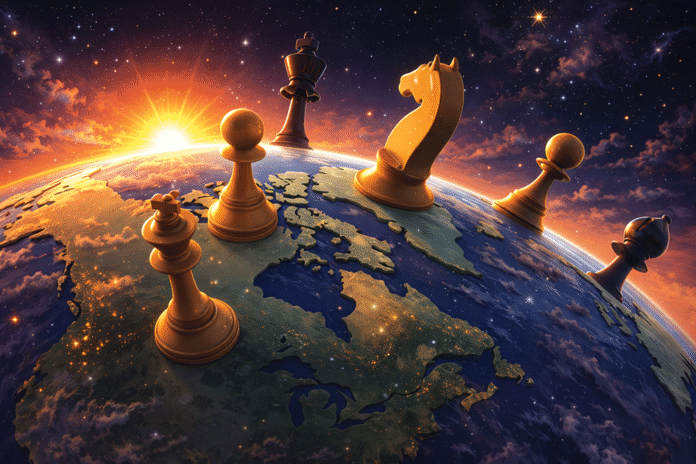
The word Interregnum comes from Latin, inter (between) and regnum (reign or rule). In ancient Rome and medieval Europe, it described the dangerous legal vacuum between the death of one ruler and the formal accession of the next. As per historical records, these power vacuums, even temporary ones, are rarely peaceful (Wallerstein, 2004). It was an Italian scholar, writing in a prison cell, who transformed the concept into a powerful analytical tool in modern political thought. Antonio Gramsci, confined by Mussolini’s government, wrote in his Prison Notebooks (1929–1935) the words that resonate even today:
“The crisis consists precisely in the fact that the old is dying and the new cannot yet be born; in this interregnum a great variety of morbid symptoms appear.”

For Gramsci, an interregnum was not merely a political transition ; it was a crisis of hegemony. The ruling class loses its cultural and moral authority and its capacity to lead through consent rather than coercion, before an alternative leadership has organised itself sufficiently to take its place. The ‘morbid symptoms’, as Gramsci predicted — the rise of irrational ideologies, purposeless wars and the collapse of shared norms and values — are the predictable occurrences that fill the vacuum of legitimate authority (Gramsci, 1971). Similarly, Immanuel Wallerstein’s world-systems theory characterised the post-Cold War moment as a structural crisis of the capitalist world order. He described it as a long interregnum between American hegemonic decline and an uncertain successor configuration (Wallerstein, 2004). The question this article poses is candid: Is the world of 2026 living through an interregnum?
1991: The Unipolar Moment and Power Without Wisdom
The collapse of the Soviet Union in 1991 was received in Western capitals not as a call for humility and inclusive institutional design, but as an ideological vindication requiring further consolidation. Francis Fukuyama’s much celebrated The End of History and the Last Man (1992) declared that liberal democracy had won the contest of ideologies. Charles Krauthammer coined the phrase ‘the unipolar moment’ in Foreign Affairs (1990), predicting that American primacy would shape the coming century. The mood was triumphal to say the least, and triumph has a dangerous tendency to produce strategic blindness.
Antonio Gramsci, wrote the words that resonate even today: “The crisis consists precisely in the fact that the old is dying and the new cannot yet be born; in this interregnum a great variety of morbid symptoms appear”
The most revealing document of this period is the Defence Planning Guidance of 1992, drafted under Under-Secretary of Defence Paul Wolfowitz and leaked to the New York Times. Its language was candid to the point of being disconcerting. It stated that America’s primary strategic objective was to prevent the emergence of any rival power capable of challenging US supremacy, in Europe, Asia or the former Soviet space. The document explicitly targeted preventing Russia’s re-emergence as a great power and deterring European strategic sovereignty. Subsequent national security strategies of 1994, 1995, and 1999 maintained this logic beneath the softer veneer of ‘engagement and enlargement’.
Looking back, rather than using the unipolar moment to embed Russia and other emerging powers in a multilateral architecture that they had a genuine stake in preserving, the United States treated 1991 as a geopolitical dividend to be exploited. Russia was neither included as a legitimate partner in the post-Cold War order, nor in the security architecture of Europe. It was treated as a defeated power whose interests were negotiable only on Washington’s terms. Vladimir Putin, in his landmark Munich Security Conference speech of 2007, captured this grievance with measured precision:

“What is a unipolar world? No matter how we embellish this term, it ultimately refers to one type of situation, one centre of authority, one centre of force, one centre of decision-making … It is a world in which there is one master, one sovereign …” (Putin, 2007)
Putin was not complaining; it was a structural diagnosis that would prove, in retrospect, to be the clarion call for the multipolar challenge.

Mearsheimer’s Tragedy: Why Unipolarity Generates Destruction
To understand why American unipolarity degenerated into the pattern of conflict that has defined the post-1991 era, one needs to engage with John Mearsheimer’s Offensive Realism, laid out in The Tragedy of Great Power Politics (2001). The theory rests on five structural premises: international anarchy (no authority above states), offensive military capability (all great powers possess tools of coercion), uncertainty (no state can fully know another’s intentions), survival (the primary goal of every state), and rationality (states calculate to maximise security). From these five premises flows a tragic conclusion: States are structurally compelled to maximise power, not merely defend it (Mearsheimer, 2001).
The ‘tragedy’ is not that states are vindictive. It is that the structure of the international system makes aggressive behaviour rational and sometimes inevitable. Security-seeking or consolidation itself produces insecurity. As one great power accumulates capabilities, neighbouring powers feel threatened and respond in kind, generating the very conflicts that each party sought to avoid (Mearsheimer, 2001).
Applied to American behaviour after 1991, the theory of Offensive Realism is more enlightening than any other assessment. The Wolfowitz Doctrine was not an aberration; it was, as seen through the Mearsheimer’s framework, the textbook behaviour of a hegemon using a temporary window of unchallenged dominance to foreclose the emergence of any future challenger. Mearsheimer himself observed: “States that achieve regional hegemony seek to prevent great powers in other regions from duplicating their feat. Regional hegemons, in other words, do not want peers.” (Mearsheimer, 2001, p. 41). NATO expansion, regime-change operations, colour revolutions and the weaponisation of international financial institutions are all explicable through this structural lens.
A unipolar world produces more wars, not fewer, because the hegemon faces no systemic restraint (Waltz, 1979). An analysis of the post-1991 record of the world brings about this painful reality
The tragedy was that this very behaviour sent a clear message to Russia and China that no sphere of influence would be appreciated, thereby leading to accelerated military modernisation and strategic alignment with one another. Mearsheimer’s 2014 Foreign Affairs article, “Why the Ukraine Crisis Is the West’s Fault,” applied this logic directly. NATO expansion was structurally intolerable to Russia not because Putin is uniquely aggressive, but because any great power would respond similarly to a hostile military alliance expanding to its borders (Mearsheimer, 2014). He further writes, ‘US and European leaders blundered in attempting to turn Ukraine into a Western stronghold on Russia’s border. Now that the consequences have been laid bare, it would be an even greater mistake to continue this misbegotten policy’. How true! The prophecy was vindicated in 2022.
Catastrophic Wars, Bombings, Sanctions, and Subversion
Kenneth Waltz warned in Theory of International Politics (1979) that unipolarity is inherently unstable. He argued that an unchecked hegemon will inevitably overextend, generating balancing coalitions. A unipolar world produces more wars, not fewer, because the hegemon faces no systemic restraint (Waltz, 1979). An analysis of the post-1991 record of the world brings about this painful reality.
The Gulf War I (1991) established the template of US-led ‘coalitions of the willing’ that would increasingly bypass multilateral legitimacy. The Yugoslavia (1999) saw NATO conduct a sustained bombing campaign without a UN Security Council mandate — truly a watershed moment in the erosion of international law. The Afghanistan (2001–2021) after 9/11 did initially attract international support, but its twenty-year occupation ended in the most visible military failure, restoring the Taliban to power and shattering American prestige worldwide. The Iraq II (2003) was launched on the fabricated pretext of weapons of mass destruction, in explicit defiance of the UN Security Council, leading to large-scale radicalisation and jihadist recruitment (Crawford, 2019).
In Libya (2011), NATO’s ‘responsibility to protect’ mandate, obtained with Russian and Chinese abstentions (measured as support in diplomatic language), was weaponised for regime change, transforming a functional state into a failed one in which open-air slave markets eventually operated. Similarly, in Syria, Venezuela, Iran, and Cuba, the United States has deployed the full spectrum of unrestrained unilateral coercive power, including military force, aerial bombardment, proxy warfare, economic strangulation and diplomatic isolation, breaking those very international laws that it beckons others to uphold.
Where outright military intervention was deemed too costly or conspicuous, Washington developed and systematically deployed a sophisticated toolkit of what may be called ‘democracy promotion by other means’ — so called colour revolutions, as if democracy was a panacea for all evils. These were not organic uprisings but a carefully prepared, generously financed, choreographed and strategically coordinated set of operations designed to replace governments that refused alignment with US interests (Norden, 2014).
The “Bulldozer Revolution” in Serbia (2000), “Rose Revolution” in Georgia (2003), “Orange Revolution” in Ukraine (2004), “Tulip Revolution” in Kyrgyzstan (2005) and many other instances followed a pattern that was similar, although with dissimilar names betraying the uniformity of their external sponsorship.
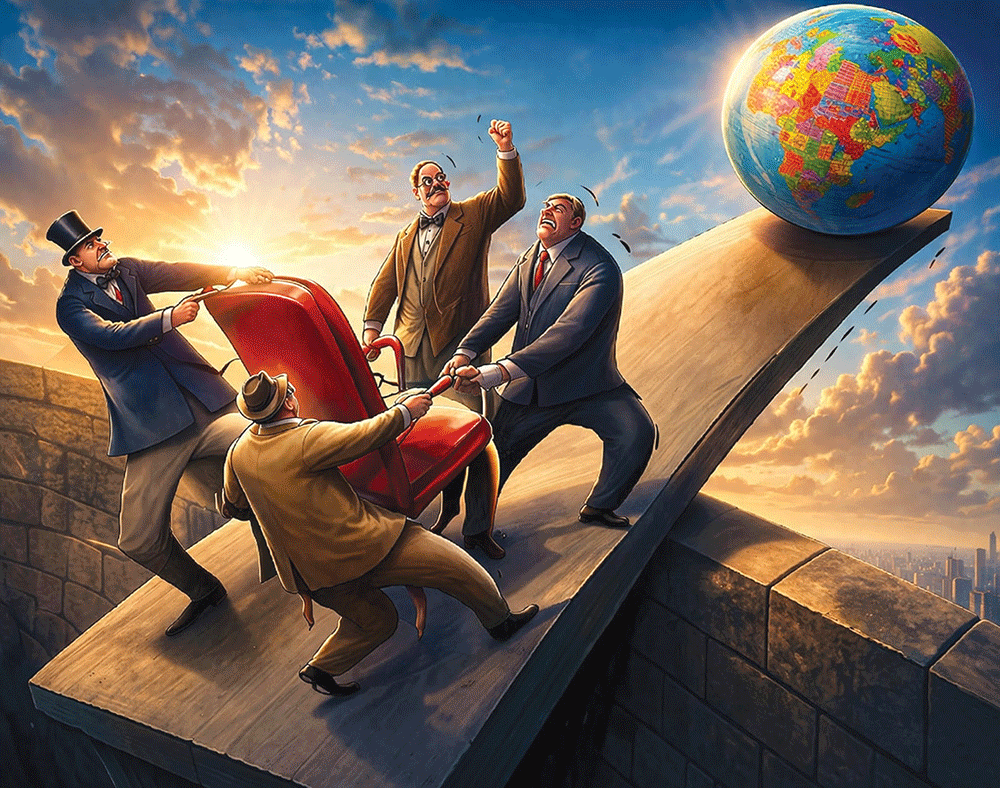
Perhaps most revealing was the response of America’s closest Western allies to this comprehensive pattern of interventions, much against the tenets of international law. Nations that had lectured the world about international law and the sanctity of sovereignty fell remarkably silent during the Venezuelan and Cuban strangulations, the Iranian assassinations and the Kosovo bombings, only to discover their indignation when a NATO member, Denmark, was itself threatened by the very hegemon they had long enabled. The selective application of principles is not an international rules-based order. It is, as Russian Foreign Minister Sergei Lavrov has stated on various occasions with characteristic directness, that The West has never liked the order based on the central role of the UN and respect for international law, because it is used to living in a neo-colonial paradigm ….. It has created for the privileged few a ‘rules-based order’, to the detriment of international law …….. a self-referential system in which the West writes the rules, interprets the rules, and applies them or suspends them. The UN Security Council has been systematically bypassed, the International Criminal Court has been instrumentalised to suit a few, and the World Trade Organisation’s dispute settlement mechanism has been effectively crippled by sustained US obstructionism.
The Structural Decline of American Power
The cumulative cost of these interventions has been staggering and self-defeating. Wars and overseas deployments have cost the United States an estimated eight trillion dollars without producing a single durable strategic victory (Crawford, 2019). The Pentagon’s own assessments have concluded that the US military can no longer claim assured victory in a conflict with peer competitors China or Russia — a noteworthy public acknowledgement for a defence establishment that once spoke confidently of ‘full-spectrum dominance’.
The old is dying. American military credibility has been damaged by decades of inconclusive wars. Dollar hegemony is eroding. Western-led institutions face deepening legitimacy crises
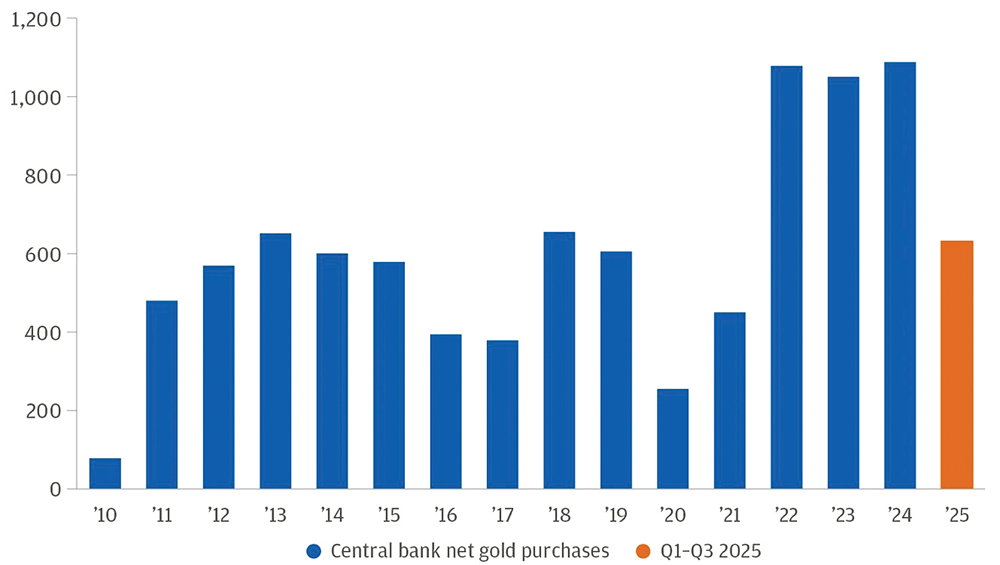
Weaponising the dollar and global trade mechanisms has been counterproductive. The arbitrary freezing of approximately 300 billion dollars of Russian sovereign reserves held under international legal frameworks in 2022 has alarmed central banks worldwide. The message received was clear: dollar-denominated assets held in Western financial institutions are not safe from political seizures. The result has been an accelerated de-dollarisation process. BRICS nations are actively developing alternative payment systems, Saudi Arabia has begun pricing oil sales in non-dollar currencies, and global central bank gold purchases have reached multi-decade highs (Eichengreen, 2022).
Alternative institutional frameworks are simultaneously consolidating. The Shanghai Cooperation Organisation (SCO), now encompassing over 40 per cent of the world’s population, has emerged as a security and political forum explicitly committed to multipolarity and non-interference. The New Development Bank and the Asian Infrastructure Investment Bank offer infrastructure financing without the ideological conditionality embedded in IMF and World Bank programs. The BRICS grouping, expanded in 2024 to include Saudi Arabia, the UAE, Iran, Ethiopia and Egypt, represents the formal institutionalisation of the Global South’s collective desire to construct alternatives to the Bretton Woods order (Stuenkel, 2020).
Is the world of 2026 living through Gramsci’s interregnum?
Considering the current geopolitical milieu, Gramsci’s century-old diagnosis now corresponds precisely with the present international system (Bauman, 2012).
The old is dying. American military credibility has been damaged by decades of inconclusive wars. Dollar hegemony is eroding. Western-led institutions face deepening legitimacy crises. NATO’s internal coherence is strained. The moral authority once derived from championing democracy and human rights has been severely compromised by unconditional support for military campaigns that international courts have found to violate fundamental humanitarian norms.
The new cannot yet be born. China is an economic giant but, as scholars observe, a political pygmy, with its global leadership claim undermined by governance deficits, Belt and Road debt concerns, and territorial assertiveness that has alienated many neighbouring states. Russia possesses strategic nuclear capability and battlefield experience but insufficient economic weight for global leadership. BRICS lacks the institutional cohesion to govern the global economy, and the SCO has no collective security mechanism comparable to NATO (Stuenkel, 2020).
The morbid symptoms abound. The proliferation of regional wars, the rise of authoritarian nationalism across every continent, the collapse of arms control architectures and the weaponisation of currencies and resource supply chains, are precisely the symptoms Gramsci predicted. The wars in Ukraine, Gaza, and Iran , and the gathering confrontations over Taiwan, Greenland, Cuba and unilateral tariffs, are not isolated incidents. These are consequences of a hegemonic system in transition, without adequate institutional guardrails.
India and Russia: Navigating the Interregnum Together
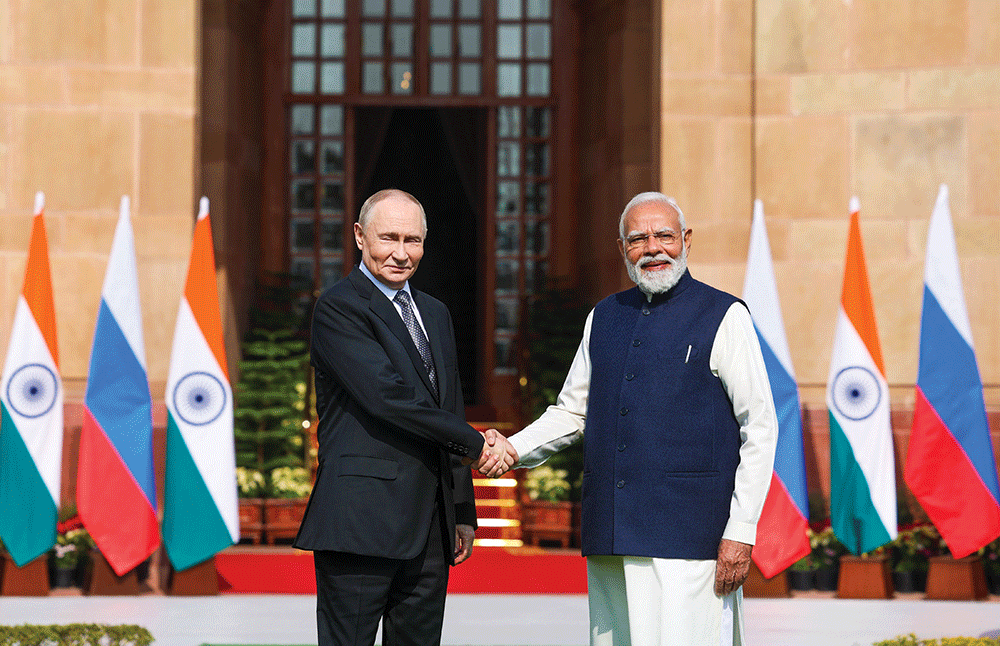
No bilateral relationship is more consequential for navigating the current interregnum than the partnership between India and Russia. Rooted in six decades of strategic cooperation, elevated to the Special and Privileged Strategic Partnership in 2010, the India-Russia relationship carries a depth of institutional memory, mutual trust and convergent geopolitical vision that no current great power realignment has been able to erode (MEA India, 2025; Joshi, 2020).
The 23rd India-Russia Annual Summit of December 2025 reaffirmed this convergence in explicit terms. The Joint Statement positioned the bilateral relationship as “an anchor of global peace and stability, grounded in the principle of equal and indivisible security ”. It committed both nations to “strive for global peace and stability in a multipolar world as well as in a multipolar Asia” (MEA India, 2025).
Shared Vision of Multipolarity
At the normative level, both India and Russia share a foundational commitment to a multipolar world order governed by the UN Charter’s principles of sovereign equality, non-interference in internal affairs and peaceful settlement of disputes. As a post-colonial democracy of continental scale, India has always been allergic to unilateral Western prescriptions. As a great power excluded from the post-Cold War settlement, Russia has consistently championed the construction of multilateral alternatives. Together, India and Russia represent the two most credible advocates of a reformed multilateral system that gives genuine voice to the non-Western world (International Journal of Legal Research and Development, 2025).
Lavrov’s articulation of this vision aligns precisely with India’s longstanding diplomatic position:
“There is actually a situation when the West with its insatiable hegemonic ambitions has entered, as they say, a clinch, with the desire of the world majority to overcome existing challenges on the basis of equality, justice or in other words on the basis of the principles of the UN Charter.” (Lavrov, 2023)
India has consistently echoed this principle while maintaining its own voice at the UN, G20, SCO, and BRICS. Its abstentions on Ukraine-related Security Council resolutions were not expressions of indifference but of principled commitment to the belief that the UN Charter’s norms must apply universally, not selectively (Jankar, 2025).
Institutional Leadership of the Global South
Where India and Russia are most powerfully positioned to act together is in the institutional reform of the multilateral order itself. Russia’s permanent membership of the UN Security Council and India’s imminent permanent membership, actively supported by Russia, France, and the United Kingdom, would transform the Council from a relic of 1945 power distribution into a body more genuinely reflective of today’s world.
Within BRICS, encompassing the world’s largest economies by purchasing power parity, India and Russia can jointly champion the construction of alternative financial architectures. These could include: a BRICS currency and payment system that reduces vulnerability to dollar weaponisation, a BRICS development finance institution with robust governance standards, and a BRICS-SCO security dialogue that offers the Global South a forum for conflict resolution outside Western-dominated mechanisms (Stuenkel, 2020).
India’s Voice of Global South Summit initiative and Russia’s Greater Eurasian Partnership concept are, in practice, complementary frameworks that together span the civilisational breadth across the continents. India brings democratic legitimacy and Global South moral authority whereas Russia brings strategic depth, energy resources and Eurasian continental connectivity (CNA, 2025). The combination, if managed with strategic patience and mutual respect, is greater, as they say, than the sum of its parts.
The genuine path out of the interregnum is not the restoration of American unipolarity or of Chinese hegemony, but the patient, deliberate construction of a reformed multilateral order
Traversing Through the Tensions
Intellectual honesty demands acknowledging that the India-Russia partnership operates under some stress. India’s deepening defence and technology cooperation with the United States and its border dispute with Russia’s closest strategic partner, China, complicate the relationship. However, with maturity and mutual understanding, as in the past, these stresses could be managed amicably. In this transactional world, where the geopolitical realignments amongst nations have shifted rapidly, India-Russia friendship has been one constant that has only become stronger with the passage of time.
Navigating the Turbulent Times
Gramsci wrote that when the old is dying and the new cannot yet be born, monsters appear. The monsters of our interregnum are unwinnable wars, unilateral sanctions, global institutions that have lost their legitimate authority, and great powers that enforce rules that they themselves routinely violate. The genuine path out of the interregnum is not the restoration of American unipolarity or of Chinese hegemony, but the patient, deliberate construction of a reformed multilateral order. An order in which the voices of the majority of humanity are genuinely heard and in which the UN Charter’s norms of sovereign equality apply to the powerful as rigorously as to the weak.
India and Russia, as the two largest non-Western democracies and great powers with the deepest bilateral institutional relationship in the developing world, carry a special responsibility. Their partnership is not a relic of the Cold War; it is a forward-looking strategic alignment calibrated to the demands of these changing times.
It is unlikely that this period of interregnum will end quickly. The morbid symptoms, however, need to be contained long enough for new legitimate institutions to be born or redefined. India and Russia, navigating together with strategic patience, principled commitment to international law, representing the civilisational wisdom of many millennia and the genuine aspirations of the world majority, must walk the path together to navigate this Storm of the Interregnum.

The writer, Kirti Chakra, AVSM, VSM, is an Indian Army veteran. He has also served as the Indian Military Attaché in Moscow. He is the Founding Director and CEO of ThorSec Global. An accomplished scholar, he specialises in Geopolitics with a focus on Russian Studies and is currently pursuing his PhD in the field, further enriching his depth of knowledge and global perspective. He can be reached at deepakmehra67@yahoo.co.uk and deepak.mehra@thorsecglobal.com. The views expressed are of the writer and do not necessarily reflect that of Raksha Anirveda





