


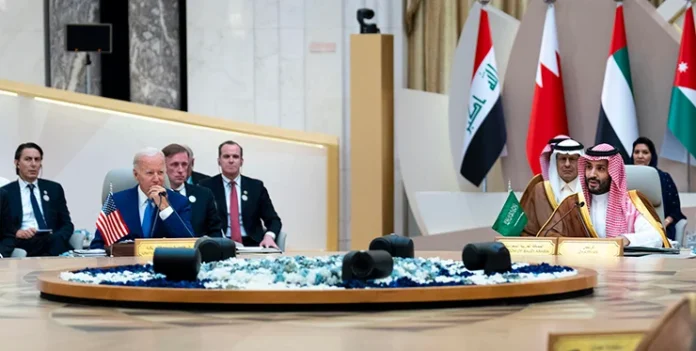
Seldom has a region in the geopolitical landscape of the Earth attracted the kind of attention that the Middle East has been drawing. Historically, the Middle East has been the seat of great power contestation: First between the colonizing powers in the first half of the 20th century and later on for oil in the second half of the same century.

The region has been known for the tumultuous nature of social peace for several reasons including sectarian infighting, the Arab-Israeli conflict, and the Shia-Sunni rivalry between Iran and the rival Sunni Gulf kingdoms.
Nature of change
The changes that are rocking the region are multifaceted. On one hand, Syria, which was dismissed as a pariah state by Arab countries following the uprising against Bashar Al Assad and later on the civil war, has been welcomed back into the fold.
Syria has been readmitted into the Arab League (1) with diplomats of multiple Arab countries wooing Syria. On the other hand, there is Turkey which is practically a European country by location. Turkey, however, has culturally and historically been a part of the Middle East for long.
Turkiye, Qatar and Iran
This pertains to Recep Tayip Erdogan who won his third consecutive term (2) in the office making outreach to Israel.

The region has been known for the tumultuous nature of social peace for several reasons including sectarian infighting, the Arab-Israeli conflict, and the Shia-Sunni rivalry between Iran and the rival Sunni Gulf kingdoms
Erdogan hosted high-level Israeli officials some months back with the aim of rapprochement and orchestrating a reset in ties which has been marred by several issues – principally over Israel’s settler policies in the West Bank and Gaza Strip.

Coming now to the issue of Qatar. The country was blockaded (3) by Saudi Arabia, the UAE, Egypt and Bahrain back in 2017. The reasons cited for the blockade were Qatar allegedly supporting Islamist organisations producing terrorists, and the Qatar state-backed news network Al Jazeera allegedly promoting terrorism.
Iran is another country which has been in the news.
Recently, Iranian foreign minister met (4) his Saudi counterpart in a bid to reset ties which have been rocked in recent years over a range of issues including Iran allegedly supporting the Houthi rebels in Yemen, Hezbollah and Hamas in Lebanon and the Gaza Strip respectively. The other issue – and this is perhaps the biggest one – is the highly contentious Iranian nuclear programme. This issue has been a bone of contention for years, especially in recent years.
Contentious issues
There are, however, several points of contention. Firstly, improving ties with Israel, the only Jewish nation-state in the region, must remain a priority. But that is easier said than done because of Israel’s controversial settler plans in the Israeli-occupied Palestinian territories and Israel’s aggressive approach to its neighbours.
Secondly, Iran and Israel are likely to remain sworn enemies in the near future with possibly zero chances of rapprochement. This is more so in light of Iran unveiling its first hypersonic ballistic missile Fattah. The missile has a range of more than 1,500km and can strike deep inside Israel and other countries in the region.
Thanks to these factors, Israel will remain antagonised to the Saudi-Iran detente and attempts to revive JCPOA or the Joint Comprehensive Plan of Action or the Iran nuclear accord that major world powers had signed in 2015 with a view to curbing Tehran’s nuclear programme meant for building its nuclear arsenal in exchange for lifting of western sanctions against the former.
An Israel-Saudi détente?
For peace to maintain a permanent hold in the region, what is imperative is a rapprochement between Israel and Saudi Arabia. This interaction with the possibility of the latter recognising the former will bury (potentially) centuries of Jewish-Muslim conflict.
Plus, it will spell the death knell for the Palestinian statehood cause, something which has already happened with the Abraham Accords signed in 2020 between Israel and Arab states Morocco, the UAE, Sudan and Bahrain. It will truly be a case for God as Karen Armstrong mentioned in her book by the same name.
References
- Syria’s Readmitted to Arab League as relations with Assad normalize (currentaffairs.adda247.com)
- Turkey’s President Erdogan sworn in for third mandate as president (euronews.com)
- Qatar blockade: What caused it and why is it coming to an end? (middleeasteye.net)
- Saudi, Iran foreign ministers meet in Tehran amid warming ties (aljazeera.com)
–The writer is currently working as a Research Associate at Defence Research and Studies (dras.in) and is a columnist. The views expressed are personal and do not necessarily reflect the views of Raksha Anirveda

The writer is a doctoral candidate in Political Science at Mahatma Gandhi Central University. The views expressed are personal and do not necessarily reflect the views of Raksha Anirveda





