


The last serious assassination attempt on the life of a US President was perhaps made in May 2005, when an Armenian named Vladimir Arutyunian threw a live Soviet-made RGD-5 hand grenade towards the podium where President George W Bush was speaking. Fortunately, the grenade didn’t explode because a red tartan handkerchief was tightly wrapped around it, preventing the safety lever from detaching. The assassination attempt in Georgia that year luckily went off track. However, US Presidents, especially those who steered the US during conflict times, had close brushes with assassination attempts. Another serious attempt was planned in 1994 by the then Al Qaeda chief Osama Bin Laden, against Bill Clinton. Bin Laden recruited Ramzi Yousef, the mastermind of the 1993 World Trade Centre bombing, to attempt to assassinate Clinton. However, Yousef decided that security would be too effective and instead targeted Pope John Paul II. In 1981, President Ronald Reagan was shot by John Hinckley to impress actress Jodie Foster, with whom he had developed an erotomanic obsession after viewing her in the 1976 film Taxi Driver.
According to reports and a former Secret Service Director, Donald Trump faced around eight threats per day, which averages out to 2000 threats per year. With increasing developments in the cyberworld, threats emanating from cyberspace are becoming increasingly difficult to track and eliminate
The Threat Matrix of US Presidents
The threat matrix for the US Presidents has always been high, but it reached concerning levels whenever the US was engaged in battle abroad. Many survived, but a few were not so lucky. Threat assessment covers a wide array, and the most difficult part is predicting the exact degree of threat. According to reports and a former Secret Service Director, Donald Trump faced around eight threats per day, which averages out to 2000 threats per year. With increasing developments in the cyberworld, threats emanating from cyberspace are becoming increasingly difficult to track and eliminate. However, a brief study was conducted by the Secret Service National Threat to evaluate the risk of targeted violence, first in 1995 and second in 1999. The Secret Service, in its Monograph titled Preventing Assassination in 1997, concluded that “Assassination is the end result of a discernible and understandable process of thinking and behaviour” and perhaps works on micro to macro threat assessments, where micro means individual-level threats, such as those from specific individuals, civilians with psychological disorders, stunt maniacs, extremists, and criminal syndicates, which are not limited to external domains and can even include individual threats within the home. The macro-level threat exists in relation to the US national security and its strategic decisions, impacting geopolitics or any specific region. The macro level emanates from organisational levels, terror outfits, and other states. The threat scale in the case of macro-level increases, and intelligence gathering and investigations, helps detect the degree of threat that the US president faces from macro threats, especially when the security environment around the US becomes serious.

The most startling miss by the Secret Service was the assassination of President Kennedy, when former US Marine Corps member Lee Harvey Oswald shot him as his motorcade passed through Dallas’s Dealey Plaza. Kennedy was shot once in the back, the bullet exiting via his throat, and once in the head
In both cases, the common link is leadership behaviour and its decisions, which impact micro and macro threats. The assassination of Israel’s Prime Minister Yitzhak Rabin by an Israeli ultranationalist after signing the Oslo Accords is one way to assess the relationship between leadership behaviour and the threat matrix. Similarly, the assassination of Abraham Lincoln also reflects the importance of leadership behaviour. In this case, Lincoln was assassinated by John Wilkes Booth, a supporter of slavery and an opponent of the idea of equality. Booth believed that Lincoln, who supported the idea of equality and was against slavery, would overthrow the Constitution and destroy the South (American Civil War). In totality, for threat assessment to be close to accurate, it has to go through qualitative intelligence assessment without any intel biases; second, it must have a thorough scan of the security environment; third, it must run an impact test of current leadership’s decisions and the President’s popularity and hostility, which will help identify micro-level threats. The macro-level threats are automatically generated by intelligence agencies and counter-terror setups.
Failure of Threat Assessment And Secret Service
The most startling miss by the Secret Service was the assassination of President John F Kennedy, when a former US Marine Corps member who later defected to the Soviet Union, Lee Harvey Oswald, shot the President as his Presidential motorcade passed through Dallas’s Dealey Plaza. Kennedy was shot once in the back, the bullet exiting via his throat, and once in the head. Surprisingly, Oswald was later shot on his way to trial. The Warren Commission thoroughly investigated the assassination and ruled out conspiracy, placing all blame on Oswald, claiming he acted alone. However, many analysts and even Americans still don’t accept that. A conspiracy theory swamped the narrative that the Deep State system in the US, especially the CIA, conspired in the assassination of its own US President, and the reason, to some extent, was quite obvious – the CIA budget was slashed, the CIA’s failure in Cuba, and various other factors that made President Kennedy’s relationship with the CIA quite troublesome. Many conspiracy theorists still believe that the Secret Service and the FBI withheld intelligence about a possible attempt to assassinate Kennedy that day.
Achieving 100% threat accuracy is far-fetched and nearly impossible, but high accuracy is possible, at least for an agency such as the Secret Service. The overload of assessments sometimes forces the agency to overlook micro-threats, which may be present in their home regardless of internal or external abetments, including civilians with psychological disorders
The Secret Service was scrutinised too much, but the agency was asked to make a few modifications to its security detail. Surprisingly, Commission member Richard Russell told the Washington Post in 1970 that Kennedy had been the victim of a conspiracy, criticising the Commission’s no-conspiracy finding and saying, “we weren’t told the truth about Oswald”. John Sherman Cooper also considered the ballistic findings to be “unconvincing”.
The Overload of Threat Assessment: Trump’s Assassination Attempt
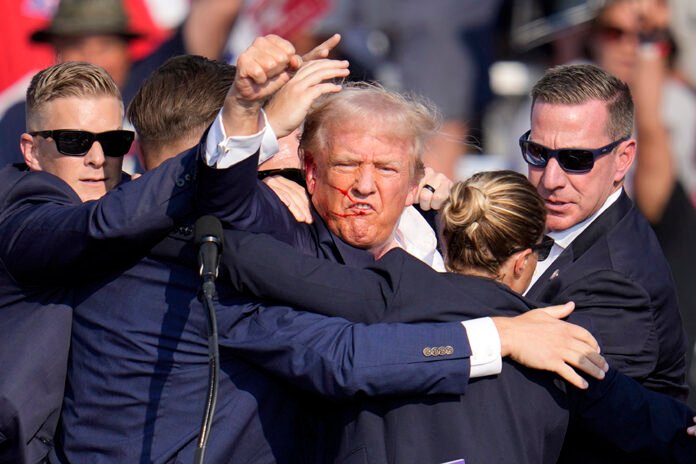
Threat assessment can go wrong and become a victim of intelligence or situational bias, as reflected to some extent in Kennedy’s case. The reason for bias and failed assessment is the overload of threats in an evolving threat landscape. The argument for achieving 100 per cent threat accuracy is too far-fetched and nearly impossible, but near or high accuracy is possible, at least for an agency such as the Secret Service. The overload of assessments sometimes forces the agency to overlook micro-threats, which may be present in their home regardless of internal or external abetments, including civilians with psychological disorders. An increase in situational awareness and close attention to micro-threats, especially in election season, could have prevented Trump’s assassination attempt. Introspection, a need to filter threats, and a strategic enhancement to increase situational awareness should become a priority for the Secret Service to avoid being caught off guard, as one mistake can have serious implications.


The writer is a national security analyst specialising in intelligence and strategic affairs. He has worked extensively with national security and foreign policy think tanks of repute, and has written for publications including The Telegraph, The Print, Organiser, and Fair Observer. He has also been a guest contributor to the School of International Studies at Jawaharlal Nehru University (JNU).





