


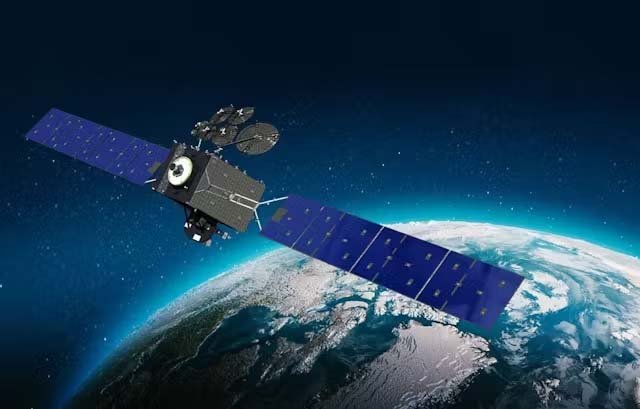
Washington: The US Space Force has chosen five companies to develop tactical communications satellites that have built-in protections against enemy jamming.
The service’s acquisition arm, Space Systems Command, awarded Boeing, Northrop Grumman, Intelsat, Viasat and Astranis a combined $37 million to design and demonstrate the Protected Tactical SATCOM-Global capability, or PTS-G. The larger indefinite delivery, indefinite quantity contract has a $4 billion ceiling.

Cordell DeLaPena, program executive officer for Tactical SATCOM, said the Space Force intentionally chose a mix of commercial and more traditional prime contractors for the effort, in part to move faster and keep development costs down.
“By maximising the use of commercially available products and awarding to a pool of offerors on this IDIQ contract, the Space Force ensures value for the DOD and taxpayer while driving competition and promoting the long-term viability of the SATCOM industrial base,” he said in a statement.
The service created PTS-G last year with a goal of launching the new satellite constellation by 2028. Its fiscal 2026 budget includes about $240 million for the effort.
The program is part of an enterprise approach to developing anti-jam capabilities, the Protected Tactical SATCOM Family of Systems. The Space Force announced July 3 that the effort would focus on rapidly delivering satellites that are protected against signal disruption by delivering capability incrementally, starting as soon as next year.

The service describes PTS-G as a bridge between more resilient, mission-focused systems and the SATCOM services available commercially. The satellites will augment current systems and provide worldwide access for military operators. While the goal is for global coverage, the program will initially focus on select hubs.
Each company selected for the first phase of PTS-G will conduct a capability demonstration within six months, a spokesperson said.

That work will inform follow-on contracts next year to companies to develop production satellites that will launch in 2028. That year, SSC plans to issue a second round of production contracts for spacecraft projected to launch in 2031.






