

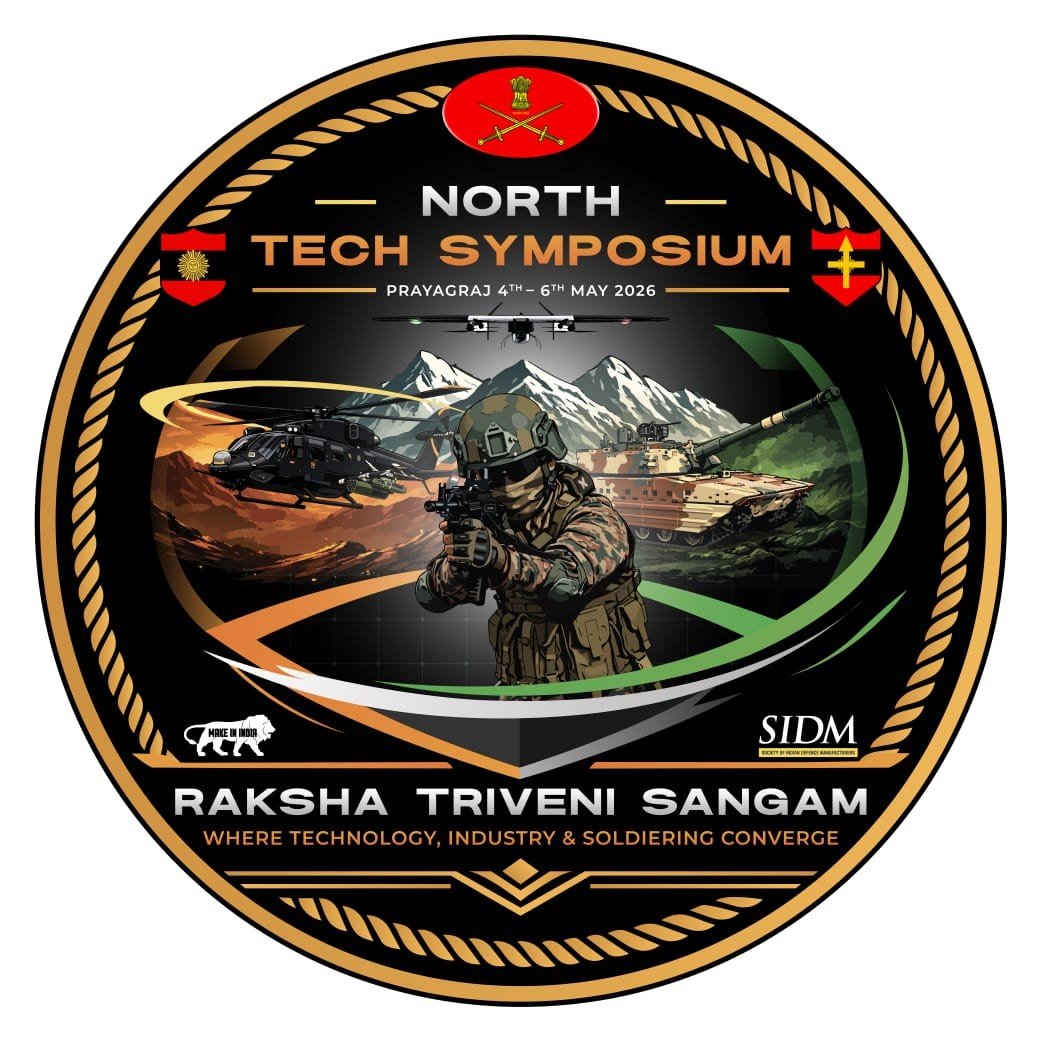
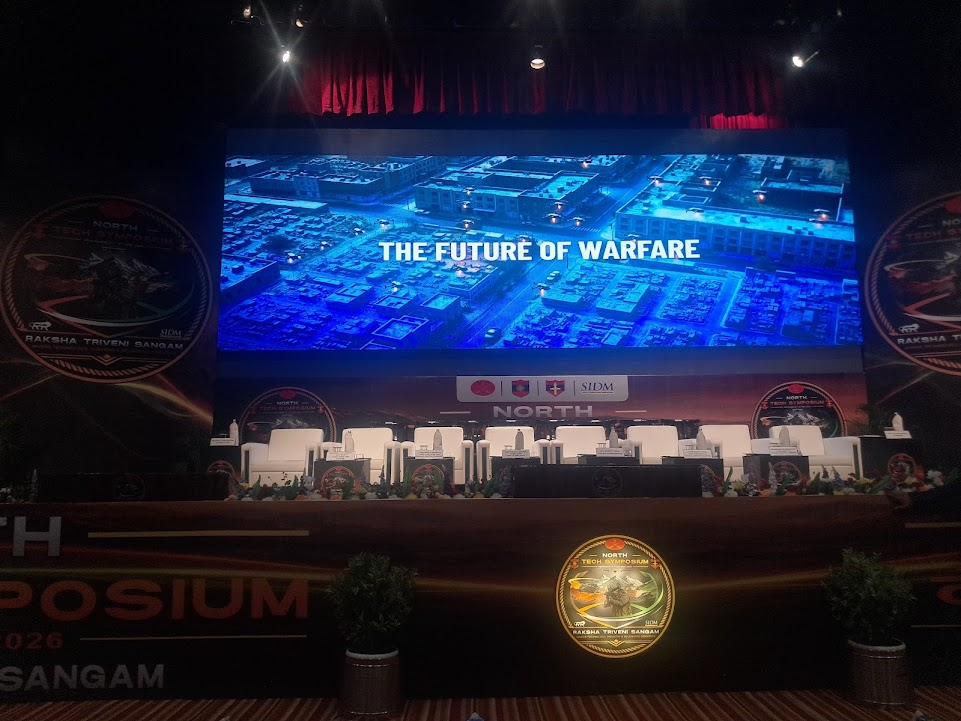
 The North Tech Symposium 2026, held in Prayagraj from May 4-6, 2026, signalled India’s transition from incremental military modernisation to technology-driven battlefield transformation. It was a strategic statement on the direction of India’s future military modernisation. Set against the symbolic confluence of the Ganga, Yamuna and the mythical Saraswati, the theme “Raksha Triveni Sangam: Where Technology, Industry and Soldiering Converge” aptly reflected the coming together of the three pillars that will shape India’s military preparedness in the decades ahead.
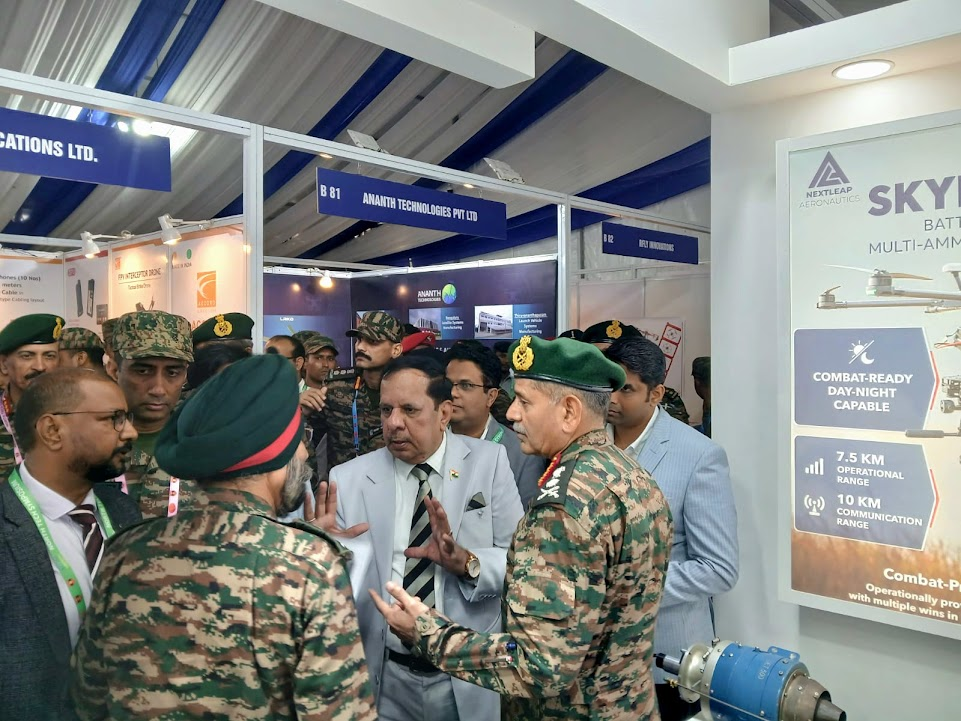
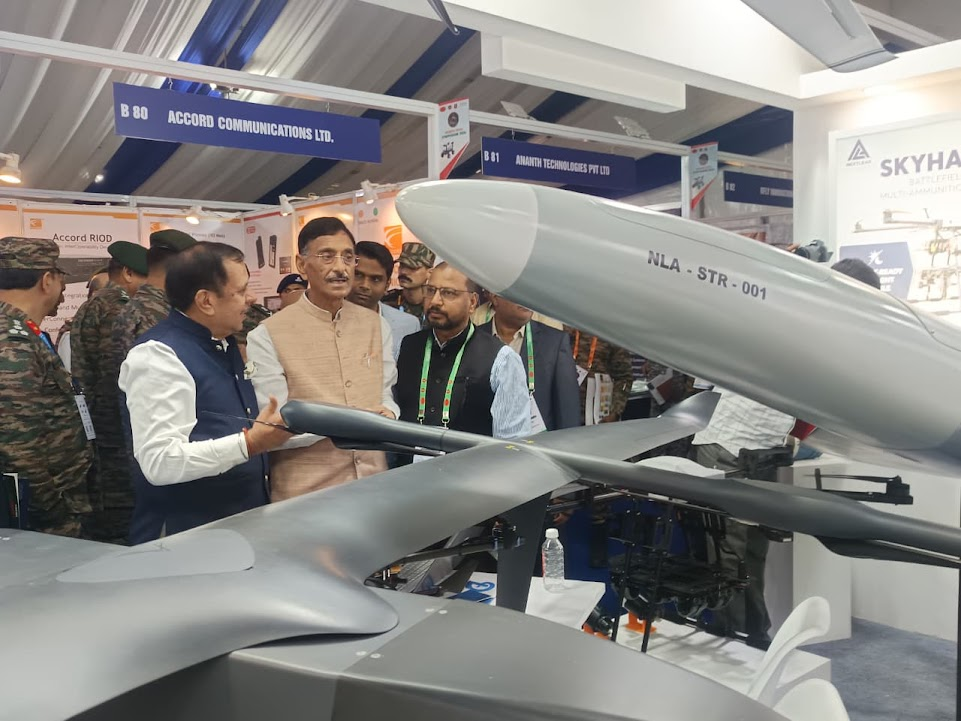
Jointly organised by the Northern and Central Commands of the Indian Army in collaboration with the Society of Indian Defence Manufacturers, the symposium emerged as a major platform for operational users, academia, innovators, start-ups, MSMEs and the defence industry to align around a common objective: building a technologically advanced, self-reliant and future-ready Indian military. More than 280 companies participated, showcasing cutting-edge indigenous capabilities across drones, robotics, artificial intelligence, electronic warfare, surveillance systems, autonomous platforms and advanced battlefield solutions.

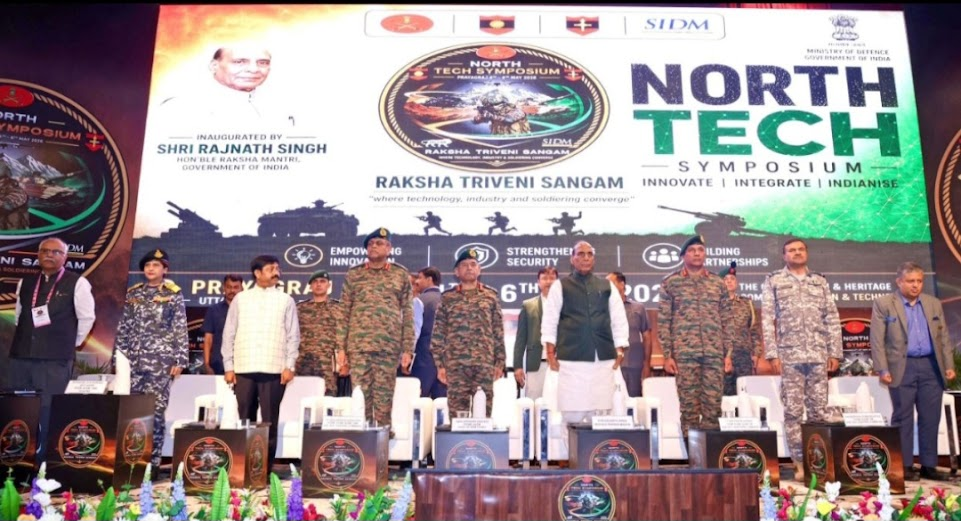
The presence of the Defence Minister, Minister of State- Defence, the Chief Minister of Uttar Pradesh, the Chief of Army Staff, and senior military leadership heightened the significance of the event. Their participation underscored a critical reality. Future conflicts will be shaped less by force size alone and more by technological agility, innovation cycles and rapid integration of disruptive capabilities. All require a collaborative, proactive and convergent approach.
Jointly organised by the Northern and Central Commands of the Indian Army in collaboration with the Society of Indian Defence Manufacturers, the symposium emerged as a major platform for operational users, academia, innovators, start-ups, MSMEs and the defence industry to align around a common objective: building a technologically advanced, self-reliant and future-ready Indian military
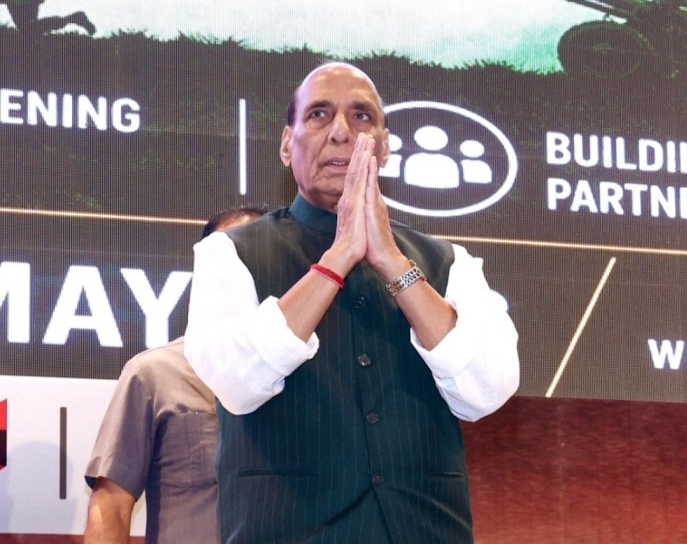
Defence Minister Rajnath Singh delivered what was perhaps the symposium’s most important strategic message. Stressing that “there is no substitute for research,” he observed that the nature of future wars is being decided in today’s laboratories. He called for sustained investment in deep research and emerging technologies such as artificial intelligence, quantum systems, hypersonics, directed-energy weapons, and autonomous warfare platforms.
His emphasis on the “element of surprise” carried particular strategic significance. In an era when battlefields are increasingly transparent through satellites, drones and persistent surveillance, the ability to innovate faster than the adversary and create technological asymmetry is a decisive operational advantage. The Defence Minister’s remarks reflected an important doctrinal shift in Indian thinking. The focus is no longer confined to conventional numerical superiority. Instead, emphasis is now placed on speed, precision, innovation and the integration of advanced technologies into operational concepts.

Equally significant was his message on collaborative innovation. Highlighting the evolving roles of DRDO and private industry, he noted that defence research cannot remain confined within institutional silos. The future lies in a partnership-driven ecosystem where armed forces, scientists, academia and industry work together to accelerate capability development. This reflects the broader transformation underway under Aatmanirbhar Bharat, where self-reliance is increasingly being viewed not merely as import substitution, but as the creation of indigenous design, manufacturing and technological leadership.
The Minister of State – Defence reinforced this vision by stressing the importance of scaling innovation and shortening the journey from prototype to deployment. The message from the political leadership was clear. India’s defence ecosystem must move beyond isolated technological achievements and build a coherent national innovation architecture capable of delivering operationally relevant solutions at speed and scale.

One of the defining themes emerging from the symposium was the transformation of combat platforms into integrated battlefield systems. Modern warfare is increasingly multidomain. Tanks, infantry combat vehicles and artillery systems can no longer operate as isolated platforms. They must become nodes within a larger combat network capable of sensing, striking and surviving in contested environments
The symposium also highlighted the Indian Army’s growing focus on technology-enabled warfare. General Upendra Dwivedi emphasised during an exclusive interaction with industry and academia the importance of indigenous capability development through collaboration among the armed forces, academia, and industry. The focus areas discussed throughout the event included drones, robotics, electronic warfare, artificial intelligence, autonomous systems and advanced surveillance technologies.
One of the defining themes emerging from the symposium was the transformation of combat platforms into integrated battlefield systems. Modern warfare is increasingly multidomain. Tanks, infantry combat vehicles and artillery systems can no longer operate as isolated platforms. They must become nodes within a larger combat network capable of sensing, striking and surviving in contested environments.
In this context, the author introduced the concept of an integrated AFV drone system for armoured platforms, which was a particularly relevant operational innovation. The concept aims to equip platforms such as the T-90, T-72 and Infantry Combat Vehicles with organic drone integration, thereby transforming them into network-enabled combat systems capable of independent multidomain operations. The tank of the future cannot remain a steel platform alone. It must evolve into an intelligent multi-utility combat system capable of sensing, striking and surviving across multiple domains simultaneously.
India’s defence modernisation is no longer confined to domestic capability creation. It is now translating into global strategic influence through rapidly expanding defence exports. In one of the most remarkable transformations in recent decades, India has moved from being among the world’s largest arms importers to an emerging defence export power
North Tech Symposium 2026 demonstrated that India’s defence modernisation is gradually shifting from isolated, procurement-driven approaches to integrated capability development. The conversations at Prayagraj reflected a growing understanding that future military advantage will not come merely from acquiring advanced platforms, but from building coherent ecosystems that integrate technology, doctrine, industry and operational experience.
Importantly, the symposium also carried strategic signalling value. Organised close to the first anniversary of Operation Parakram, it projected an image of a military steadily modernising for future conflict. It reinforced the message that India is investing not only in conventional deterrence but also in technological superiority and in developing indigenous capabilities.
 North Tech Symposium 2026 was therefore not merely an exhibition of defence technologies. It was a convergence of strategic intent, operational necessity and national ambition. It showcased an India increasingly confident in its ability to innovate, collaborate and build indigenous solutions for future warfare.
Equally significant is that India’s defence modernisation is no longer confined to domestic capability creation. It is now translating into global strategic influence through rapidly expanding defence exports. In one of the most remarkable transformations in recent decades, India has moved from being among the world’s largest arms importers to an emerging defence export power. According to official government data, defence exports have surged by nearly 5,500 percent over the last decade, rising from just ₹686 crore in 2013-14 to over ₹21,000 crore in 2023-24. Today, India exports defence equipment to more than 85 countries across Southeast Asia, Africa and the Middle East.
This growth reflects far more than numerical expansion. It signals the maturing of India’s indigenous defence ecosystem under Aatmanirbhar Bharat. Policy reforms have simplified export approvals, positive indigenisation lists have accelerated domestic manufacturing, and private-sector participation has expanded significantly across the supply chain. India is now exporting not merely components or small arms, but sophisticated platforms such as the BRAHMOS supersonic cruise missile and the Pinaka multi-barrel rocket launcher system.
India’s defence ecosystem is transitioning from dependence to design leadership, from fragmented innovation to integrated capability building, and from reactive modernisation to proactive battlefield transformation. In an era where technological superiority may determine the outcome of future wars, such convergence may well define India’s future battlefield edge
Yet shortfalls in deep institutional R&D and its funding, innovation tempo, indigenous high-technology components, and platform/system delivery promises remain a major grey area. Continued investment in research and development, MSME integration, innovation ecosystems, and long-term maintenance support will determine whether India can sustain this momentum and emerge as a leading global defence manufacturing hub.
The message emerging from Prayagraj was unmistakable. India’s defence ecosystem is transitioning from dependence to design leadership, from fragmented innovation to integrated capability building, and from reactive modernisation to proactive battlefield transformation. In an era where technological superiority may determine the outcome of future wars, such convergence may well define India’s future battlefield edge.
Prayagraj will therefore be remembered not merely as the venue of a symposium, but as one of the defining markers of India’s transition into a technologically empowered military power prepared for the wars of tomorrow.

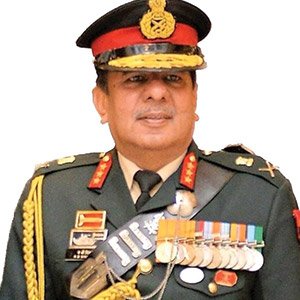
The writer, a PVSM, AVSM, VSM has had an illustrious career spanning nearly four decades. A distinguished Armoured Corps officer, he has served in various prestigious staff and command appointments including Commander Independent Armoured Brigade, ADG PP, GOC Armoured Division and GOC Strike 1. The officer retired as DG Mechanised Forces in December 2017 during which he was the architect to initiate process for reintroduction of Light Tank and Chairman on the study on C5ISR for Indian Army. Subsequently he was Consultant MoD/OFB from 2018 to 2020. He is also a reputed defence analyst, a motivational speaker and prolific writer on matters of military, defence technology and national security. The views expressed are personal and do not necessarily carry the views of Raksha Anirveda





