


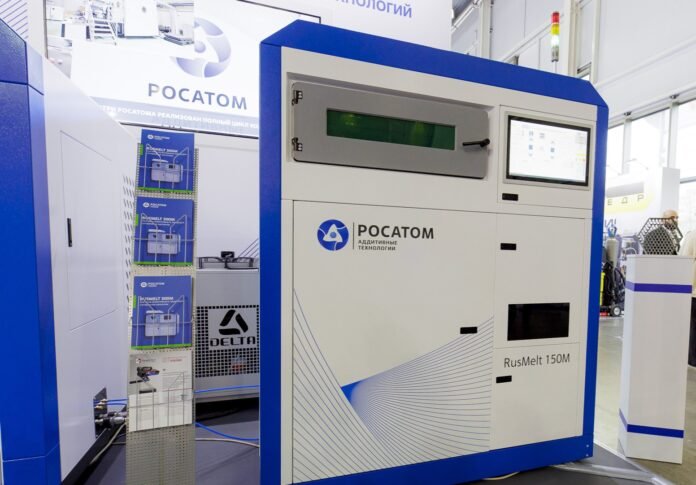
Mumbai: At Metalloobrabotka 2026 trade show, Rosatom’s Fuel Division (the Additive Technologies business line evolved as a part of it) showcased RusMelt 150M – a compact small-size 3D printer. This model will extend Rosatom’s line of 3D printers that rely on selective laser melting (SLM) technology. The line already has two mass production units – a medium-size RusMelt 300M machine and a large-size RusMelt 600M printer.
Development of a small-size 3D printer has emerged as a direct response to requests of Russian industrial enterprises, research institutes, universities and medical centres that need high-precision equipment for manufacturing products with complex geometry, R&D and prototyping. Compact dimensions, reduced power consumption, lower gas and powder flow rates and, consequently, lower cost make this unit a cost-effective and affordable solution for a wide range of users.

RusMelt 150M 3D printer enables to solve engineering tasks in aviation and space, for instance, printing of turbine blades, seals, antennas and thermal elements. Prototypes, spare parts and other complex small-size products for quick replacement of necessary components can now be manufactured for industrial enterprises. For medicine and, specifically, for dentistry it is possible to print dental crowns and bridges, customised implants, orthopedic elements.
Universities and research centres have got a powerful tool for R&D, research of materials, manufacturing of experimental specimens. Cheaper hi-tech equipment will also be helpful in accelerating the implementation of additive technologies in education and training a new generation of engineers who will not be constrained by the barriers of conventional technologies in solving technical challenges.
“The small-size SLM printer with a build chamber of up to 150 mm drastically lowers the entry threshold into metal 3D printing for businesses and engineering centres. Compared to larger systems, it requires significantly less investment, occupies less production space, consumes less inert gas and electricity, and makes material changeover and new design launch faster. For challenges where most of the parts are up to 100-120 mm in size, the use of large-format equipment is economically unfeasible: the cost of printing one part by a compact system can be 2-4 times lower due to reduced powder consumption, shorter preparation time and cheaper equipment operation,” says Ilya Kavelashvili, Director of the Additive Technologies business line at Rosatom’s Fuel Division.
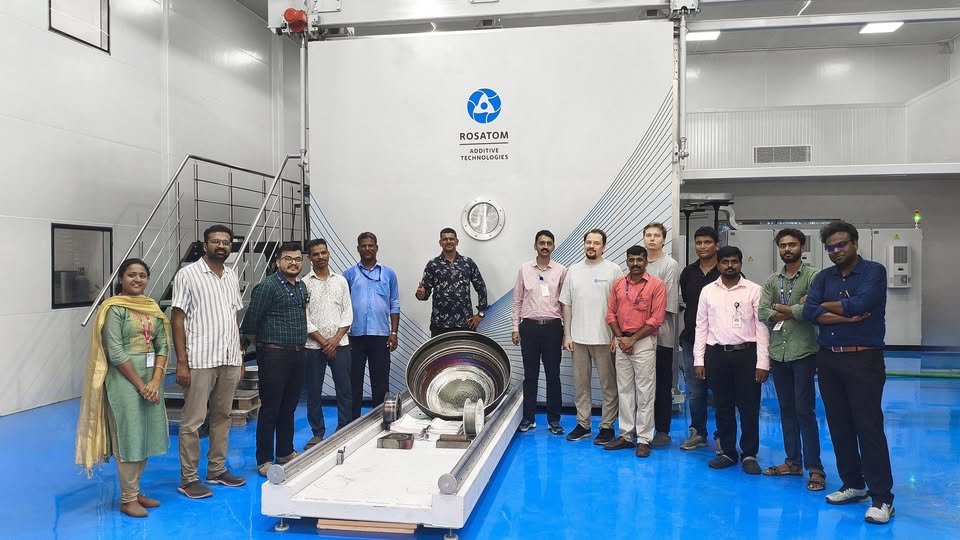

RusMelt 150M capacity reaches 15 cm³/hour at scanning speed up to 10 m/s, which provides efficiency even for small-scale production. With overall unit dimensions (2100x990x2230 millimetres) and weight of slightly over 900 kg, it can be deployed at a standard laboratory or a university room without a dedicated heavy foundation and a separate manufacturing area.
The build area (150 mm in diameter and 200 mm high), combined with the small chamber volume, gives significant savings in gas and powder flow rates. A real-time quality control system and a data logging system provide traceability and confirm the manufacturing stability of each part.







