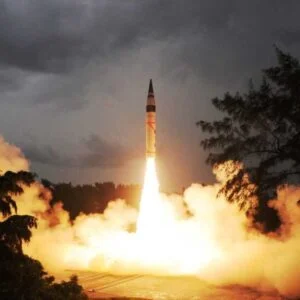
Beijing: Citing a United Nations Security Council (UNSC) resolution after India carried out nuclear tests in 1998, China questioned India’s missile programme amid reports of an upcoming test for the Agni-V intercontinental ballistic missile.
“As for whether India can develop ballistic missiles capable of delivering nuclear weapons, the UNSCR 1172 already has clear stipulations,” Foreign Ministry spokesperson Zhao Lijian said in response to questions over reports on the upcoming test, which has received wide attention in the Chinese press with focus on the detail that the 5,000 km-range nuclear-capable missile would bring many cities in China within range.

“Maintaining peace, security and stability in South Asia meets the common interests of all, where China hopes that all parties would make constructive efforts,” Zhao said.
The Foreign Ministry spokesperson was referring to the UNSC resolution 1172, adopted in June 1998. The resolution, in the aftermath of the 1998 nuclear tests, “calls upon India and Pakistan immediately to stop their nuclear weapon development programmes, to refrain from weaponisation or from the deployment of nuclear weapons, to cease development of ballistic missiles capable of delivering nuclear weapons and any further production of fissile material for nuclear weapons, to confirm their policies not to export equipment, materials or technology that could contribute to weapons of mass destruction or missiles capable of delivering them and to undertake appropriate commitments in that regard”.
Even as it questioned India’s missile programme, China has, in contrast, been aiding the development of Pakistan’s nuclear and missile programmes for decades, from providing enriched uranium and even technology for nuclear-capable missiles.
That cooperation has continued unabated and was officially acknowledged three years ago. In 2018, the state-backed Chinese Academy of Sciences announced it had sold Pakistan a tracking system to speed up development of multi-warhead missiles, a detail that the government chose to declassify.

Zheng Mengwei, a researcher with the CAS Institute of Optics and Electronics, told the Hong Kong-based South China Morning Post that Pakistan had purchased a “highly sophisticated, large-scale optical tracking and measurement system”. “We simply gave them a pair of eyes. They can use them to look at whatever they want to see, even the Moon,” he said, noting that China was the first country to export such sensitive equipment to Pakistan which had been deployed by the Pakistani military “at a firing range” for testing new missiles.
The South China Morning Post report at the time linked the sale to India’s development of Agni-V. It noted that it “has been a long-held notion that Beijing is supporting Islamabad’s missile development programme but solid evidence can seldom be found in the public domain, making the CAS statement a rarity”. The CAS team “enjoyed VIP treatment during the nearly three months it spent in Pakistan assembling and calibrating the tracking system and training technical staff on how to use it,” the CAS statement on the sale said.

The Post report noted that “an optical system is a critical component in missile testing” and also helps record “high-resolution images of a missile’s departure from its launcher, stage separation, tail flame and, after the missile re-enters atmosphere, the trajectory of the warheads it releases”.