

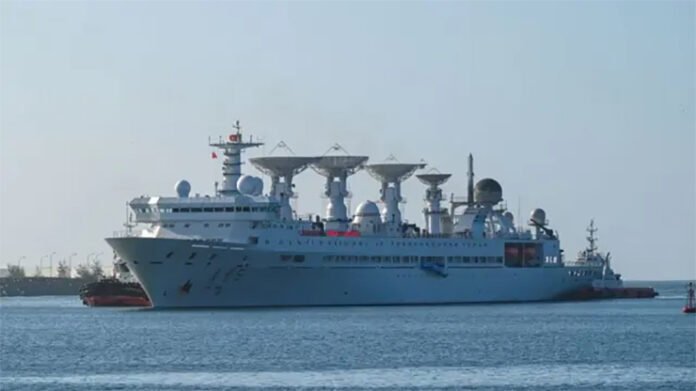
Colombo: China’s Yuan Wang-5, a People’s Liberation Army (PLA) Strategic Support Force missile and satellite tracking ship, has recently entered the Indian Ocean Region (IOR), according to open-source intelligence updates and AIS vessel listings. This vessel is widely monitored by India due to its dual-use intelligence roles and past strategic port calls such as Hambantota in Sri Lanka.
Yuan Wang-5 is a highly sophisticated surveillance ship launched in 2007, displacing around 25,000 tons, equipped with multiple large parabolic radar dishes, phased-array radar systems, and advanced telemetry receivers. Its mission focuses on tracking ballistic missile launches, satellite trajectories in low-earth and geostationary orbits, and intercepting electronic signals from naval and air units. The ship’s telemetry and tracking capabilities feed real-time operational intelligence to the PLA Navy and Rocket Force, making it central to China’s missile development and space launch support.

The vessel’s presence in the IOR comes amid heightened US-India security cooperation and growing concerns about Chinese maritime intelligence expansion.
Yuan Wang-5’s ability to monitor missile tests and space activities extends China’s strategic reach far beyond its coastline, including potential support for anti-ship ballistic missile targeting via data fusion into command networks. The ship has previously sparked diplomatic tensions, notably with India during its planned visits to Hambantota port in Sri Lanka, which India protested. The vessel’s repeated visits and current presence in the Indian Ocean align with PLA Navy ambitions to map seafloor topography, monitor naval manoeuvres, and prepare maritime domains for submarine operations.
In addition to missile and satellite tracking, Yuan Wang-5 carries electronic support measures (ESM) to collect radar emissions and communication signals from foreign vessels and aircraft, contributing to China’s electronic warfare and countermeasure developments.
Analysts view this deployment as a strategic move in Indo-Pacific information control, which impacts regional naval and missile deterrence postures.

Yuan Wang-5’s Indian Ocean deployment represents China’s sustained assertive posture in maritime intelligence gathering, space telemetry support, and undersea warfare preparedness, raising strategic alarm for both India and its allies involved in Indo-Pacific security frameworks.






