


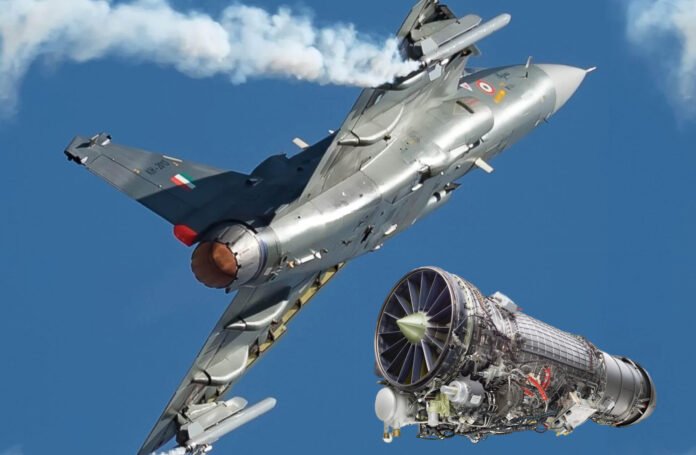
New Delhi: Days after delivering sixth F404-IN20 engine to Hindustan Aeronautics Limited (HAL) for the Tejas Light Combat Aircraft (LCA) Mk 1A aircraft, General Electric Aerospace (GE) has reportedly finalised key aspects of a new technical deal. PTI reports that the agreement is expected to lead to a formal contract later this year and is seen as a significant boost for the Indian Air Force (IAF) as it looks to rebuild its declining fighter squadron strength and expand its fleet to meet dual-front security challenges involving China and Pakistan.
Meanwhile, technical discussions between GE Aerospace and state-owned HAL for the co-production of the F414 jet engine in India have been concluded. Under the agreement almost 80 per cent of the manufacturing technology and intellectual property rights for the F414 jet engine, developed by the GE, will be transferred to India.

Announcing the agreement on technical matters related to F414 engine co-production, the release from both parties’ spokespersons on April 14 stated, “GE Aerospace and Hindustan Aeronautics Limited are pleased to announce significant progress regarding F414 co-production today, having reached agreement on technical matters. This agreement marks a significant step forward in strengthening economic growth and advancing cooperation for both India and the US and expands the 40-year partnership between GE Aerospace and HAL.”
The agreement is set to mark a first-of-its-kind transfer of advanced military aero-engine technology from the United States to India, enabling domestic manufacturing of a frontline fighter engine.
Cleared in June 2023, the programme entails the transfer of a substantial share of manufacturing technology for the F414 engine, which will power the Tejas Mk-2 fighter.
Sources said the project has now moved into the commercial negotiation phase, with the production line expected to be operational within two years of the contract being signed.

Alongside, GE will also establish a depot-level maintenance, repair and overhaul (MRO) facility in India for F404 engines used in the Tejas Mk-1A fleet. The facility will be owned and operated by the IAF, with GE providing technical inputs, training, and specialised equipment. This will result in lesser turnaround time and reduce reliance on overseas repair pipelines.
The F414 engine underpins India’s next-generation fighter plans. The Tejas Mk-2, designed around the engine, is expected to see an order of at least six squadrons, or around 120 aircraft, translating into a requirement of roughly 130 to 140 engines, including reserves.

The engine is also planned for the first tranche of the Advanced Medium Combat Aircraft (AMCA), projected at around 40 aircraft, taking the combined near-term requirement to about 170 to 180 engines.
Beyond this, India is in advanced discussions with French company Safran to co-develop a higher-thrust 110–120 kN class engine for the AMCA’s later variants. This engine is intended to replace the F414 in the long term and power the AMCA Mk-2 configuration.
Even as the F414 programme moves forward, delays in the supply of F404 engines have slowed Tejas Mk-1A production. HAL is contracted to deliver 83 Mk-1A fighters under the initial deal, with a follow-on order taking the total to 180 aircraft. However, engine deliveries have lagged, with only six F404 engines delivered so far, leaving multiple aircraft on the production line awaiting engines.
GE has attributed the delays to the ongoing West Asia conflict involving the US, Israel, and Iran, along with broader global supply chain disruptions, including shortages of critical components, vendor constraints, and post-pandemic production bottlenecks.
Last week, Foreign Secretary Vikram Misri had an interaction with the US Under Secretary of War for Acquisition and Sustainment Mike Duffey at the Pentagon in Washington DC.
Following the meeting, Ministry of External Affairs spokesperson Randhir Jaiswal had said in a post on social media platform X that “this was to advance India-US major defence partnership, focusing on co-production, sustainment, and shared priorities in the Indo-Pacific.”






