


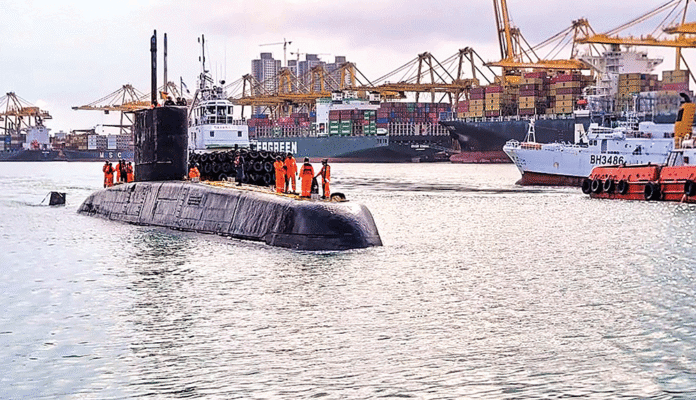
The evolving maritime security environment in the Indo-Pacific region by 2035 will be shaped decisively by the rising naval capabilities of China, especially through its Carrier Battle Groups (CBGs) and Anti-Access/Area Denial (A2/AD) strategies. India’s strategic response must anticipate these developments with innovative force structuring and platform capabilities. One such transformative initiative could be the conversion of the forthcoming ‘upgraded’ ballistic missile submarine (SSBN – Ship, Submersible, Ballistic, Nuclear) design into a new class of nuclear-powered guided missile submarine (SSGN – Ship, Submersible, Guided, Nuclear), armed with the next-generation BRAHMOS missile (BRAHMOS NG – BRAHMOS Next Generation).
By focusing on the 2035-time frame, it is prudent to analyse how this SSGN platform, leveraging cutting-edge missile technology and stealth, can reshape naval balances and deterrence postures in the Indo-Pacific. For this, we need to discuss two very significant and comparatively recent RMAs (Revolution in Military Affairs): the near real-time transparency of the surface and air battle space, and the advent and success of SLCM (Sea Launched Cruise Missiles). These two technology-driven transformations have evolved and matured over the last two to three decades and have impacted both the battle at sea as well as influencing the land battle.

Battle Space Transparency- Space Based Surveillance
Though space-based surveillance has existed for a number of decades, it was hitherto available to only a very few militaries. However, post the Cold War, as we moved from a bipolar to a multi-polar world, there has been a proliferation of these space-based surveillance technologies. Now many more nations either have access to the technologies itself or have access to the satellite imagery in almost real time. The source of the imagery could be either their geo-strategic partners, ideological well-wishers or merely a commercial entity making a financial killing.
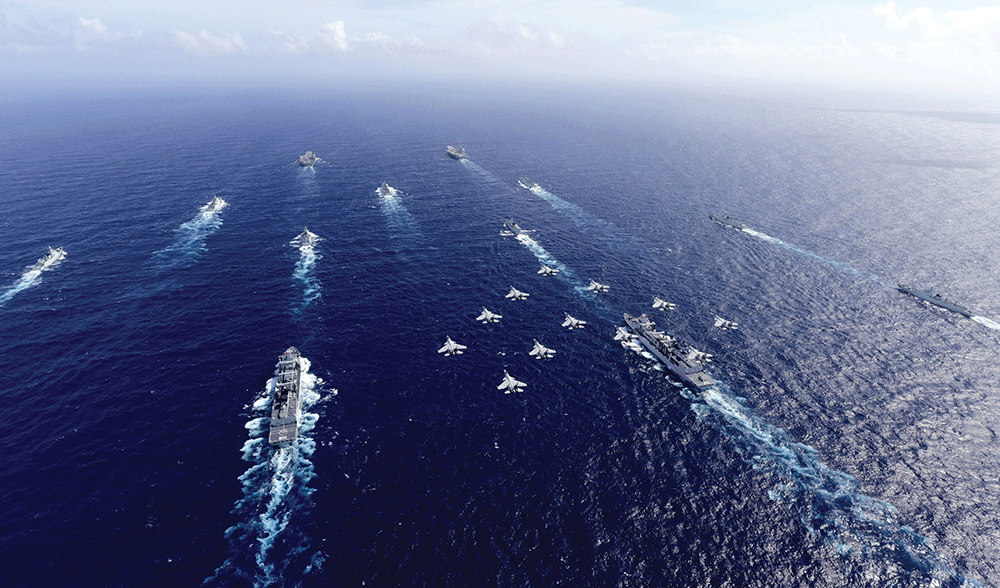
The net outcome is that militaries, including navies, can no longer keep the position of their ships and composition and location of their formation, whether in harbour or at sea, secret from their adversaries. The days of sneaking up on an enemy coastline, harbour, shore-based installation or even an adversaries’ CBG, to the weapon release line, will now be an extremely risky proposition, if not near impossible.
Advent and Proliferation of the Cruise Missile
Though developed during WWII, the US and Soviet Union invested significantly in cruise missiles during the Cold War era. These missiles are now capable of being launched from ships, submarines, aircraft and land-based launchers. So, while the term SLCM continues to be used ‘loosely’ to categorise such missiles, the fact is that they are now capable of being launched from sea, air and from land.

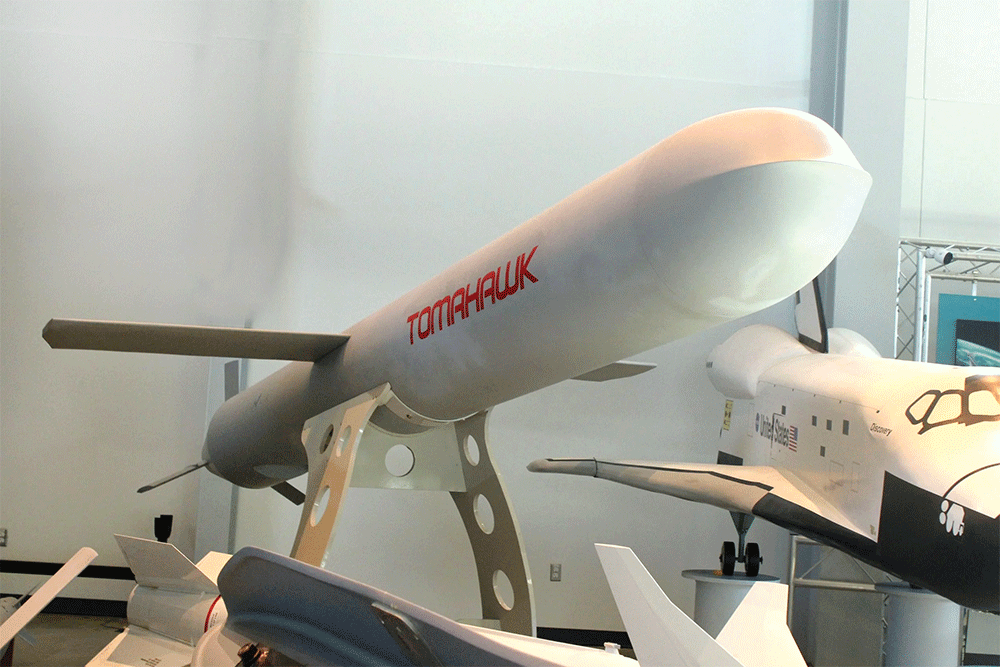
Sea Launched Cruise Missile Tomahawk: Introduced in the 1980’s, the Tomahawk became the cornerstone of US naval power. It is capable of being launched from submarines and ships and has the ability to carry out precise strikes, with reduced collateral damage, at standoff ranges beyond 1500 km. The precision not only enhances operational effectiveness but also helps in maintaining legitimacy in international conflicts.
During Desert Storm (1991), the US Navy fired over 800 Tomahawk missiles against Iraqi targets. Similarly, during Operation Odyssey (2011), the US Navy used the Tomahawk to neutralise/degrade the Libyan air defence and military infrastructure prior to launching the air campaign.

Cruise Missiles–Crucial Component of Anti Access/Area Denial (A2/AD) Architecture: Long-range cruise missiles are also a critical component of any A2/AD architecture. Anti-Access or A2 can be defined as “actions and capabilities designed to prevent an opposing force from entering an operational area.” Conversely, Area Denial or AD is defined as the “capabilities to limit its freedom of action when within the operational area”. In simple terms, while A2 is the action/capability to build the ‘wall’, AD is the intervention required once the A2 wall is breached. Therefore, the scope and range of the former is strategic, and the latter, tactical/operational.
Asymmetric Warfare and Non-State Actors: Unfortunately, cruise missiles have also proliferated and influenced the tactics of non-state actors and insurgent groups. During the initial stages of the ongoing Israeli campaign in Gaza, the Houthis used locally assembled /indigenous ‘Quds 1 and Borkan missiles to disrupt shipping and attacked oil installations, ports and even warships.
Therefore, cruise missiles are a threat in being for all maritime operations and activities, including force projection and any A2 /AD architecture, established to protect a nation’s mainland, coastline, and archipelago or island chain.
Chinese CBG’s Deployment in the IOR- Compulsions, Composition and Counter Strategies
The Compulsion of Deployment: Ninety per cent of China’s crude oil is transported via the sea route. During a twelve-month period, on average, about 550 million barrels of crude, bound for China, transits through the Indian Ocean. Add to this the non-fossil fuel traffic of primarily, food grain, soya bean (crucial for animal feed), raw material and finished goods, the traffic may be as high as about 200 China-bound ships every day. Therefore, to protect and ensure free passage of these merchantmen, the foray of a Chinese CBG into the Indian Ocean is a given and is their geo-strategic compulsion.
Converting the S5 SSBN hull into an SSGN equipped with BrahMos NG not only leverages India’s indigenous strategic assets but also multiplies their operational utility. This hybrid platform enhances deterrence by adding a covert, potent strike capability that complements the strategic nuclear deterrent of SSBNs
Likely Components Organic to the Chinese CBG: By 2035, China is likely to operate at least six aircraft carriers, including the advanced Type 003 carrier. These 80,000-ton carriers will accommodate a wide range of fighter jets, including the J-35 stealth fighters and KJ-600 early warning aircraft. The CBG will likely include Type 055 destroyers, offering air defence, anti-surface and anti-submarine warfare functions. Nuclear-powered attack submarines (Type 093) and strategic nuclear submarines (Type 094) will form a critical part of the CBG for underwater operations and deterrence capabilities. The inclusion of unmanned aerial vehicles (UAVs) for reconnaissance and combat roles, as well as unmanned underwater vehicles (UUVs), will enhance the operational capabilities and reach of the CBG. Thus, the CBG will have a cruise missile arsenal in excess of 500 to 600 projectiles! Therefore, countering the ingress of the Chinese CBG, attempting to establish sea control in the Indian Ocean Region IOR, will be one of the key maritime challenges of the Indian Navy.
Counter Strategies- BRAHMOS vs the Chinese CBG
The BRAHMOS Missile: The BRAHMOS missile is notable for its speed (about Mach 3), final active homing, and terminal manoeuvring. This, coupled with its ability to be launched from ships, submarines, aircraft and coastal batteries, makes the BRAHMOS the weapon of ‘first choice’ against a CBG. The BRAHMOS NG and BRAHMOS-X variants under development, are faster, difficult to intercept and much more lethal.
The Salvo Size of BRAHMOS Missiles to Sink a Chinese Carrier: A recent Digital Combat Simulator by Grim Reapers, a YouTube channel, provides some insights into the number of BRAHMOS missiles needed to sink a carrier. While the simulation was specific to a current version of the missile, launched from a shore-based battery, here are some key outcomes from various scenarios tested.
- Single Missile Efficacy: A single BRAHMOS missile against a target, like a Chinese destroyer, is likely to be successfully intercepted by advanced systems like the HQ-9B (this was, however, not validated under real-time battle conditions during an exercise like Operation Sindoor, when the system could not intercept a single missile fired by India).
- Saturation Attacks: A salvo of up to 12 BRAHMOS missiles faced total interception by existing defence systems of the Chinese CBG. However, when increased to 24 missiles, two missiles successfully penetrated the defences of the CBG and sank the carrier.
- Enhanced Salvo Size: 36 BRAHMOS missiles launched simultaneously, resulted in approximately 12 successful hits, sinking multiple ships of the Chinese CBG. However, when a similar attack was launched at a US CBG, only seven BRAHMOS missiles were able to hit their targets, despite the CBG firing as many as 95 interceptor missiles.
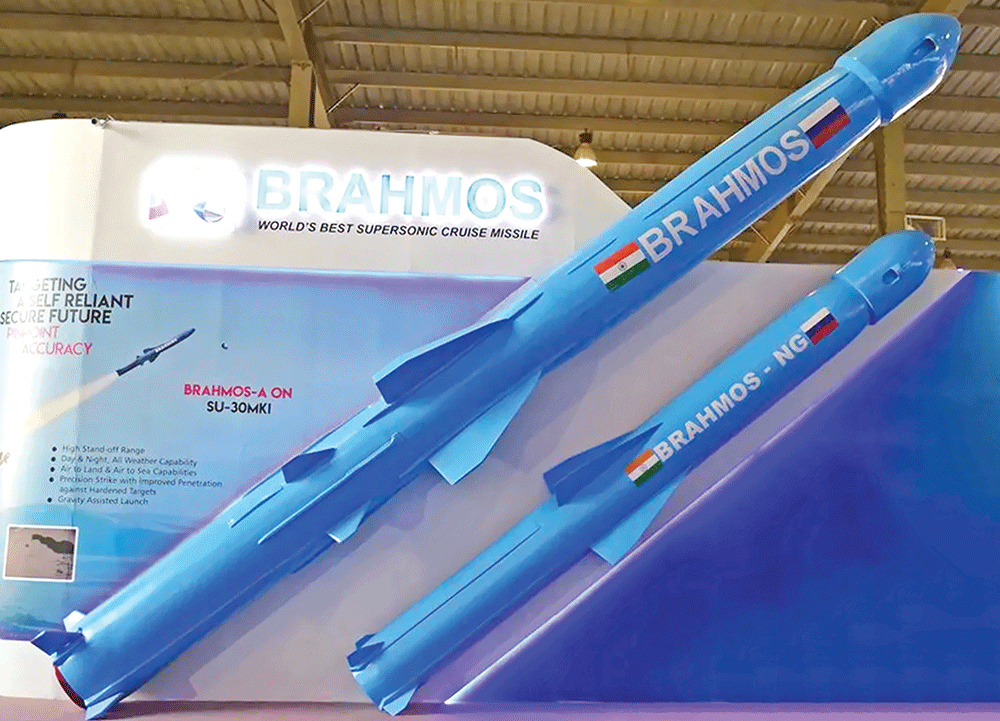
Required Numbers of Missiles: From these simulated scenarios, experts suggest that around 40 to 50 BRAHMOS missiles may be necessary under real combat conditions to guarantee a successful attack on a Chinese CBG. The variance is largely due to interception rates, which can fluctuate based on leadership, tactics, and the technological state of both the BRAHMOS missiles and the carrier’s defences.
Strategic Implications: Notwithstanding the fact that a simulation is a simulation, the findings from such DCS studies are crucial for military planning. They highlight that aircraft carriers, while formidable, are not invulnerable and that modern cruise missiles like the BRAHMOS, when fired in large salvo sizes, pose a significant threat.
Submarine Launched Cruise Missiles – The Carrier Killer
A CBG, centred on an 80,000 -ton plus nuclear-powered power-projection aircraft carrier, will have an air and surface surveillance bubble extending to around 1000-1200 nm in diameter and several thousand feet in height. To penetrate such a surveillance bubble, survive the defences, arrive at the weapon release line in adequate numbers and then bring to bear a weight of attack of significance on the carrier, can possibly be done only by a sub-surface missile carrier like the SSN or SSGN.
In the recently conducted Operation Midnight Hammer, the US Air Force deployed a total of 125 military aircraft, to deliver 14 BGU bunker buster bombs, carried by 7 B-2 Spirit stealth bombers. To deliver a weight of attack of around 30 to 40 BRAHMOS missiles, an aircraft package would be so large that its detection is almost certain and the subsequent attrition rate unacceptable. Due to their limited endurance and all-up weight, drones and UAVs, too are ruled out. The chances of survival of a large, slow-moving surface action group, attempting to close in to the weapon release range, are dismal and not worth contemplating.
Sub-Surface Cruise Missile Carriers: Therefore, the only viable platform to ingress the surveillance bubble of the CBG and launch a successful attack is an SSGN. Even an SSN, with its ‘comparatively’ limited missile-carrying capacity, may be inadequate. The US Navy appreciated this reality in the late 1990s and they initiated the Ohio Class Conversion Programme – conversion of four Ohio-class SSBNs into SSGNs.
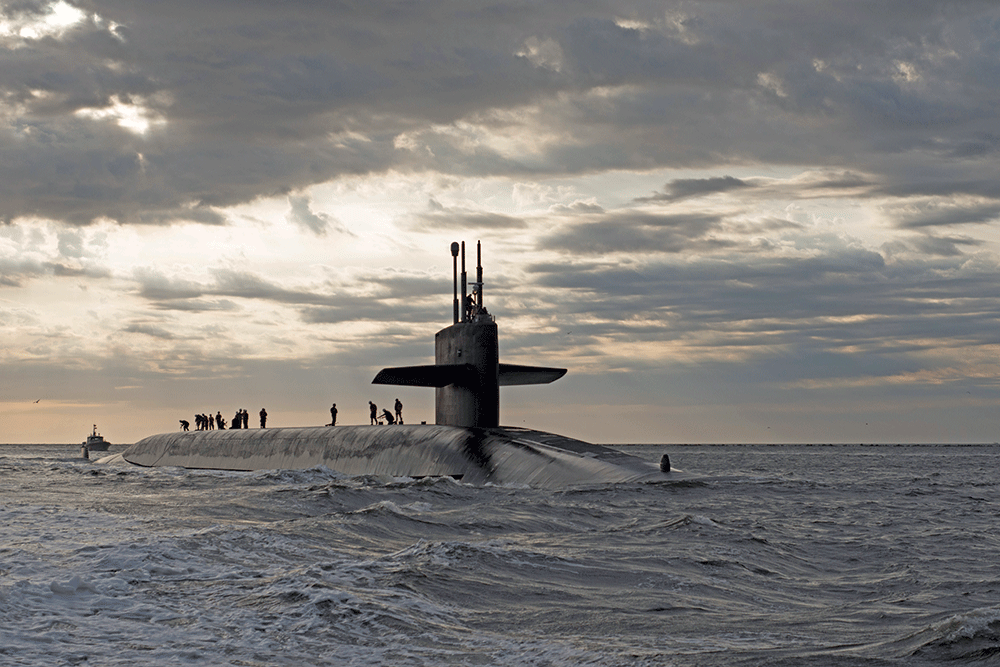
The Ohio Class Conversion- SSBN to SSGN: In the early 2000s, the US Navy decided to repurpose four Ohio-class SSBNs into SSGNs. The ballistic missile tubes were removed and the submarine was reconfigured to accommodate a VLS system. Each converted SSGN can now carry up to 154 Tomahawk missiles. This marked a shift in naval strategy, providing a versatile option for land-attack missions and neutralising a heavily defended CBG. SSGNs enhance the strike capability and lethality manifolds, when compared to SSNs.
India’s Option for a New Class of SSGN- ‘Upgraded SSBN’ Hull Design and BRAHMOS NG
An ‘Upgraded SSBN’ is planned as India’s next-generation nuclear-powered ballistic missile submarine, succeeding the Arihant-class, with significantly enhanced stealth, endurance, and missile payload capabilities. It will likely displace over 13,000 tons submerged, making it one of the largest SSBNs globally.
Converting the Upgraded SSBN into an SSGN would involve repurposing the ballistic missile launch tubes for cruise or land-attack missiles. The BRAHMOS NG, an advanced, smaller, and more versatile variant of the BRAHMOS supersonic cruise missile, will provide the SSGN with lethal strike reach, high speed, and precision. BRAHMOS NG is expected to have ranges beyond 400 km with hypersonic speeds (Mach 5+), sea-skimming attack profiles, and enhanced anti-ship and land-attack capabilities. The under-development 200 MW nuclear reactor will ensure high endurance, enabling long deployments in contested waters, with stealth and strategic reach.
While the calculation as to how many missiles the SSGN will carry is a matter of detail and design consideration, a ‘realistic estimate’ would be around 30 to 40 VLS cells, with a missile hump aft of the sail.
Countering Chinese CBG Ingress in the Indian Ocean
China’s naval modernisation includes a growing fleet of Carrier Battle Groups designed to project power far beyond the Western Pacific into the Indian Ocean Region (IOR). By 2035, multiple Chinese CBGs are expected to transit the Malacca Strait into the Indian Ocean, challenging Indian naval dominance, threatening maritime trade routes, and potentially enabling coercive diplomacy against littoral states.
The Role of S5-Derived SSGN with BRAHMOS NG: Some of the roles envisaged for the SSGN in the IOR are enumerated below:
- Forward Presence: The SSGN can covertly position itself along likely ingress routes such as the Strait of Malacca and Sunda Strait, undetected for extended periods and provide undisturbed intelligence, surveillance, and reconnaissance (ISR) inputs.
- Precision Strike on High-Value Targets: With multiple BrahMos NG missiles onboard (potentially 30-40), the SSGN can launch salvo attacks on a Chinese CBG. BRAHMOS NG’s supersonic speed and range allows the SSGN to strike from beyond the detection ranges of the ASW components of the CBG.
- Area Denial and Disruption: The threat of covert SSGNs imposes a strategic dilemma on Chinese commanders, forcing CBGs to allocate resources to ASW and anti-missile defences, potentially slowing their ingress and reducing operational freedom.
- ISR and Targeting Support: SSGNs could also act as critical nodes in a networked warfare environment, providing real-time targeting data to Indian Navy assets, Indian Air Force maritime patrol aircraft, and allied forces.
- Deterrence through Ambiguity: Unlike surface strike groups or conventional attack submarines, a nuclear-powered SSGN with long-range cruise missiles presents a persistent, hard-to-locate threat that can hold critical Chinese assets at risk, thereby deterring CBG penetration.
- Deploying the SSGN in the South China Sea: To Breach the Chinese A2/AD Umbrella and maintain strategic reach into the Western Pacific, including supporting freedom of navigation and monitoring PLA Navy movements.
The threat of covert SSGNs imposes a strategic dilemma on Chinese commanders, forcing CBGs to allocate resources to ASW and anti-missile defences, potentially slowing their ingress and reducing operational freedom. This provides a critical area denial and disruption capability for the Indian Navy
SSBN to SSGN Conversion – Value Addition and Strategic Significance
The proposed SSBN to SSGN conversion has certain other strategic significances.
- Force Multiplication and Deterrence: Converting the S5 SSBN hull into an SSGN equipped with BRAHMOS NG not only leverages India’s indigenous strategic assets but also multiplies their operational utility. This hybrid platform enhances deterrence by adding a covert, potent strike capability that complements the strategic nuclear deterrent of SSBNs.
- Cost-Effectiveness and Indigenous Capability: Repurposing the S5 hull is a cost-effective alternative to developing a new SSGN platform, accelerating deployment timelines. It also capitalises on India’s advancing missile technology and nuclear propulsion expertise, reinforcing strategic autonomy.
- Geopolitical Signalling: Deploying such SSGNs sends a clear message to regional actors and China about India’s readiness to defend its maritime interests assertively and innovatively, balancing against China’s growing blue-water navy.
Bottom Line
By 2035, the strategic maritime landscape of the Indo-Pacific will be defined by high-stakes power projection and advanced A2/AD systems, primarily driven by China’s ambitions. The conversion of the S5 SSBN hull into a BRAHMOS NG-armed SSGN presents a transformative opportunity for India to shape this environment proactively. In the Indian Ocean, such SSGNs can covertly counter and neutralise Chinese CBG ingress, bolstering India’s maritime defence and regional leadership. In the South China Sea, they provide the strategic reach and strike power to breach Chinese A2/AD umbrellas, enhancing Indo-Pacific security dynamics.
While technical and geopolitical challenges remain, the strategic benefits of this conversion, from deterrence enhancement to operational flexibility and regional power projection, make the SSGN a potential cornerstone of India’s naval modernisation and Indo-Pacific strategy, for 2035 and beyond.

–The writer is a veteran submariner. He contributes regularly to various defence journals and professional magazines. The views expressed are personal and do not necessarily reflect the views of Raksha Anirveda





