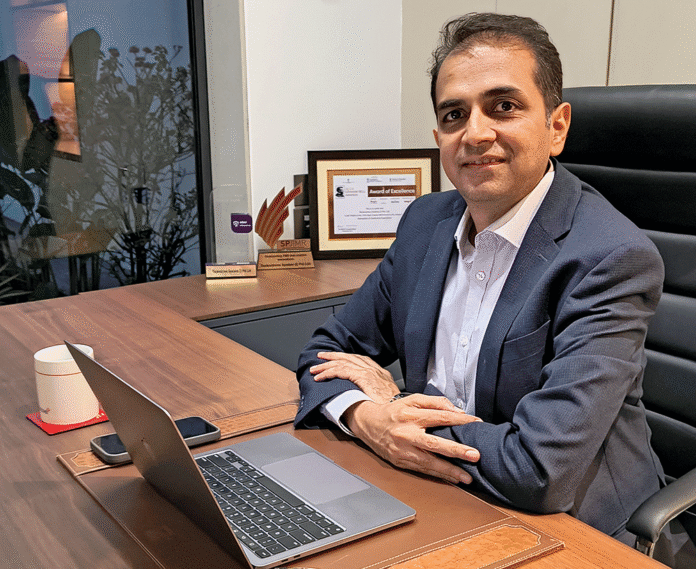
Tecknotrove is a leading provider of technology-enabled training solutions. With the successful execution of more than 1,500 projects globally across industries, it has emerged as a leader with a key focus on innovation in simulation, AI, robotics, and futuristic technologies.
In a candid conversation with Raksha Anirveda’s Editor; Shantanu Gupta—founder and managing director of Tecknotrove Systems—spoke at length in his impactful and eloquent style. He offered insights into the company’s innovation-led growth trajectory, strategic market expansion, product development, and focus on sustainability, while consolidating its leadership position in this challenging and competitive market. Edited excerpts:

RA: As a pioneer in VR and AR simulation technologies in India, what emerging trends in simulation like AI integration or immersive metaverse training, do you see shaping the future of defence and aviation training over the next five years
SG: Recognised as a pioneer in simulation technologies in India, I believe we are entering a decisive phase where immersive simulation is no longer an adjunct to training. Simulation is becoming the core infrastructure of defence and aviation readiness. Over the next five years, several transformative trends will redefine how forces plan, train, adapt, and operate. Simulation is serving the need for repeatable, high-risk scenario training and research without real-world consequences, making it both safer and more scalable.
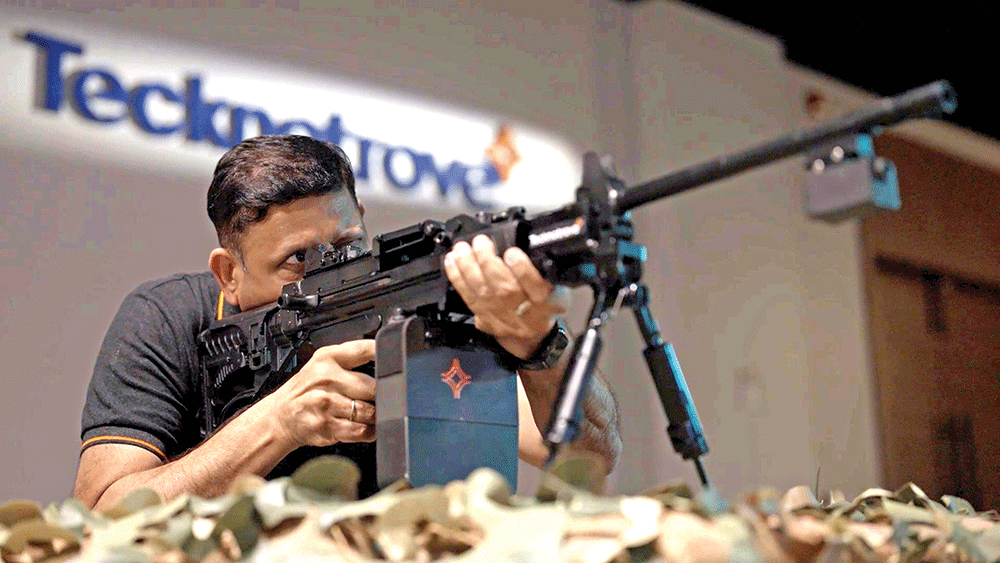
This is particularly important for countries like India, where maximising readiness with constrained resources is critical. The evolution of simulation is increasingly being driven by the need to replicate not just platforms, but operational complexity and decision environments.

Simulation technologies are rapidly growing from individual standalone systems to multiplayer mode enabling crew and group level trainings. At the same time, immersive and networked environments enable distributed training across locations, allowing multiple stakeholders to participate in a shared synthetic environment and train together. Artificial intelligence is also increasing by enabling adaptive, non-templated training scenarios, where systems respond intelligently to user actions.
Overall, the emphasis is surely shifting from isolated simulation to integrated, scalable ecosystems, where immersive realism elevates training standards.

Our cloud-based TMS is our backbone for global expansion. It is a unique platform that is designed to enable scalable, connected training by integrating simulators, VR systems, and testing environments on a single framework. We are continuously working on upgrading this system to integrate more technologies and create a comprehensive learning environment
RA: Tecknotrove has expanded into multiple sectors like aviation, mining and construction with domain-specific simulators. How do you plan to scale these solutions globally?
SG: Scaling simulation solutions globally requires a balance between standardisation, innovation and contextual adaptability. While core technologies can be developed with a global outlook, their deployment must reflect local operational realities, regulatory frameworks and training philosophies.
With our experience working across industries globally, we have worked on these aspects and specialise in curating customised and effective solution as per the needs of our clients. Our solutions are modular, interoperable and scalable. This approach has helped us in expanding our portfolio.
Over the years we have designed manufactured and deployed customised simulation solutions across 35+ countries, serving corporates, OEMs, governments, and training institutes across sectors like aviation, mining, construction, defence, logistics, oil & gas, and nuclear. That foundation gives us enormous confidence but also responsibility.
We are now looking at technology as a core multiplier. We are actively investing in technologies like AI and machine learning to enhance simulation accuracy, cloud-based simulation platforms, digital twin technologies, and advanced sensor systems. These they directly reduce the cost and complexity of deploying solutions in new geographies and bring scale.
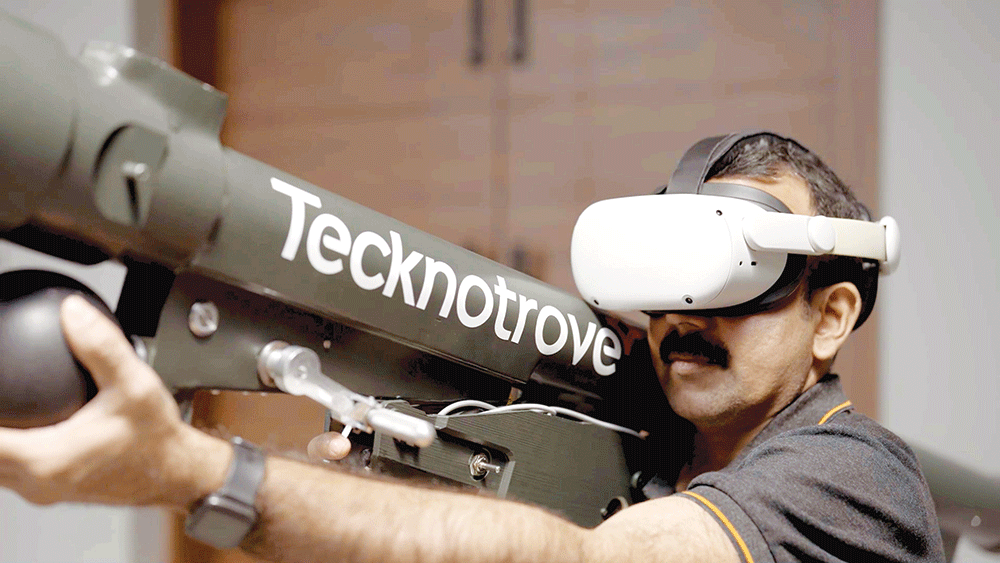
Our cloud-based TMS is our backbone for global expansion. It is a unique platform that is designed to enable scalable, connected training by integrating simulators, VR systems, and testing environments on a single framework. We are continuously working on upgrading this system to integrate more technologies and create a comprehensive learning environment. This is the infrastructure layer that ties everything together whether you’re a mining company in Australia or an airport authority in the Middle East.
Tecknotrove has been an IP driven company for 20 years. All our development is based on sovereign technology and design-led indigenisation, where core system architecture, software frameworks and integration capabilities are developed indigenously by us in a scalable manner to allow for future upgrades
We are very focused on expanding our defence product portfolio for the global market. Earlier this year, Tecknotrove was part of delegation for various global seminar and events organised by the Indian Defence Organisations, building connections for defence manufacturing and global trade. Especially for the defence industry, we are looking at early and active collaboration with original equipment manufacturers which plays a critical role in ensuring that new technologies are compatible, deployable, and adopted at scale.
RA: With India’s push for ‘Make in India’ in defence tech, what have been the biggest hurdles in localising advanced simulation hardware and how has Tecknotrove overcome supply chain dependencies on global components?
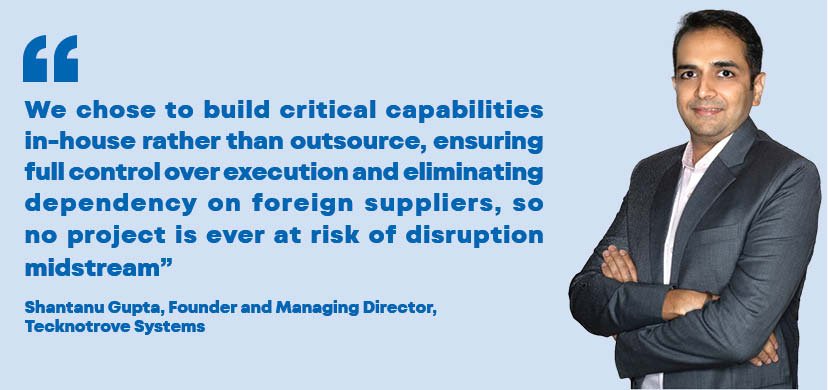
SG: Tecknotrove prides itself on its 100% indigenous setup with state-of-the-art in-house manufacturing and R&D capabilities. Make in India was a strategic decision made early on in 2005 by Tecknotrove. We invested in building capabilities in-house that others outsourced, specifically so we would never be held hostage by a foreign supplier mid-project. Our software, simulation engines, scenario design tools, and mechatronics are all developed internally.
Today we have built and operate India’s largest simulator manufacturing and DSIR recognised R&D facility, situated in Gujarat which allows us to manufacture at scale and with the quality standards that defence demands. We have demonstrated our Make in India capability by executing over 1,500 + simulation projects in over 35 countries across industries like Aviation, Automotive, Mining, Law Enforcement, Police and Defence.
Tecknotrove has been an IP driven company for 20 years. All our development is based on sovereign technology and design-led indigenisation, where core system architecture, software frameworks and integration capabilities are developed indigenously by us in a scalable manner to allow for future upgrades. This approach has not only reduced external dependency for us but also facilitated complete lifecycle management.
We safeguard our Make in India innovations through patents, trademarks, and copyrights, and collaborate with industry partners, academic institutions, and start-ups to accelerate future-focused development. As we expand globally, our IP portfolio is what prevents commoditization and keeps us differentiated from our domestic and international competitors.
The way forward has been to focus on sovereign technology and design-led indigenisation.
RA: Your simulators, such as those for aviation pushback and truck driving, emphasise realism. Can you share a recent innovation in real-time data integration that’s enhanced training outcomes for clients?
SG: Innovation and Product development is not something we do, it’s in the DNA of Tecknotrove. One of our most impactful recent innovations is the integration of AI in our simulation systems. AI integration has allowed us to merge real-time performance data and analytics into the simulation loop, transforming simulators from static systems into adaptive, intelligent training platforms. Today, the focus is not just on realism, but on how effectively systems measure, personalise, and continuously improve training outcomes.
At Tecknotrove, we are advancing further through developing digital twins that are integrated with real-time machines and systems, creating living virtual environments that mirror real-world operations. This enables predictive planning, dynamic scenario adaptation, and precise synchronisation between physical feedback and simulation.
Equally important is our latest software upgrades to data capture and after-action analytics, which shifts training from experience-based to evidence-based performance evaluation. The result is smarter decision-making, safer operations, and highly efficient, data-driven training ecosystems.
At Tecknotrove, we are advancing further through developing digital twins that are integrated with real-time machines and systems, creating living virtual environments that mirror real-world operations. This enables predictive planning, dynamic scenario adaptation, and precise synchronisation between physical feedback and simulation
RA: How is Tecknotrove incorporating sustainable practices into simulator manufacturing and what measurable impact have your solutions had on reducing real-world training costs and risks?
SG: We believe that every simulator is a Sustainability Instrument. Simulators replace live equipment training. Every time a soldier trains on a Tecknotrove simulation platform instead of a live weapon, missile or military tank we are eliminating ammunition waste, fuel burn, eliminate carbon footprint, equipment wear, and the risk of injury or death. That is sustainability at its most direct and measurable. Every one of those training hours replace the real-world equivalent that would have consumed fuel, risked equipment, or endangered a trainee.
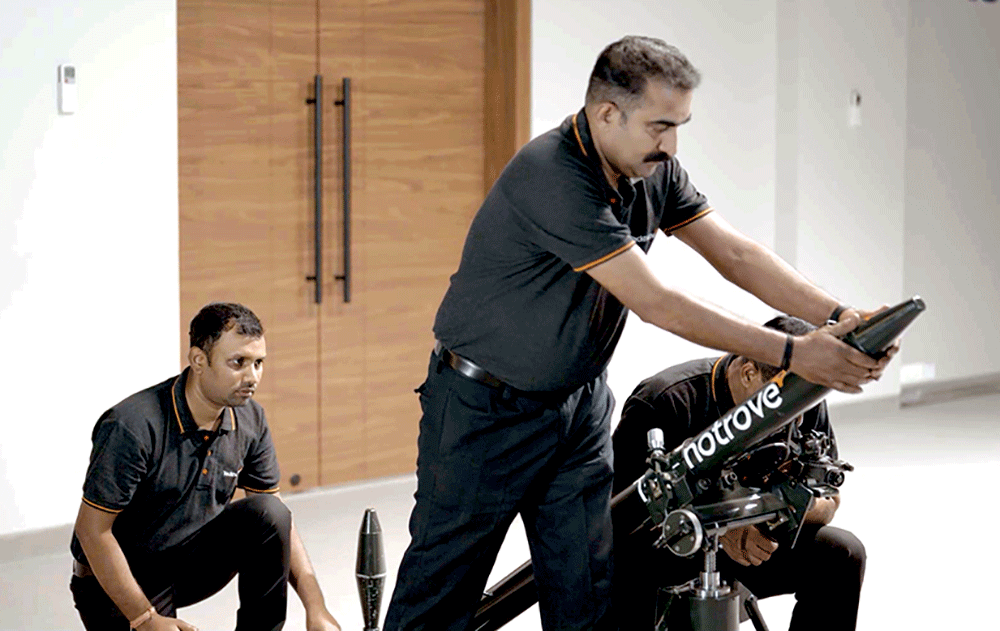
Defence training around the world is moving towards integrated training and wargaming solutions. With integrated simulation training centres, we are able to offer a complete strategic training environment with measurable results speak clearly: ISTC not only helps the defence forces, it prepares teams for rare and mission-critical situations that are difficult to replicate in real life. It also trains the forces to operate as a team where Army, Navy and Air Force can plan and rehearse together; supports scalable training across large, geographically distributed operations. This is where the real substantiality comes in.
In addition, our manufacturing philosophy reinforces this through energy-efficient electric actuator motion systems, interchangeable convertible kit architectures that minimise hardware waste, and dedicated EV training simulators that support India’s green mobility transition. Recognised with the Aegis Graham Bell Award for Innovation in Immersive Experiences, Tecknotrove’s ultimate sustainability metric is simple: accidents prevented, emissions avoided, and workers and soldiers who go home safely every single day.
At Tecknotrove, sustainability is embedded in our core mission. Every simulator we build directly impacts sustainability at a global level and with over 5 million people trained across 1,500+ projects in 35 countries, the impact is enormous in scale.
At Tecknotrove, sustainability is embedded in our core mission. Every simulator we build directly impacts sustainability at a global level, and with over 5 million people trained across 1,500+ projects in 35 countries, that impact is enormous in scale
RA: As a growing simulation company, how do you attract and retain top talent in a competitive tech landscape and what role does Tecknotrove play in upskilling India’s workforce through your own training programmes?
SG: The simulation domain sits at the intersection of multiple disciplines engineering, design, data science and domain expertise making talent development a challenge. Tecknotrove attracts talent primarily through the nature and purpose of the work itself. The organisation offers a unique work environment where creative minds work together with a fresh approach on projects that make news, inspiring each other to redefine the standards of virtual reality. Exposure to complex, real-world problem statements and emerging technologies is another reason why many young creative minds are looking to becoming a part of Tecknotrove team.
We have passionate people in our team who align with our vision and philosophy of continuous innovation to develop world-class systems that solve real problems
Equally important for us is continuous upskilling. We believe that organisations in the technology space have a responsibility to contribute to the ecosystem by creating structured learning pathways, hands-on training exposure and industry-academia collaboration. We invest in upskilling our team to ensure we are ahead of the curve at all times.
RA: The Indian simulation market has evolved over the past few years and is increasingly becoming competitive. What’s your business outlook for next two years? How do you plan to strengthen Tecknotrove brand positioning in near future?
SG: The Indian defence simulation market is entering a phase of strategic maturity, driven by defence modernisation, increased platform complexity, and a strong push for indigenisation under Aatmanirbhar Bharat. Over the next two years, Tecknotrove expects sustained growth in demand for high fidelity, networked, and mission oriented simulation solutions across the armed forces. As training priorities shift toward readiness, realism, and cost efficiency, indigenous players with proven domain expertise and lifecycle support capabilities are well positioned to lead this transition.
We believe that Defence Simulation is transforming from being a niche capability to becoming a mainstream training and operational enabler. Increased policy focus, coupled with growing awareness across sectors, is expected to drive sustained demand over the next few years. In this environment, differentiation will be less about individual products and more about the ability to deliver integrated, scalable and future-ready training ecosystems.
Tecknotrove is creating an architecture to integrate Live, Virtual and Constructive (LVC) training to facilitate seamless training across different levels, types of combat unit and hierarchies to address real-life challenges of the Indian Armed Forces.
We are strengthening our positioning as a complete defence training solutions provider, covering:
- Basic to high-fidelity simulators
- Crew, unit, and collective training solutions
- Mission rehearsal and Wargaming solutions
- Post-exercise analytics and performance assessment
- Long-term lifecycle support and upgrades
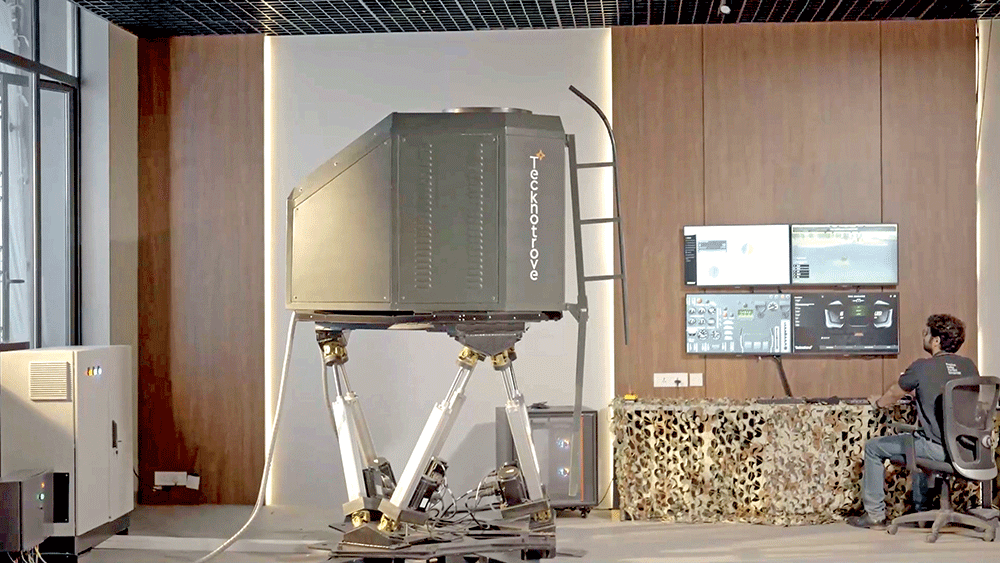
We believe that this integrated approach is increasingly valued by the Defence forces. Tecknotrove’s vision is to become an end-to-end defence training partner rather than a standalone simulator provider. In the next two years Tecknotrove aims to reinforce its image as a trusted Indian defence simulation company, competitive with global OEMs and committed to long term capability development.
The key takeaway has been the importance of building long-term domestic capability rather than short-term acquisition. Going forward, DAP reforms can further strengthen the ecosystem by simplifying processes, reducing timelines and creating stronger incentives for innovation-driven development
RA: Reflecting on your two decades of journey, do you think Make in India, Aatmanirbhar Bharat and Viksit Bharat initiative by the government has made positive impact on the domestic defence sector? Kindly highlight the key takeaways. Also share you views on the upcoming DAP reform.
SG: Initiatives such as ‘Make in India’ and ‘Aatmanirbhar Bharat’ have played a significant role in shifting the focus towards indigenous capability development and greater private sector participation. They have also helped create a more structured and forward-looking procurement environment.
The key takeaway has been the importance of building long-term domestic capability rather than short-term acquisition. Going forward, DAP reforms can further strengthen the ecosystem by simplifying processes, reducing timelines and creating stronger incentives for innovation-driven development. A balanced approach that combines procedural clarity with encouragement for emerging technologies will be critical in sustaining momentum.
In the longer term, I believe that the country has to graduate from the L1 System to a L1-Q1-I1 (cost-quality-indigenous) wherein specifications, cost and indigenisation guide procurement.