

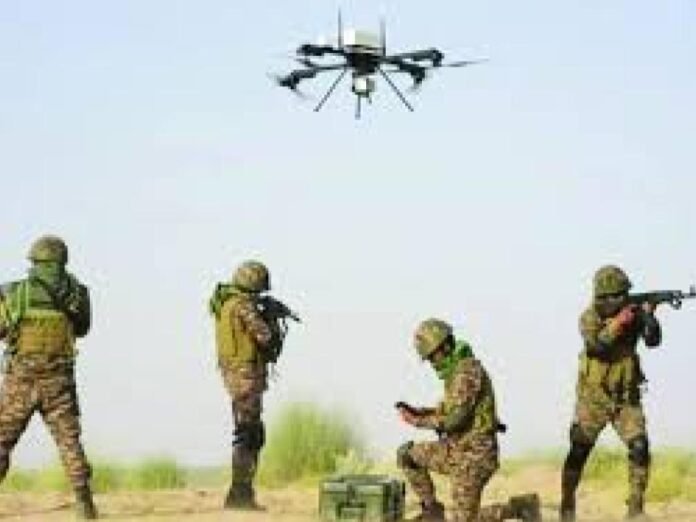
New Delhi: Looking to build its own sovereign swarm warfare capability, the Indian Army’s search for a joint development partner to design and develop an indigenous swarm algorithm has begun. This could eventually provide it with a unified command, control and autonomy framework for multi drone operations.

The Army has invited bids for the project through a formal Request for Proposal, or RFP, and will hold a pre-bid meeting in the second week of May, according to sources.
Pointing out that the bid is far bigger than simply acquiring another swarm capability, a source said, “What the Army is trying to do is build a common architecture of its own, so swarm operations are no longer tied to individual vendors or proprietary systems.”

At a time when contemporary conflicts have sharply underscored the operational value of networked drone swarms across surveillance, logistics, payload delivery and adaptive combat roles, the project is structured in two phases over six months. The initial two-month stage will focus on developing an indigenous ground control station and software-only integration framework capable of commanding existing drones without requiring changes to their hardware or firmware.

The source explained that the focus is on creating a secure common control layer over existing drone assets, with fully offline capability built in from the outset. “That is a deliberate requirement because this system is being designed for contested environments, where dependence on cloud architecture or external autonomy engines could become serious operational vulnerabilities,” added the source.
The first phase will culminate in a live field demonstration where multiple drones, operating under a unified command structure, simultaneously carry out persistent surveillance and coordinated payload delivery missions.
During the remaining four months, the second phase expands the ambition from centralised control to decentralised swarm autonomy, with onboard computing, indigenous software stacks and greater battlefield resilience.
According to the source, the objective is to test whether these prototypes can continue functioning in tougher, more realistic operational conditions, rather than only in controlled environments. It will test adaptive formations, task reassignment, collision avoidance and the swarm’s ability to sustain operations even when communications are disrupted, drones are lost or navigation systems come under strain.
The Army has made it clear that indigenous control will be non-negotiable. The stress on indigenous control also comes amid persistent security concerns over foreign, especially Chinese components in drone systems. With third party black box autonomy engines barred, and source code and intellectual property to be jointly shared with the selected partner, the project signals a larger push to secure not just swarm capability, but control over its technological backbone.



