

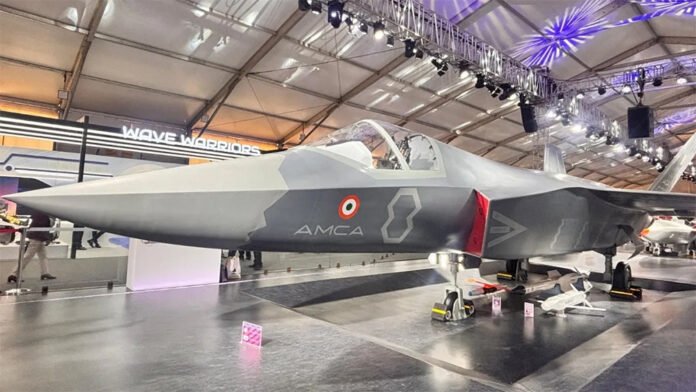
New Delhi: The finalisation of the Advanced Medium Combat Aircraft (AMCA) paper design by India’s Aeronautical Development Agency (ADA) represents a watershed moment in the nation’s pursuit of indigenous defence capabilities and strategic self-reliance. This comprehensive milestone marks India’s entry into the elite club of nations capable of developing fifth-generation stealth fighter aircraft, positioning the country alongside technological powerhouses like the United States, China, and Russia in advanced combat aviation.
The AMCA programme has evolved from its initial conception as a 20-tonne class fighter to the current 25-tonne twin-engine configuration, reflecting the increasing sophistication and capability requirements of modern air warfare. The project received critical approval from the Cabinet Committee on Security in March 2024, with a sanctioned budget of ₹15,000 crore (approximately $1.8 billion) for prototype development. This funding will support the development of five prototypes, each estimated to cost ₹1,000 crore ($120 million).

The development timeline is ambitious yet structured, with the prototype rollout planned for late 2026 or early 2027, followed by the first flight in 2028, certification by 2032, and induction targeted for 2034. The programme follows a phased approach where the first three prototypes will conduct developmental flight trials, while the remaining two will focus on weapons integration and systems validation.
AMCA Project Director Krishna Rajendra has emphasised the aircraft’s fully indigenous nature, developed through extensive collaboration between ADA, multiple DRDO laboratories, CSIR institutions, and Indian academic institutions. This collaborative ecosystem represents a new paradigm in India’s defence research and development, leveraging the collective expertise of the nation’s scientific and academic communities.
The aircraft’s design philosophy centres on achieving stealth capabilities through multiple approaches beyond traditional radar-absorbent materials. The stealth features include airframe shaping for minimal radar cross-section, concealed weapons systems, and heat signature management.
As Rajendra explained, “This aircraft will not be noticed on enemy radar; that is the stealth feature of this aircraft.”


