


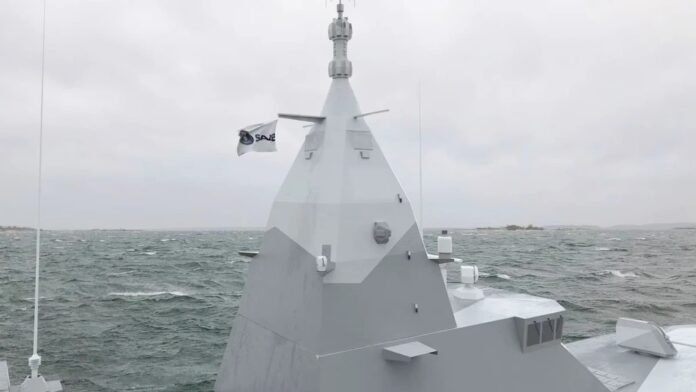
Swedish defence company Saab has formally offered its Lightweight Integrated Mast (SLIM) technology to the Indian Navy to enhance warship stealth and sensor fusion capabilities. This advanced system integrates radars, antennas, and communication arrays into a single, ultra-light composite mast, significantly reducing a vessel’s radar cross-section (RCS) and cluttering of the upper deck.
Key features and strategic implications of the SLIM offer include:
Stealth and Performance: Constructed from carbon-fibre composites (derived from Saab’s Visby-class corvette experience), the mast lowers top weight for better stability while smoothing reflective surfaces to make ships harder to detect.

Turn-Key Integration: Saab provides the mast as a fully assembled, tested unit, taking responsibility for electromagnetic compatibility and sensor performance, which simplifies shipbuilding and reduces integration risks.
Target Programmes: The technology is positioned for India’s ₹40,000 crore New Generation Corvettes (NGC) programme, aimed at building eight 3,500-tonne warships via domestic builders GRSE and Goa Shipyard Limited.
Versatility: The modular design allows for installation on new builds or retrofits on existing fleets, supporting India’s shift toward sensor-centric, network-centric warfare. Saab’s SLIM mast technology could transform Indian Navy warships with better stealth, integrated sensors, and improved combat efficiency in modern naval warfare.
Saab SLIM mast technology is emerging as a major breakthrough in modern naval design, especially as the Indian Navy pushes toward stealth-driven, network-centric warfare.

What is Saab SLIM Mast Technology?
The Saab Lightweight Integrated Mast (SLIM) is an advanced naval structure designed to house multiple sensors, radars, and communication systems inside a single, compact mast.
Unlike traditional warships that scatter antennas and sensors across the deck, SLIM integrates everything into one unified structure. This drastically improves efficiency, reduces clutter, and ensures seamless system performance.

Importance of Saab SLIM Mast Technology in Modern Naval Warfare
Modern naval battles are no longer just about firepower. They are about who detects first, who remains hidden longer, and who processes information faster.
Key Advantages
The smooth composite design of SLIM significantly lowers radar cross-section (RCS), making ships harder to detect; further as all electronic systems work together without interference, it improves battlefield awareness. The use of lightweight materials reduces top weight, enhancing balance and performance at sea. Overall, a ready-to-install mast reduces construction time and integration risks.
Saab’s SLIM technology is not experimental. It is built on the company’s experience with Sweden’s Visby-class stealth corvettes, one of the world’s first warships using carbon-fibre construction.
This legacy ensures that SLIM is based on real-world operational success, not just theoretical design.
Global Adoption Strengthens Credibility
SLIM is already being used and tested by advanced naval forces worldwide: The Finnish Navy is installing it on Pohjanmaa-class multi-role corvettes, a 4,300-tonne vessel designed for harsh environments. The Swedish Navy has upgraded its older Gävle-class corvettes with SLIM, proving that even legacy ships can gain modern capabilities. These deployments confirm that SLIM is scalable and adaptable across different ship classes.
Strategic Opportunity for India
India is currently investing heavily in naval modernisation, with a strong focus on indigenous manufacturing and advanced technologies.
The ₹40,000 crore NGC project aims to build eight modern warships through domestic shipbuilders like Garden Reach Shipbuilders and Engineers (GRSE) and Goa Shipyard Limited (GSL). These 3,500-tonne corvettes are expected to be highly advanced, network-enabled platforms.
Integrating SLIM technology into this programme could: Boost stealth capabilities, improve combat system integration, enhance real-time data sharing, reduce long-term maintenance complexity, and one of the most important aspects of Saab’s offer is its “turn-key” delivery model. This eliminates the common challenge shipbuilders face when combining multiple systems from different vendors.
Indian Navy Shift Toward Sensor-Centric Warfare
Naval warfare is rapidly evolving into a domain dominated by: multi-function radars, electronic Support Measures (ESM), and advanced communication networks.
In this environment, the mast is no longer just a structure—it acts as the central nervous system of a warship.
SLIM aligns perfectly with this shift by offering a unified, intelligent platform for all critical systems.
Strategic Implications for India
If adopted, Saab SLIM mast technology could strengthen India’s maritime dominance in the Indian Ocean Region, improve survivability in high-threat environments, support indigenous shipbuilding with advanced global technology, and enhance interoperability in joint operations.
This aligns with India’s long-term naval strategy of building a blue-water navy with advanced stealth and network capabilities.






