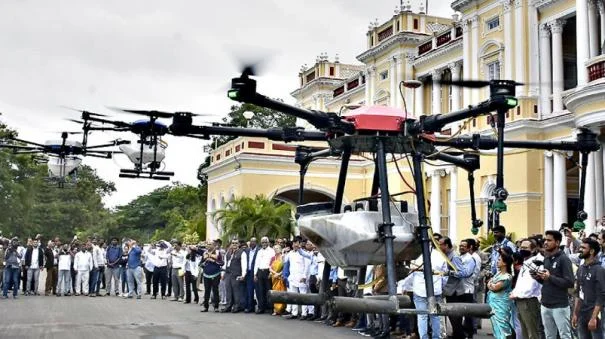
New Delhi: With the government increasingly focusing on Unmanned Aircraft or drones and holding the Bharat Drone Mahotsav inaugurated by Prime Minister Narendra Modi, experts felt that the country was indeed developing this technology “very fast” and as Dr Rajiv Nayan, Senior Research Associate of Manohar Parrikar Institute of Defence Studies and Analysis (MPIDSA) said “India is developing its technology very fast and many of the terrain which seemed impossible to achieve are now coming within our reach which is very significant,” and that 320 startups are contributing to it.
Participating in a discussion on Parliament TV, “Drones: The New Era”, Sai Pattabiram, Managing Director, Zuppa Geo Navigation Technologies said that in terms of Drone Technology, Indian companies have a huge potential to not only capture the Indian markets but also lead the world. The government aim of making India the Drone Hub 2030 as spelt out by the prime minister while inaugurating the Mahotsav, Pattabiram said “it is very much feasible and within reach and the recent initiatives by the government have definitely boosted the industry.”

As Defence Policy Expert, Dr RK Narang said “some of the companies have demonstrated that they are world class. It is the first time that India is developing technology which has not evolved anywhere in the world.”
According to Pattabiram “one of the problems faced by drone industry for a very long time and which today is being eased out is thanks to easing of regulations in February 2022 is funding of application of technologies where there has been a lot of shortcomings as far as India is concerned and especially so in the defence side of it. There are programmes like iDEX but I think a little more needs to be done and here it is in terms of aligning the capabilities that are available across the country by planning a national kind of initiative where specific funding could be given and specific projects could be developed with the available capabilities that are there in India today and that is one aspect that can be improved and will be improved over a period of time.”
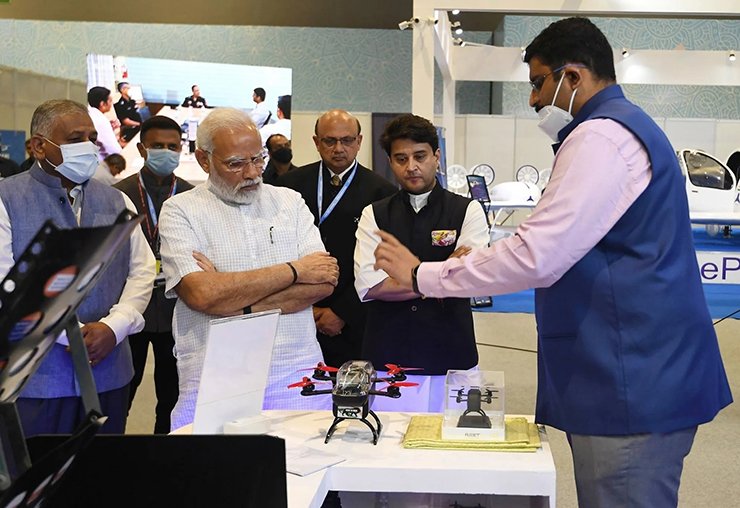
As Dr Nayan of MPIDSA said “government is giving money but if you’re not utilising it, than it is a different thing. We hired many academic and educational institutions like IITs which have patented their designs and somehow restricted to design and not coming out with technology. Now, they have got an opportunity to come out and work on it, have tie-ups, collaboration and new entrepreneurship should come.”

On drones, he said “swarm drones are considered a big threat and we have to regulate it though of course it is not that we aren’t moving forward. We have the technology and the only thing is we have to apply it properly and now the government has realised it and is pushing it forward and now the industry has to make use of it and if they don’t, it is their fault.”
On the use of drones, Pattabiram said “critical areas is civilian application like agriculture and there is lot of scope to build on such as mapping under the Panchayat, digitalisation of land records with the help of drones. Besides, trials are also on the use of drones for last mile connectivity in medical field for delivering medicines to remote locations. There is lot of scope for use of drones for this purpose given the size of the country and ability to connect medical facilities in a much shorter time.”

However, Defence Policy Expert, Dr Narang felt that there is need for “integration of manned and unmanned aircraft in both civil and military and these are areas that have not received attention and if we are able to address it, I think we will be able to achieve greater success in our mission.”